Ilulissat Icebergs: Best Time to Visit (2026 Guide)
The best time to visit Ilulissat is mid-July through the end of September. Mid-July to mid-August brings 24-hour daylight and the heaviest iceberg calving in Disko Bay. By the last week of September the sky finally goes dark enough for the first northern lights of the season, with the fjord still packed with ice. Winter is for specialists.
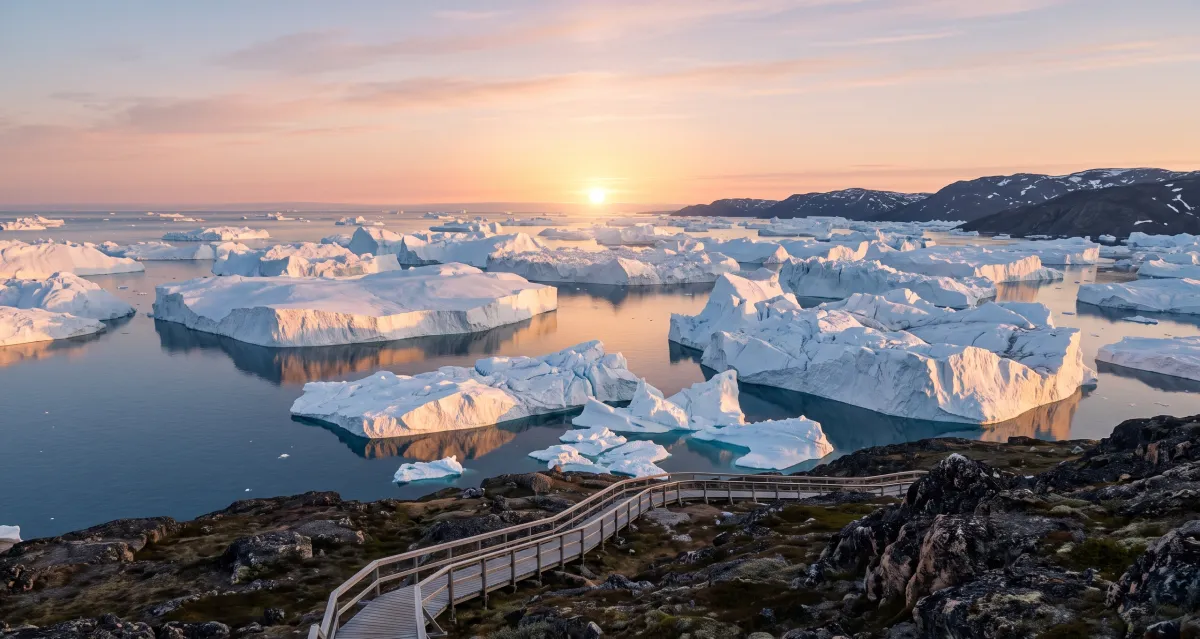
At 1:14 a.m. on a July night in 2024 I stood on the boardwalk above Sermermiut in a t-shirt, watching a slab of ice the size of an eight-story building tip over in the fjord. The sound arrived a beat late. A dry crack, then a boom I felt in my chest before I heard it. Two American tourists near me flinched and then laughed at themselves.
That delay between sight and sound is the thing nobody warns you about, and it is the reason you fly to Ilulissat instead of any other place where ice falls into the sea. The town sits at the mouth of the Ilulissat Icefjord, where the Sermeq Kujalleq glacier dumps roughly 35 billion tonnes of ice into the water every year. Getting here used to mean a connection through Kangerlussuaq and a small Dash-8. Since June 2025, United flies Newark to Nuuk and SAS runs Copenhagen routes into the rebuilt airports, and the new Ilulissat runway takes jets. The town is busier than I have ever seen it. Timing matters more now, not less.
When is the best time to visit Ilulissat?
Go between mid-July and the end of September. The first half of that window hands you round-the-clock sun and the wildest calving, when weeks of warm meltwater have been grinding the glacier. The back half trades a few hours of daylight for real darkness, which is when the early aurora shows up over a fjord still choked with bergs. Pick your half based on whether you want light or lights.
I have flown in for both. If someone forced me to keep only one trip, I would take the last ten days of September. You still get icebergs the size of cathedrals, the cruise crowds have thinned, and on a clear night around 11 p.m. the green starts low over Disko Island. More on that below.
Season by season: light, crowds, and what you will actually pay
Greenland is not cheap, and Ilulissat is the most visited and most expensive town outside Nuuk. Plan for it. Here is how the year breaks down on the ground.
Summer, July to mid-August: midnight sun and maximum ice
This is peak. Highs sit around 8-12C (46-54F), the sun never sets in late July, and the calving barely lets up. It is also when every cruise ship in the Arctic seems to anchor offshore. A 3-hour iceberg boat tour with World of Greenland or Disko Line runs about 950 DKK (roughly $140); the midnight version costs the same and is far better, because the low gold light turns the bergs amber and the day-trippers are asleep. Hotel Arctic charges 2,400-3,200 DKK a night in this window (about $350-470) and books out months ahead. The trade-off: prices top out, trails fill, and you will share the Sermermiut viewpoint with 40 people at midnight.
Early autumn, late August to late September: the window most people skip
Everyone fixates on the midnight sun, and they miss the better trip. By the first week of September the nights return, temperatures drop to 2-7C (36-45F), and the icebergs have not gone anywhere. This is when you can stand at the Icefjord near midnight and watch the aurora unspool over ice that took a thousand years to reach the water. Greenland northern lights in September are never guaranteed, but I had three clear nights out of five up here one late-September week. Boat tours still run, hotel rates ease 15-20 percent, and the cruise season is winding down. If you only have one trip in you, this is it.
Winter, November to March: dog sleds, polar night, and almost no one
Real winter suits a specific traveler. The sun barely clears the horizon in December, temperatures sit around -15 to -25C, and the aurora can fill the whole sky. Dog sledding with a local musher is the genuine article here, not a summer photo op on wheels. But flights cancel, daylight shrinks to a 3-hour blue smear, and half the boat tours stop because of sea ice. Worth it if you came for the lights and the quiet. Rough if you expected to walk the fjord trails.
How cold does Ilulissat get in summer?
Summer in Ilulissat is cool, not cold. July highs run 8-12C (46-54F) and rarely top 15C. Nights near the water feel colder because of wind sliding off the ice, so you want a warm layer even under the midnight sun. I wore a t-shirt at 1 a.m. once and regretted it inside twenty minutes.
The shoulder window I would actually book
The last week of September into mid-October is the most underrated stretch of the Ilulissat icebergs season. You get both worlds: bergs still grinding through the fjord, and skies dark enough for aurora. Prices drop, the halibut boats are out, and the midday light goes long and low for hours instead of minutes.
The trade-off is real, so I will be straight with you. Some smaller operators pull their zodiacs by early October, and a run of grey days can wall off the northern lights completely. My honest skip: do not pay 4,500 DKK (about $660) for the helicopter to the glacier front in this season. Cloud sits low and you will often see less than you would from a 950 DKK boat at water level. Save the money. And instead of crowding the main Sermermiut yellow trail, take the blue route past the old Holms Bakke heliport at dusk; I had it to myself two evenings running, and the angle across Disko Bay is wider.
"The ice has no schedule," a guide at the Ilulissat Icefjord Centre told me when I asked which week the biggest bergs come through. "We watch it like weather. You come, you wait, you get lucky."
The months to avoid, and the one nobody warns you about
Two windows give most first-timers trouble. December and January read romantic on paper, but the polar night, frequent flight cancellations out of the new airport, and shuttered boat tours can leave you stuck in a hotel staring at a 3-hour twilight. Save deep winter for a second trip, once you know you love the place.
The sneakier one is May into early June. The sea ice is breaking up, which sounds promising, but it means many boats cannot run reliable iceberg tours and the fjord turns to a slush of brash ice rather than the clean cathedrals you came for. Trails stay snow-patched and muddy. Prices are lower for a reason. And to be blunt about who this town is not for: anyone chasing warmth, nightlife, or a budget holiday. There is one main strip, dinner for two at Restaurant Mamartut ran me about 650 DKK ($95), and the bars close early.
Events and natural timings worth building a trip around
Ilulissat is not a festival town. The dates that matter here are mostly written by nature, with one human exception.
- Greenlandic National Day, June 21. The town wears national dress, people sing by the harbor, and kaffemik (coffee-and-cake) gatherings spill out of front rooms; you can sometimes be waved in. Full midnight sun. Light is the draw, not the ice.
- Humpback arrival, mid-July into September. Humpbacks and the odd fin whale feed in Disko Bay all summer, and the boat crews reroute toward them when they surface. I watched five humpbacks work a bait ball off the harbor in late July, close enough to smell the spray.
- Equinox aurora, around September 21-23. Geomagnetic activity tends to spike near the equinox, and that lines up with the first properly dark nights. It is the strongest calendar bet for Greenland northern lights in September.
Can you see the northern lights in Ilulissat in September?
Yes, from roughly the second week of September once the nights go dark. Clear skies are the only real requirement, and late September around the equinox is the strongest bet. I caught three good displays over the Icefjord across five nights one late-September week. Any earlier and the midnight sun simply drowns them out.
One practical last word. Whichever month you pick, leave a buffer day at each end. Weather here grounds boats and planes without much notice, and the thing you flew all this way for, the calving, the whales, the green light, does not run on your schedule. I lost a full day to fog in 2024 and won it back the next morning, when a berg the size of a church split clean in two off the boardwalk while I was still holding my coffee. Pack the warm layer. Bring the patience.
Map-o-World Team
Travel Writers & Destination Experts
We're a team of passionate travelers and writers who have explored destinations across 7 continents. Our guides combine first-hand experience with deep local research to help you plan unforgettable trips. Every recommendation comes from real visits and genuine insights.
Learn more about us arrow_forward