
Jeju King Cherry Blossom 2026: Best Spots and Bloom Dates
I have been to Hanami in Tokyo. I have driven through the Tidal Basin in Washington, D.C., with the windows down. Neither one prepared me for a Jeju King Cherry Blossom tree at peak bloom. The petals are roughly the size of a 100-won coin, nearly twice as large as the Yoshino variety that dominates the rest of Korea, and they grow on this island and nowhere else. That is not a tourism slogan. It is a genetic distinction confirmed by DNA analysis in 2018. Standing under a full canopy of them on a still morning, with petals dropping around you like slow-motion confetti, is one of the best reasons to fly south instead of joining the crowds in Seoul.
When to Go - Timing the 2026 Bloom Window
Jeju typically sees its first cherry blossoms around March 22-25, a solid week ahead of Seoul. For 2026, the Korea Meteorological Administration (KMA) is forecasting blooms 2-7 days earlier than the historical average due to a warmer-than-usual winter. That pushes your window to roughly March 18-23 for first flowers, with peak bloom likely falling between March 25 and March 30. Here is the thing: peak bloom lasts only about 5-7 days before wind and rain start pulling petals off the branches.
I have visited three springs in a row now, and the sweet spot is always days 3-5 of peak bloom. Before that, the canopy still has gaps. After day 5, one good rainstorm turns everything into a soggy pink carpet on the sidewalk. Check the KMA's official forecast at weather.go.kr starting in early March - they update bloom predictions weekly, and those updates are more reliable than any travel blog's guess published in January.
Where to See King Cherry Blossoms - Four Spots, Ranked Honestly
Jeonnong-ro (The One You Have Seen on Instagram)
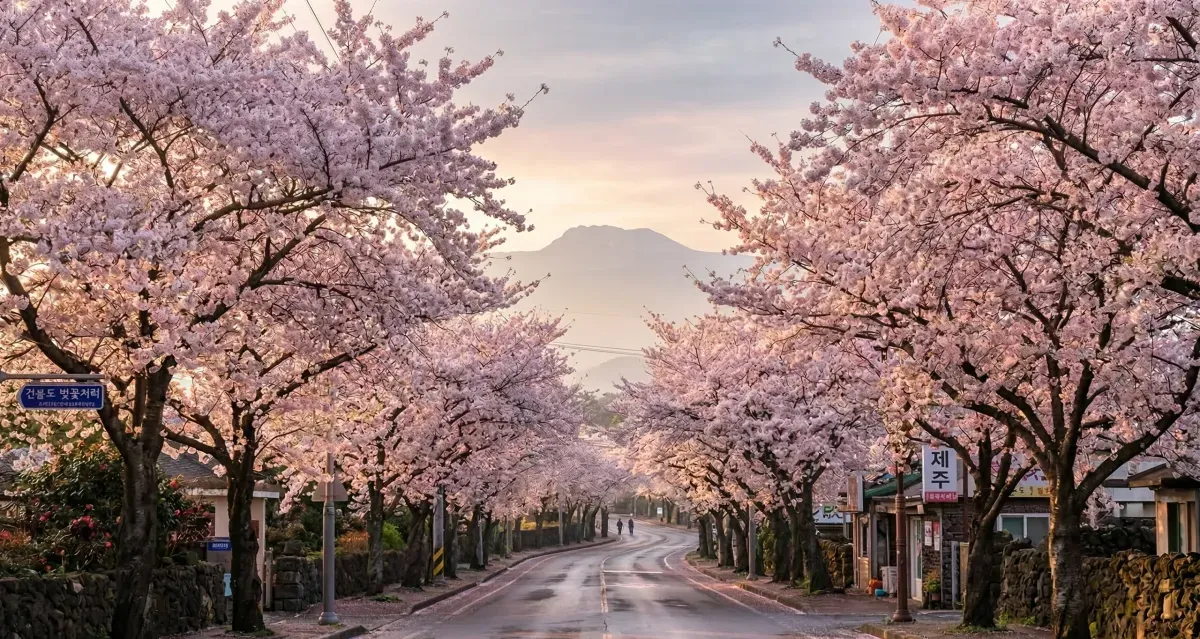
This 1.2-kilometer stretch in Jeju City runs between Jeju National University and the Jeju Sports Complex. King Cherry trees line both sides of the road and form a complete tunnel at peak bloom. Best time to visit: before 7:30 AM. By nine o'clock the crowds are thick and the selfie sticks come out. You can walk the whole stretch in about 20 minutes if nobody is blocking the path, and there is no admission fee. It earns its fame, but you need to earn your early alarm.
Noksan-ro (Where I Would Send My Best Friend)
If Jeonnong-ro is where everyone goes, Noksan-ro is the one I keep coming back to. This road near Seogwipo runs for roughly 10 kilometers with cherry trees on both sides and almost nobody around on a weekday morning. You will need a car or a taxi - expect about 15,000 KRW from Seogwipo bus terminal. The trees are slightly younger and do not form a full overhead canopy yet. But the views toward Hallasan behind the blossoms make up for it in a way no photograph has ever captured for me.
Hallim Park
Hallim Park (admission 13,000 KRW for adults, open 8:30 AM to 6:00 PM during spring) has a well-maintained grove of King Cherry trees alongside its subtropical gardens. It is more manicured than the roadside spots, which some people actually prefer. The real move is grabbing a bench near the palm tree garden around 10 AM and watching petals drift across the pond with a can of Georgia coffee from the vending machine outside. Sometimes the best viewing requires no walking at all.
Jeju National University Campus
Walk past the Jeonnong-ro strip and onto the university grounds. Most tourists turn around at the end of the road, which is their mistake. The campus interior has mature King Cherry trees that get a fraction of the foot traffic. Free, open, and quiet before afternoon classes start. I sat on a bench here for 45 minutes last spring and counted exactly three other people.
The Jeju Cherry Blossom Festival - Dates, Food, and a Counterintuitive Tip
The Jeju Cherry Blossom Festival (제주 왕벚꽃 축제) typically runs for 3-4 days in late March, centered on the Jeonnong-ro area. In 2025 it fell on March 28-30. Official 2026 dates have not dropped yet, but expect a similar window - possibly shifted a few days earlier given the bloom forecast. The festival brings food stalls, live performances, and a night illumination of the cherry trees that completely transforms the street after dark.
About those food stalls: get the hotteok. 2,000 KRW for a crispy, sugar-filled pancake that burns the roof of your mouth if you bite too soon. And honestly? The tteokbokki from the grandma running the cart nearest the university gate was better than any I had in Seoul. Now here is my counterintuitive tip: skip the festival's opening day. Everyone floods in for the first afternoon, but the cherry trees do not care about the festival schedule. Day 2 or 3 gives you better blooms (they keep opening throughout the week) and noticeably thinner crowds. Night illumination runs every evening of the festival, so you miss nothing by arriving later.
A Jeju friend once told me: 'Mainlanders come for the cherry blossoms. Jeju people come for the quiet morning before the mainlanders wake up.' I have taken that advice every trip since.
Planning Essentials - Prices, Weather, and the Car Question
Book accommodation at least six weeks out. Jeju during cherry blossom season is peak domestic tourism, and hotel prices around Jeju City double. A decent guesthouse runs 60,000-80,000 KRW per night during peak bloom, compared to 35,000-45,000 KRW in February. Airbnbs near Seogwipo tend to be slightly cheaper and put you closer to Noksan-ro.
Rent a car. Jeju has decent bus service between major points, but the best roadside spots are not accessible by public transit. Local agencies near the airport offer rentals starting around 40,000 KRW per day, and they accept international driving permits. Fair warning - parking near Jeonnong-ro during festival days is a nightmare. Use the public lot behind Jeju Sports Complex and walk the last 10 minutes.
Late March weather on Jeju averages 10-14 degrees Celsius during the day. Mornings drop to 5-7 degrees, and I have been caught in cold fog more than once. Pack layers you can peel off by noon. A light windbreaker does double duty against surprise gusts that shake loose petals - beautiful to watch, less beautiful when they stick to your sunscreen. Bring a portable charger too. You will take more photos than you planned.
Tags
Map-o-World Editorial Team
Travel Research & Editing
Our guides are researched from official tourism sources, local operators, transport authorities and recent traveller reports, drafted with AI assistance and reviewed by our editors before publishing. Prices, opening hours and entry rules change often - please double-check before you travel, and tell us if you spot something out of date.
Read our editorial policy arrow_forward