Sharjah Desert Star Bathing: What to Pack in 2026
For Sharjah's autumn star bathing window, roughly late September to early December, pack a fast wide lens, a tripod with wide feet, a dew heater band, three spare batteries, and a red headlamp. Nights at Mleiha drop to around 17C, dew beads on glass by 1am, and soft sand swallows thin tripod legs whole.
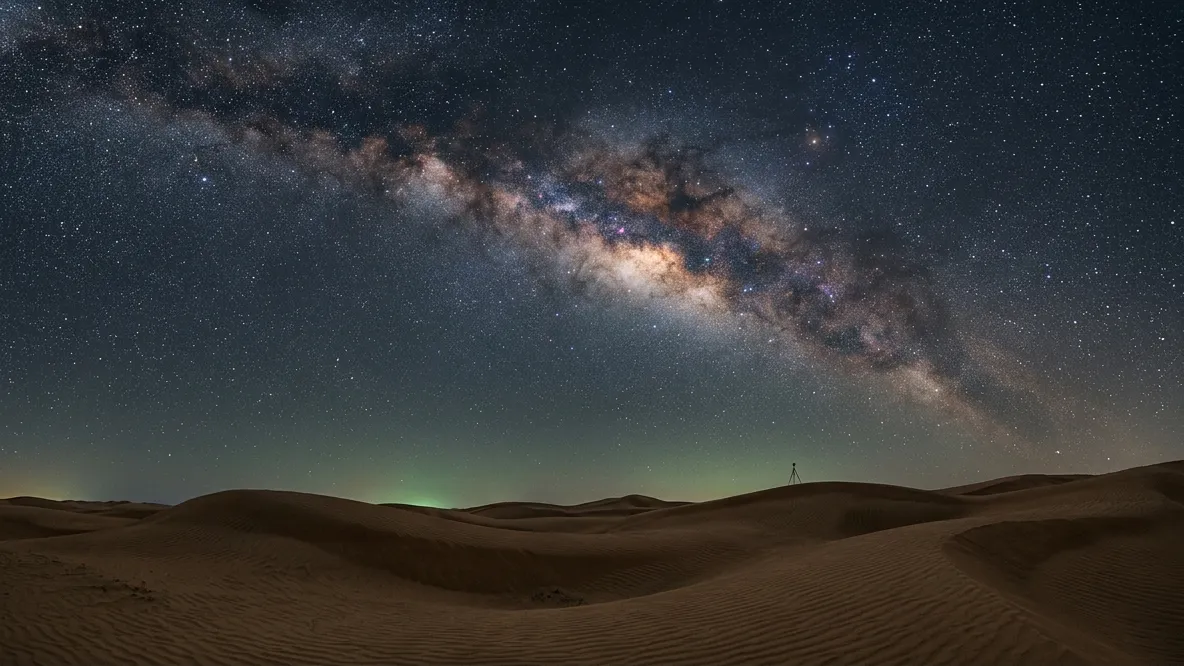
Late October 2025, 40 minutes past midnight, Mleiha desert. My 14mm lens had just fogged over from the inside of the front element, and I was crouched in the sand blowing warm breath on it like an idiot while the Milky Way did exactly what I had driven an hour from the coast to shoot. That was the moment I learned the difference between packing for a beach holiday in the UAE and packing to actually make frames in a dark-sky reserve.
Here is the thing about sharjah desert stargazing packing: the guides written for tourists tell you to bring water and a jacket. Useful. Also not remotely enough if you are chasing a 25-second exposure at ISO 3200 and want it sharp.
What to pack for Sharjah desert stargazing this autumn
The season decides half your list. From late September the day heat finally breaks, and by mid-November the desert nights sit between 15C and 20C after 11pm. That temperature swing is the whole game. Warm sand, cooling air, and humidity blowing in off the Gulf 50km west means dew, and dew is a lens killer.
Aim your trip at a new moon. In the 2026 autumn window the darkest nights cluster around the new-moon dates each month, and the Milky Way core sits low in the southwest until it dips below the horizon by late November. Miss the moon phase and you can pack perfectly and still go home with a washed-out sky. Check the phase before you book the resort, not after.
A Mleiha guide named Rashid told me, "The desert gives you the sky for free. The dew, you pay for." He was right. My tripod balls were slick with it by 2am.
Gear category by category, and why each earns its bag space
I shoot full-frame and travel light, so everything below survived a real cost-benefit fight for space. This is the section people actually mean when they search star bathing 2026 what to pack.
Lenses: go fast and go wide
One lens does most of the work out here: a wide, fast prime. My Samyang 14mm f/2.8 is cheap glass, but it opens wide enough to keep ISO sane. If your budget stretches, the Sigma 14mm f/1.8 is the astro workhorse, and yes, the extra stop is worth the weight. Leave the zoom in the car. A 24-70 at f/2.8 sounds versatile and shoots muddy stars.
Fair warning: coma at the edges will haunt cheap wide lenses. Shoot a test frame and pixel-peep the corners before you commit to an angle. I learned that one the hard way, with 30 otherwise good frames and smeared stars in every corner.
Support: the tripod is where amateurs cut corners
Soft Mleiha sand ate my travel tripod's thin feet on the first setup. It sank two inches mid-exposure and blurred the shot. Bring wide feet or improvise: I ended up resting each leg on a flattened water bottle to spread the load. A genuinely sturdy tripod, something in the Manfrotto 055 weight class, beats any feather-light carbon stick out here. An L-bracket saves you re-leveling every time you switch from landscape to portrait for panoramas.
Power and dew: the two things that end your night early
Cold drains batteries. At 17C my mirrorless chewed through a battery in 40 minutes of live-view composing. Bring three spares minimum, and keep them in an inside pocket against your body. A 20,000mAh power bank runs your dew heater band and recharges between shots. That dew heater, a simple USB strap around the lens barrel, is the single item that would have saved my fogged 14mm. Ten dollars of gear versus a ruined core shot.
- Intervalometer or a phone-app remote for star trails and timelapse. In-camera timers work but eat setup time.
- A star tracker if you are serious. The Move Shoot Move or a Sky-Watcher Star Adventurer 2i turns a 25-second frame into a clean 3-minute one. Overkill for a first trip, transformative for a second.
- Two fast SD or CF cards. Astro RAW files stack up, and card errors in the dark are unrecoverable.
Warmth and light: red only
A red headlamp, not white. White light nukes your night vision for 20 minutes and ruins your neighbor's frame. Pack a beanie and a proper mid-layer even though the day hit 34C, because standing still for three hours pulls the heat out of you fast. Fingerless gloves let you work the dials.
The one thing every photographer forgets at Mleiha
A microfiber cloth is not the answer to dew. You wipe, it beads again in 90 seconds, and now you have smears. The thing everyone forgets is the dew heater band, and the second thing is a rocket blower plus a lens hood to slow the condensation in the first place.
But the real forgotten item is simpler and dumber: a headtorch spare battery and a folding stool. You will be out there four hours. Standing in soft sand hunched over a low tripod destroys your back and your patience, and patience is what separates the keeper from the throwaway when you are waiting for the core to clear a ridge. I sat on a 15 AED foam mat from a Sharjah supermarket and shot two hours longer than the guy next to me who quit at 1am.
What to buy cheaper in Sharjah, not at home
Do not overpack consumables. The Blue Souq and the electronics shops around Sharjah's Rolla area sell power banks, USB-C cables, and cheap tripod-friendly bits for less than airport prices. A 20,000mAh power bank runs about 90 to 120 AED, roughly 25 to 33 USD, half what I would pay at home for the same capacity.
- Bottled water in bulk: a 12-pack for around 8 AED, about 2.20 USD, at any Sharjah supermarket. Do not fly it in.
- Microfiber cloths and a cheap beanie: a few dirhams each at Rolla stalls.
- A foam sit-mat or cheap camel-hair blanket for the cold sand.
- Hand warmers are hit-or-miss to find, so those I do bring from home.
Skip buying a headlamp locally, though. The red-light versions are hard to find in general shops, so bring that one. Entry to the Mleiha Archaeological Centre, worth it for orientation and to legally access the desert tracks, ran me 25 AED, about 6.80 USD, and the on-site cafe does a decent karak chai to keep you awake at 3am.
What to leave at home, and the drone warning
Leave the drone. The UAE regulates recreational drones tightly, and flying one near Sharjah without the correct GCAA permit can get your gear confiscated. It is not worth the aerial shot. Leave the heavy 24-70 zoom, the on-camera flash you will never fire at stars, and the flimsy travel tripod that sinks.
Also leave the guided "stargazing experience" upsell out of your plan if you are a serious shooter. The eco-resort packages at Mleiha and Al Faya are lovely for the wellness crowd doing actual star bathing, lying back on cushions with a telescope host. But the guides run soft ambient lighting and gather a group, and both wreck a long exposure. Book the room, skip the guided session, and drive 15 minutes past the crowd.
When is the best time for star bathing in Sharjah?
The sweet window is late September to early December, on nights within four days of a new moon, after 11pm. Autumn nights cool to 15-20C, humidity is manageable, and the Milky Way core stays visible in the southwest until late November before it drops for the winter.
Summer is a mistake for this. June through August the desert holds heat past midnight, haze sits thick, and you sweat onto your viewfinder. The dry, clear nights of November gave me my sharpest frames of the trip, with the temperature at a workable 18C and the sky transparent enough to catch airglow on the horizon.
Is Mleiha or Al Faya better for night photography?
For raw darkness and foreground drama, Mleiha's eastern dunes edge it, but Al Faya Retreat sits in genuinely deep dark too and is quieter. Everyone shoots Fossil Rock at Mleiha because it is the famous silhouette. The mistake is stopping there.
Fossil Rock draws every phone-camera crowd and their car headlights sweep your frame all night. Drive past it, toward the softer dunes east of the Mleiha rest house, and you get the same sky with no light trails ruining your stack. The mleiha night photography gear that matters most there is a lens you trust in the dark, because you will be composing by starlight alone. This trip is not for anyone wanting comfort and a quick win. It rewards the photographer willing to sit in cold sand for four hours for 10 frames worth keeping. If that is not you, the resort's guided session and a glass of wine will serve you better than a tripod.
Pack the dew band. Charge everything twice. And when your lens fogs at 1am anyway, and it might, you will at least know why.
Tags
Map-o-World Editorial Team
Travel Research & Editing
Our guides are researched from official tourism sources, local operators, transport authorities and recent traveller reports, drafted with AI assistance and reviewed by our editors before publishing. Prices, opening hours and entry rules change often - please double-check before you travel, and tell us if you spot something out of date.
Read our editorial policy arrow_forward