Seville Semana Santa 2026: Complete Holy Week Guide
The first time I stood on Calle Sierpes as a Semana Santa procession turned the corner, I understood nothing. Three years later, on my second visit, I understood less. That's the honest truth about Holy Week in Seville - the more you see, the more you realize how deep this runs. Incense so thick you can taste it on your tongue. A brass band stopping mid-note, leaving only the shuffle of 40 costaleros carrying a two-ton paso through a gap barely wider than your outstretched arms. Three thousand people standing silent at two in the morning, watching a 17th-century Virgin pass under candlelight. Seville Semana Santa 2026 runs from Palm Sunday, March 29 through Easter Sunday, April 5, and if you're reading this now, you're about to walk into one of the most intense and deeply strange weeks any European city produces.
Why Semana Santa in Seville Hits Differently
Most travel coverage treats Semana Santa like a parade. It is not a parade. This distinction matters. Each procession - and there are over 60 across the week - belongs to a specific hermandad (brotherhood), some dating back to the 14th century. They each have their own route from a home church to the Catedral and back, their own pasos (floats), their own music, their own identity. The rivalry between hermandades is real and sometimes fierce. Ask a sevillano whether La Macarena or El Gran Poder is more important, and you'll get an answer delivered with the conviction of a football fan defending their club.
Here's the thing: the emotion is not performative. I watched a grown man weep openly as the Virgen de la Esperanza Macarena emerged from the Basilica at midnight during Madrugada. Nobody looked twice. That's just what happens. The saetas - spontaneous flamenco songs cried out from balconies as a paso passes below - will raise the hair on your arms whether you're Catholic, atheist, or anywhere between. Raw and unfiltered in a way that organized religious events rarely manage to be.
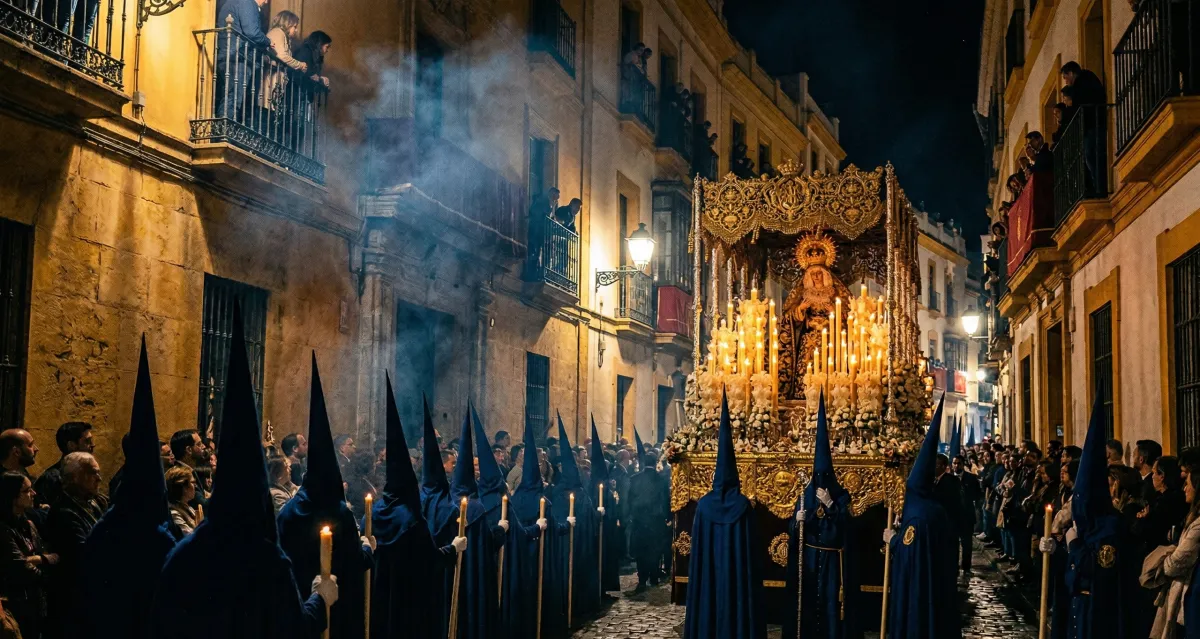
The scale is staggering. Some processions take 12 hours to complete their route. The pasos themselves can weigh over 5,000 kilograms, and beneath each one, teams of costaleros lift and carry in synchronized steps, guided only by the llamador - a small bell or knocker that signals when to lift, walk, and stop. You hear the wood creak. Wax drips from hundreds of candles onto the cobblestones below. And the streets of the old town, many of them barely wide enough for a car, somehow accommodate these enormous structures with centimeters to spare.
The 2026 Procession Schedule - What to See and When
Not all days of Semana Santa carry equal weight. Here's how the week breaks down so you can plan your Seville Easter week itinerary for 2026 without trying to see everything and burning out by Wednesday.
Palm Sunday (March 29) kicks off the week with processions from late morning. La Borriquita - the brotherhood depicting Christ's entry into Jerusalem on a donkey - is the most family-friendly and a good way to ease in. Expect large crowds along Avenida de la Constitucion, but nothing compared to what's coming later in the week.
Monday through Wednesday are what locals call the "quiet days," though quiet is relative. The processions are smaller and the crowds thinner, which actually makes these ideal viewing days. I'd argue Monday evening near the Iglesia de San Lorenzo gives you a more intimate experience than anything on Thursday or Friday. El Gran Poder's departure on the early hours of Friday is legendary, but seeing a smaller brotherhood leave its parish church on a Tuesday night, with only a few hundred spectators pressed against the walls of a side street - that stays with you differently.
Jueves Santo (Holy Thursday, April 2) is when things escalate. Multiple hermandades process simultaneously through the afternoon and evening. Los Negritos, El Museo, and El Valle all have afternoon departures. The real action starts after midnight.
La Madrugada - the early hours of Good Friday, April 3 - is the climax. Full stop. Six of the most prestigious hermandades process through the night and into dawn. El Silencio leaves at 1:00 AM in absolute silence - no music, no sound except footsteps. From San Lorenzo, El Gran Poder departs around 1:00 AM. And La Macarena, the most famous of all, leaves her basilica around midnight, not returning until past noon on Friday. The Seville Holy Week processions schedule for Madrugada is published by the Consejo de Hermandades around early March - check their official site for exact times, as they shift slightly each year.
Good Friday afternoon features El Cachorro and O, two processions with devoted followings. Sabado Santo (Holy Saturday, April 4) is comparatively calm. Easter Sunday brings the final brotherhood, La Resurreccion, through the streets in the morning - a shorter, lighter procession to close the week.
Where Are the Best Spots to Watch Semana Santa in Seville?
The official route - called the carrera oficial - runs along Calle Campana, through Plaza de San Francisco, and down Avenida de la Constitucion to the Catedral. Every single brotherhood passes through this stretch. You can buy silla (chair) seats along the carrera oficial through the Consejo de Hermandades, typically for 30-50 euros per seat depending on the day. For Madrugada or Viernes Santo, expect to pay 50 euros or more, and they sell out fast.
But here's my counterintuitive take: the carrera oficial is the worst place to experience Semana Santa. I know. Everyone says to go there. The problem is that it feels like a spectator event - you're seated in rows, the procession passes in front of you, and you're watching it like television. The real magic happens in the barrios, in the narrow streets where the pasos barely fit and you're pressed against a wall feeling the vibration of the drums in your ribcage.
My favorite spots after five Semana Santas: stand outside the Basilica de la Macarena on Calle Becquer for the salida (departure) of La Macarena on Thursday night. Arrive by 10 PM at the absolute latest - by 11 PM you won't get within 200 meters. The moment the Virgin appears in the doorway and the crowd erupts is the single most electric thing I've experienced in Europe. For El Gran Poder, position yourself on Calle Hernando Colon as the paso approaches the Cathedral - the acoustics of that narrow street amplify the music into something overwhelming.
For a less crowded but equally powerful experience, watch any procession navigate the tight turn from Calle Cuna into Calle Cerrajeria. The costaleros have to execute a complicated pivot, and you can see the effort on their faces, hear the llamador tapping instructions, watch the paso tilt and correct. Where craft meets faith, the result is extraordinary.
Can You Watch Semana Santa Without Paying for Seats?
Absolutely. Most of the procession routes through the barrios are free to watch from the sidewalk. The paid seating only applies to the carrera oficial stretch. Get there early, bring patience, and you'll find a spot. Standing behind the sillas along the carrera oficial also works - you just won't have the best sightlines. Plenty of sevillanos watch the entire week without spending a cent on seating.
Seville Semana Santa Tips for First Timers
Wear comfortable shoes with good grip. I cannot stress this enough. The streets are cobblestone, often slick with candle wax by Thursday, and you will walk 15-20 kilometers on a big day. Skip the sandals. Your feet will thank you at 4 AM.
Eating during Semana Santa requires planning. Many restaurants along procession routes close or operate on reduced hours. The streets around the Catedral and Alfalfa become near-impassable during evening processions, which makes getting to a restaurant on time an exercise in creative routing. Book dinner early - 8 PM instead of the usual 9:30 or 10 PM - or eat late after the processions pass. Bars and smaller spots in Triana, across the river, tend to stay open and are less affected by route closures. A bocadillo de pringada (the traditional Semana Santa sandwich of slow-cooked meat from the puchero) from any street vendor will cost you 3-4 euros and keep you going for hours.
Dress in layers. Late March in Seville can be warm during the afternoon - 22-24 degrees Celsius - but temperatures drop sharply after sunset, especially during the Madrugada hours when you might be standing still from midnight to 5 AM. A light jacket you can stuff into a bag is essential.
"El que no ha visto Sevilla en Semana Santa, no ha visto maravilla." - Whoever has not seen Seville during Holy Week has not seen a marvel. A sevillano proverb you'll hear more than once.
Hotels book up months in advance and prices triple during the week. If you're arriving now and finding slim pickings in the centro, look at Triana or Nervion - both well-connected by bus and on foot. Expect to pay 150-250 euros per night for a mid-range hotel during peak Semana Santa dates. A room in Los Remedios will run cheaper and you can walk across the Puente de San Telmo to the centro in 15 minutes.
Your phone will die. Processions go on for hours and you'll be taking photos and videos constantly. Bring a portable charger. Here's the one thing every Seville Semana Santa 2026 guide leaves out: put the phone away for at least one procession. Just watch. Let the incense and the music and the weird medieval energy of it all wash over you without a screen between you and the thing itself. You'll remember that one more clearly than anything you filmed.
How Do You Navigate Seville During Holy Week?
Street closures are constant and unpredictable. Google Maps becomes unreliable as routes shut down for hours at a time. The city posts barriers and policia local redirect foot traffic. Download the official Semana Santa app (search "Semana Santa Sevilla" in your app store), which shows real-time procession positions and street closures. The bus system still operates but routes get diverted - the metro is unaffected and runs to Los Remedios, Nervion, and other key areas. Walking is usually fastest, as long as you're not trying to cross a procession route mid-paso.
One more thing. You will see people in tall pointed hoods and long robes. If you're not familiar with Semana Santa, this can be startling. These are nazarenos - members of the hermandades - and the capirote (pointed hood) is a centuries-old penitential garment with zero connection to anything else you might associate with that silhouette. The tradition predates any other use of similar clothing by hundreds of years. Knowing this context before you go makes the experience richer and avoids uncomfortable misunderstandings.
Map-o-World Editorial Team
Travel Research & Editing
Our guides are researched from official tourism sources, local operators, transport authorities and recent traveller reports, drafted with AI assistance and reviewed by our editors before publishing. Prices, opening hours and entry rules change often - please double-check before you travel, and tell us if you spot something out of date.
Read our editorial policy arrow_forward