Barcelona Gothic Quarter Walk: La Mercè 2026 Guide
This self-guided Barcelona walking tour of the Gothic Quarter runs about 2.5 km, takes 3 to 4 hours with stops, and rates easy on mostly flat cobblestone. Time it for La Mercè festival week around 24 September 2026 to catch castellers, correfoc fire runs and free street concerts across the Barri Gòtic.
The first ember hit my sleeve at 10:47 pm on Via Laietana, and I did what the woman beside me did. Kept moving. That is correfoc, the fire run, and it is the loudest way to meet Barcelona's old town. I walked the Gothic Quarter four separate times during La Mercè week in September 2024, once at dawn when the stone was still cold and once at midnight smelling of gunpowder and orange blossom. This is the route I would hand a friend, plus the parts nobody warns you about.
When is La Mercè 2026 and where does it happen?
La Mercè honours Barcelona's patron, the Mare de Deu de la Merce, and the saint's day is always 24 September. In 2026 that falls on a Thursday, so the free program spreads across the four or five days bracketing it, roughly 23 to 27 September. Almost every marquee event lands inside or against the Barri Gotic, which is exactly why the old town walks best on foot that week.
The rhythm is worth knowing before you plan. Castellers build their human towers in front of the town hall on Placa Sant Jaume, usually on the Sunday around noon. The correfoc devils run down Via Laietana after dark. Free concerts fill Placa Reial and the smaller stage at Placa del Pi most nights, and the whole thing closes with the Piromusical fireworks over at Montjuic, which is a metro ride out of the quarter. If you want the la merce festival 2026 dates on a calendar, check the city's ajuntament site in July when the exact program drops.
Length, time and difficulty of this Gothic Quarter walk
Short version: 2.5 km, 3 to 4 hours with photo stops and one coffee, rated easy. There is almost no elevation, but the surface is uneven medieval paving that gets slick after rain and gets crowded past 8 pm during the festival. If you power through without stopping you can do the loop in 70 minutes. You should not.
This barcelona walking tour gothic quarter route works as a morning walk and a night walk that happen to share the same streets. Do it once at 8 am when delivery trolleys are the only traffic and the light rakes low across the stone. Come back after dark during La Mercè for the noise. Same geography, two completely different cities.
Stop-by-stop through the Barri Gotic
Start at Placa Nova, in front of the cathedral, where the two Roman towers frame the entrance to the old wall. From here the route curls south and loops back, and I have marked the walking distance between each point so you can pace yourself.
- Barcelona Cathedral (La Seu), Placa Nova. Skip the interior queue during festival week and pay 3 EUR (about $3.30) for the rooftop lift instead. Ten minutes up top, gargoyles at eye level, the whole warren of roofs below you. Best at opening, 9:30 am, before the tour groups.
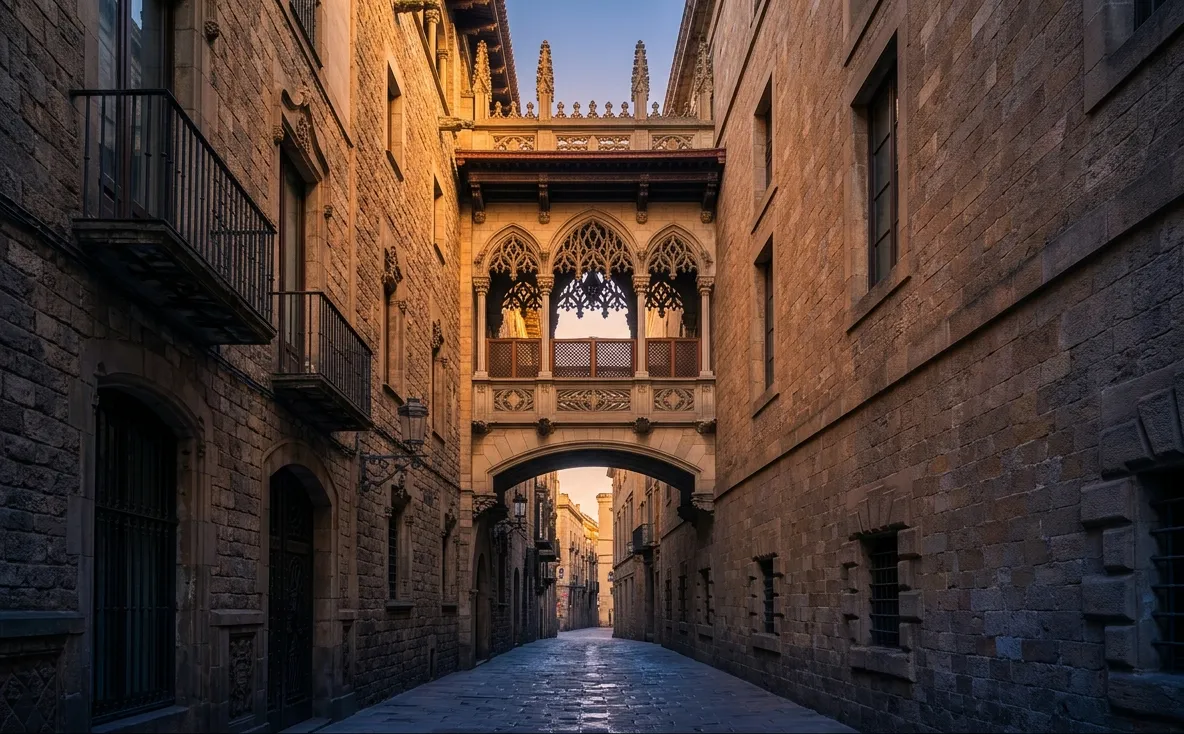
- Pont del Bisbe, Carrer del Bisbe. 90 m. The neo-Gothic stone bridge everyone photographs. Get your shot, then read the next section, because there is a catch to this one.
- Placa Sant Felip Neri. 130 m. A tiny square with a fountain and a church wall pocked with holes. Sit on the stone bench. The quiet here after the bridge crush is the sharpest contrast on the whole walk.
- Placa Sant Jaume. 220 m. The civic heart, town hall on one side, Catalan government on the other. This is where the castellers stack six and seven levels high. Arrive 45 minutes early on the Sunday if you want to actually see the base, not the back of someone's head.
- Placa del Rei. 260 m. A closed medieval courtyard, all straight lines and a fan of steps where kings once received Columbus. There are steps here, worth noting if wheels are involved.
- Carrer de la Palla to Placa del Pi. 380 m. A gentle bend of antique shops and the honey-coloured facade of Santa Maria del Pi. The festival stage here is smaller and calmer than Placa Reial.
- Placa Reial. 350 m, via Carrer de Ferran. Palm trees, arcades and Gaudi's first commissioned lampposts. Loud, packed, and the natural end point before you spill onto La Rambla.
Fair warning: my phone GPS spun uselessly in the tall stone canyons around Carrer dels Banys Nous, arrow pointing at three different walls. A man restocking a bakery pointed me the right way with a floury hand. Download an offline map. The streets are older than the concept of a straight line.
Where to stop for coffee, xurros and vermut
Two blocks off the cathedral, on Carrer de la Palla, is Caelum. It sits over a medieval Jewish ritual bath and sells sweets made by convents and monasteries around Spain. I paid 2.50 EUR (about $2.75) for a coffee downstairs in the vaulted cellar, candle wax and cold marble, and it was the calmest ten minutes of my day.
For xurros, everyone funnels into Granja La Pallaresa on Carrer de Petritxol, and the xurros amb xocolata there is genuinely good at 4.20 EUR (about $4.60). But the queue at festival time is brutal. Here is the trade-off: Caelum has no xurros but no line either, and Granja Dulcinea two doors down on the same street moves faster with nearly identical chocolate. Pick your battle.
Come vermut hour, around 1 pm, I stood at the marble counter of Bar del Pla near Santa Caterina market and had a house vermut for 3.50 EUR (about $3.85), poured over ice with an olive and a twist of orange. The smell of wet stone and frying dough drifting in from the lane is the thing I remember most.
A vendor near Placa del Pi told me, 'La Merce is the only week we give the city back to the people who live in it.' Then he handed me a plastic cup of cava and told me to move, the devils were coming.
What most walkers miss on Carrer del Bisbe
Everyone crowds the Bishop's Bridge on Carrer del Bisbe believing it is medieval. It is not. The architect Joan Rubio built it in 1928, and if you look up at the underside you will find a small skull with a dagger through it, tucked where the phone cameras never point. Local legend says the city falls if the dagger is ever removed. Nobody has tested it.
The real thing worth slowing down for is 100 metres away at Placa Sant Felip Neri. The pockmarks across the church wall are shrapnel scars from a Fascist bombing in January 1938 that killed 42 people, most of them children sheltering in the crypt. I ran my hand across them. The stone is rough where the metal tore in, and no plaque shouts about it. Most walkers photograph the fake old bridge and skip the wall that actually holds the century. That is the counter-consensus of this whole quarter: the postcard is younger than it looks, and the genuine wound is unmarked.
How long does this self-guided Barcelona itinerary take?
Plan on 3 to 4 hours for the full loop with a coffee, a food stop and real time at the castellers. As a self guided barcelona itinerary it fills a morning or a long afternoon comfortably, and you can stretch it to a full day by adding the Picasso Museum or the Born district next door. Rushing it defeats the point.
My honest skip-this call: do not pay 25 EUR (about $27.50) for a group walking tour during La Mercè week. The streets are so dense with festival crowds that a guide holding a paddle above 20 people becomes an obstacle, not a help. The free program is the tour. Walk it yourself with this list and your own pace.
Is the Gothic Quarter walkable during La Mercè?
Yes for most people, with two real caveats. The paving is uneven granite and cobble, worn smooth and genuinely slippery in rain, so leave the smooth-soled shoes at the hotel. There are short flights of steps at Placa del Rei and a few tight lanes, though the core route along Carrer del Bisbe and into Placa Sant Jaume stays flat and step-free.
This walk is not for everyone. If you use a wheelchair, the daytime route is doable on the main squares but the medieval lanes narrow and the festival crowds make evenings hard to navigate. If you hate crush and noise, do the whole thing at 8 am and skip the nights entirely. And if you have mobility limits or asthma, stay well back from correfoc: the fire runners spray real sparks, the air fills with gunpowder smoke, and the crowd surges without warning. Wear cotton, not synthetics, because a stray ember melts polyester onto skin. I learned that from the burn mark still on my old jacket.
Tags
Map-o-World Editorial Team
Travel Research & Editing
Our guides are researched from official tourism sources, local operators, transport authorities and recent traveller reports, drafted with AI assistance and reviewed by our editors before publishing. Prices, opening hours and entry rules change often - please double-check before you travel, and tell us if you spot something out of date.
Read our editorial policy arrow_forward