Tashkent Solo Travel Guide for Serious Foodies 2026
Tashkent is one of the easiest solo trips in Central Asia for a food lover: visa-free for US, UK and EU passports, cheap to the point of disbelief, and safe enough to walk home alone after dark. Base yourself near Chorsu Bazaar, ride the metro for the tilework, and eat plov before noon, because the best kazans sell out fast.
The plov was gone by 11:40 a.m. I'd dawdled over a third cup of green tea at Besh Qozon, watched a cook lift a cast-iron lid the size of a manhole cover, and by the time I queued the lamb-and-quince version had a hand-lettered sign over it: tugadi. Finished. A retired engineer named Bekzod, eating alone two stools down, slid his plate toward me and said, in slow Russian, eat, you came too late. That is the whole trip in one gesture. Show up hungry, show up early, and people feed you.
I went last August, when the thermometer outside Chorsu hit 38C by ten in the morning and the melon stalls smelled of warm sugar and diesel from the loading trucks. Here is what I learned eating solo for nine days.
How solo-friendly is Tashkent for a food traveller?
Very. More than Tbilisi, more than Istanbul, and it isn't close. Tashkent runs on a grid, the metro is bilingual on signage, and solo diners are normal rather than pitied. Nobody seats you in the bad corner. Single stools at the plov centres turn over fast, so you rarely wait.
The genuine friction is language. English drops off a cliff outside hotel lobbies. I got by on ten words of Russian, Google Translate's camera mode pointed at menus, and a lot of pointing at other people's plates. Cash matters too: many bazaar vendors still wave away cards, so keep som on you. An ATM at the TBC bank branch on Amir Temur gave me the cleanest rate, around 12,600 som to the dollar in August 2025.
As Bekzod put it between mouthfuls: a man who eats plov alone is not lonely, he is just first in line.
Where to stay if you want to eat with strangers
Pick your neighbourhood by what you want to eat for breakfast. I stayed two nights in the gleaming new-build district near Tashkent City Park and regretted it: glass towers, chain coffee, a 20-minute taxi to anything cooked over fire. Move closer to the old town.
The Old City around Chorsu is where I'd send any food-first solo traveller. I booked a room at Art Hostel Chorsu for 195,000 som a night (about $15), a five-minute walk from the bazaar's blue dome. The shared kitchen and rooftop did the social work for me; I met two German cyclists and an Uzbek-American on her first roots trip, and the four of us ended up splitting a 14-dish table at a neighbourhood choyxona that none of us could have finished alone. That is the trick to eating widely as a solo: you need a couple of stomachs, not just one.
- Old City / Chorsu - walkable to the bazaar and the morning plov, cheapest beds, best for hostels and shared kitchens.
- Mirobod, near the train station - quieter, more guesthouses, a short metro hop to everything, good if hostels aren't your speed.
- Skip the City Park towers unless you specifically want a pool and a quiet room. The food scene there is built for business travellers, not for you.
Which Tashkent neighbourhoods feel safe, and when
I walked alone at midnight near Chorsu, along Navoi Avenue, and through the underpasses by Mustaqillik Square. No incident, no hassle, not once. Petty crime is low and violent crime against tourists is rare. The police presence is heavy and largely indifferent to you.
The real hazards are mundane. Drivers treat zebra crossings as decoration, so cross with a local or use the metro underpasses. Stray dogs gather around the bazaar's meat section after closing; give them room. And the unofficial taxis, every parked car is a potential cab, will quote a tourist three times the rate. I used the Yandex Go app instead: a ride from Chorsu to the Tashkent City fountains ran 18,000 som, about $1.40, with the price fixed before I got in.
One honest warning. The bazaar's spice and dried-fruit aisles run a hard upsell on visitors, pressing samples into your hand and then naming a price. Smile, taste, and only commit once you've heard a number. I paid 40,000 som for saffron I later saw for 25,000 two stalls down. Lesson learned, lightly.
Eating alone: Chorsu Bazaar food, plov centres and the metro tilework
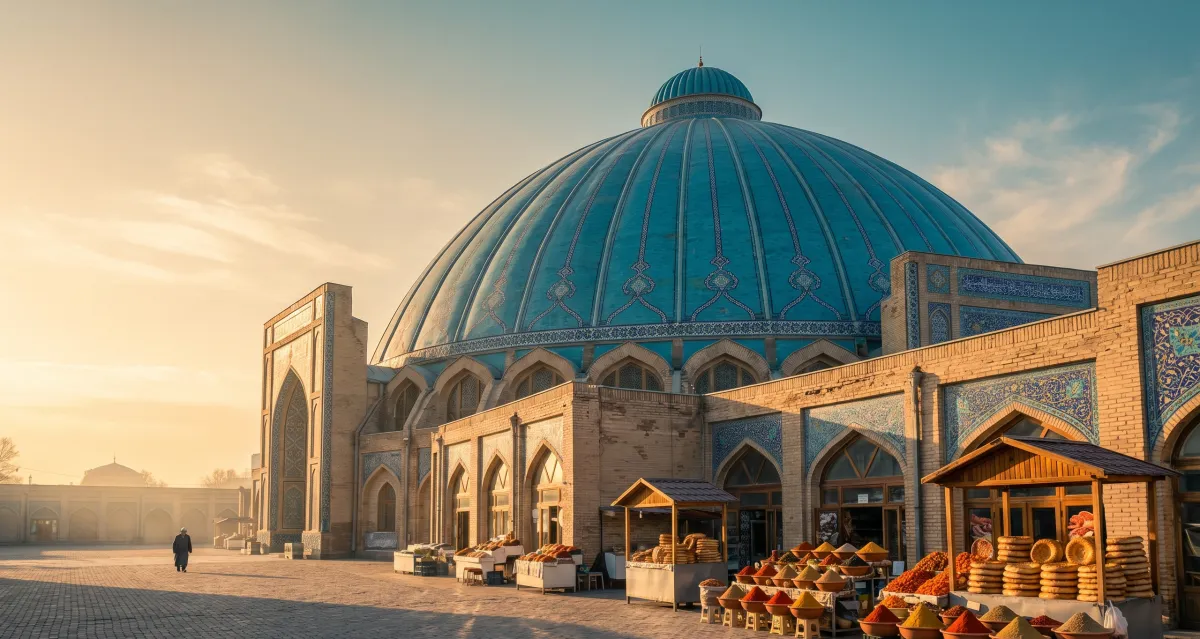
Start with Chorsu Bazaar food, under the turquoise dome, and go before 9 a.m. The dome hall is meat and dairy: hang-dried kurt balls, slabs of fresh suzma, horse-meat kazy that the vendors will shave into your palm. Outside it, the bread sellers stack obi non in towers; a stamped, sesame-crusted round still warm from the tandyr cost me 4,000 som, roughly 30 cents, and was better than half the restaurant meals I paid ten times more for.
For plov, the famous stop is Besh Qozon, the Central Asian Plov Centre near the TV tower. It is a spectacle, eight cauldrons, a viewing platform, the smell of cottonseed oil and cumin hanging over the car park. Worth seeing once. But here's the counter-consensus call: the plov there is good, not transcendent, and the place runs on tour-bus volume. For the better plate, I'd point you to a smaller neighbourhood operation like Manas Osh near the Olmazor metro, where the cook does one batch, sells it, and shuts. Get there by 11. After that, the kazan is scraped and your day's plov decision has been made for you.
The metro is the third meal of the day, the one you eat with your eyes. Tashkent's stations are open to photography now, and the underground tilework at Kosmonavtlar, all cobalt and ceramic spacemen, has become a TikTok pilgrimage. The Tashkent metro mosaics are genuinely worth a slow afternoon, but skip the crowded Kosmonavtlar selfie scrum and ride out to Pakhtakor and Alisher Navoi instead, where the ribbed turquoise ceilings are emptier and, to my eye, lovelier. A single ride is 1,700 som, about 13 cents. I got off at the wrong station twice on day one and considered both mistakes a gift.
How much does a solo foodie trip to Tashkent cost?
Less than you think. I averaged $34 a day all-in: a hostel bed, three meals plus snacks, metro and taxi, and one splurge dinner. A plov plate runs 35,000-45,000 som ($2.80-3.60). Street samsa from a tandyr is 8,000 som. Even a sit-down feast at a tablecloth restaurant rarely tops $12 a head.
Budget more for the bazaar than you plan to. Dried apricots, walnuts, saffron, the long-keeping kurt, all of it follows you home. I blew an unplanned $40 on spices and regret none of it, except the saffron markup.
When is the best time to visit Tashkent for food?
July to September, hands down, if you can take the heat. This is melon-and-grape season, when the bazaar's fruit tables groan under torpedo melons that perfume an entire aisle, and the plov gets its summer vegetables. Mornings are bearable; afternoons hit 38C, so eat early and nap like a local.
If the heat scares you, late September trades some fruit for thinner crowds and softer light. Avoid January unless you actively want grey skies and a city eating indoors. The new direct Wizz Air and Air Astana routes that opened across 2025 and 2026 have made summer fares from Europe genuinely cheap, which is exactly why the place is filling up.
Who should book Tashkent, and who should skip it
This trip is built for a specific person: the traveller who plans the day around lunch, who reads a menu they can't decode as a puzzle rather than a problem, who'd rather eat a 30-cent flatbread on a curb than a $30 hotel breakfast. If that's you, you'll be very happy and very full.
Who might struggle? Vegetarians, first. Uzbek cooking is lamb, horse, beef and tail fat, in that order; the vegetable dishes are real but supporting players, and explaining your diet across the language gap is exhausting. Anyone who needs English-language ease or a polished restaurant scene will find Tashkent rough around the edges. And if you travel to be social every single night, know that the hostel scene is thin by Southeast Asia standards. You make your own luck here, usually at a shared table, usually over plov.
By day nine I had a routine. Bread by eight, bazaar by nine, plov by eleven, metro and melon all afternoon. On my last morning the lamb-and-quince kazan still had two portions left when I arrived at 11:15. I'd finally learned to show up first.
Map-o-World Team
Travel Writers & Destination Experts
We're a team of passionate travelers and writers who have explored destinations across 7 continents. Our guides combine first-hand experience with deep local research to help you plan unforgettable trips. Every recommendation comes from real visits and genuine insights.
Learn more about us arrow_forward