How to Visit Bhutan Responsibly in 2026: Thimphu Guide
Quick answer: Bhutan's Sustainable Development Fee runs $100 per adult per night in 2026 and directly funds free healthcare, schools, trail crews, and reforestation. The single highest-impact choice you can make is booking a Department of Tourism certified guide, traveling in mid-October shoulder weeks, and sleeping in Bhutanese-owned hotels or registered homestays instead of imported luxury brands.
"Please do not tell people Bhutan is cheap now." Kinley Wangchuk, my guide of six days, said this over a plate of beef momos at Zombala 2, a strip-lit dumpling joint just off Norzin Lam where a plate of eight costs Nu 120, about $1.40. It was mid-October 2025, the week after Thimphu's tshechu crowds had drained out, and the street outside smelled of juniper smoke and diesel. He had spent the morning walking me through Bhutan's tourism math, and he was worried I would get it wrong.
Here is the version he wanted written down. Bhutan halved its daily fee in 2023 and locked the rate through August 2027, the Gelephu Mindfulness City project has put the kingdom in global headlines, and the country hosted its first International Travel Mart in 2025. Demand for autumn 2026 is already firming up. The question is no longer whether to go; it's how to visit Bhutan responsibly when everyone wants the same ten autumn weeks.
The Quick Answer - Book the Guide Before the Hotel
People asking how to visit Bhutan responsibly usually start with the fee. Start with the guide instead. Every visitor pays the Sustainable Development Fee - $100 per adult per night, $50 for children aged 6 to 11, free under 6, plus a one-off $40 visa - and that part is fixed. The highest-impact choice left to you is who you hire, because guides are mandatory for trekking and for travel beyond Thimphu and Paro, and the gap between a licensed local guide and a gray-market fixer decides where your remaining money lands.
Check the Department of Tourism's registered operator list at bhutan.travel before you pay anyone a deposit. A certified guide in 2026 earns roughly Nu 3,000 to 3,500 a day, about $35 to $41, and spends it in the same valley economy you're visiting. I booked through a five-person Thimphu agency, paid $2,950 all-in for six days solo, and could trace every line item. Friends who booked a cut-rate package through a foreign reseller saved $200 and got a guide licensed for four months who had never walked the trail we shared.
Fair warning - this trip is not for everyone. If your style is spontaneous, budget-first, or built around nightlife, Bhutan in peak autumn will frustrate you at $250 to $400 a day all-in. Go to Nepal, which does the Himalaya brilliantly at a third of the price, and come back when the fee reads as value rather than obstacle.
What Does Bhutan's $100 Daily Fee Actually Fund?
The fee goes into the national budget as earmarked tourism revenue: free healthcare, free education through university, trail maintenance, and the reforestation work that keeps Bhutan one of the world's only carbon-negative countries. It is not a hotel surcharge, and your operator never touches it - you pay the government directly when your visa is processed.
You can see the spending without trying hard. Free Basic Health Unit clinics across the country draw from the same pot, and so do the trail crews I passed above Motithang, four men in orange re-benching a switchback with hand tools. Kinley's daughter attends a free public school in Babesa, which is the shortest line I can draw between a visitor's wallet and a local outcome.
Now the part most coverage misses. The usual framing calls the fee an exclusionary tourist tax, and plenty of travelers skip Bhutan on principle. What that framing ignores: the $100 rate, halved from $200 in September 2023, replaced an older all-inclusive minimum package of $250 per day, so independent travelers now have more control over their own spending than at any point since tourism opened in 1974. You choose your hotel, eat where you like, and set your own pace. The fee, explained properly, is a floor rather than a wall.
Beds and Wheels - the Low-Impact Version of Thimphu
Thimphu's grid runs on hydropower, the taxi fleet is going electric fast, and the town core is small enough that I walked most of it. Clock Tower Square to the Centenary Farmers Market took me 12 minutes on foot; an e-taxi hop across town cost Nu 150 to 250, about $1.75 to $2.90. Skip the private car entirely for city days and tell your operator when they build the itinerary, because the default package still assumes a vehicle idling outside every stop.
For beds, I stayed at Namgay Heritage Hotel on Doebum Lam, a Bhutanese-owned three-star where a double ran Nu 5,800 a night, about $67, breakfast included. Locally owned three-stars keep essentially the whole room rate inside the country, while imported five-star brands repatriate their management fees. If you want the farmhouse version, ask specifically for a registered homestay in the Thimphu or Paro valley: expect Nu 2,500 to 3,500 with dinner, a bukhari wood stove, and a mattress on a painted plank floor.
How much does a responsible week in Bhutan cost in 2026?
Budget $2,400 to $3,200 per person for seven nights: $700 in Sustainable Development Fees, a $40 visa, roughly $450 to $470 for a mid-range Thimphu hotel, $250 to $420 for a licensed guide, and the remainder on food, e-taxis, entry fees, and a shared driver for out-of-valley days.
Meals barely dent that total. A lunch of ema datshi, red rice, and pickled radish at Ama Restaurant near the market cost me Nu 350. Even the splurge was modest: a set dinner at Babesa Village Restaurant, served in a 600-year-old farmhouse south of town, came to Nu 1,100, about $12.75.
Over-Tourism in a Kingdom of 800,000 - Real, Just Concentrated
Bhutan received about 145,000 visitors in 2024, a number Barcelona absorbs in a weekend. Averages deceive, though. Autumn compresses a third of the year's arrivals into ten weeks, and nearly all of them want the same six experiences. At Dochula Pass, 45 minutes east of Thimphu, I counted 14 tour vans at 9:30 am; by 11 the 108 chortens were effectively a parking lot with prayer flags. Tiger's Nest in Paro sees 600-plus walkers on a clear October day, and the queue for the final staircase moved slower than Thimphu's famous police-directed intersection, the one that still has no traffic light.
My honest skip: Simply Bhutan, the living-museum compound that every itinerary includes by default. You pay Nu 1,000, get 40 minutes of staged archery and a thimble of ara, and leave knowing less than one slow lap of the real farmers market would teach you - the weekend stalls there sell dried yak cheese, fiddlehead ferns, and chillies by the sack, Friday through Sunday. Ask your guide to swap it out. Mine did not argue.
The trekking version of the same trap is the Druk Path, the classic five-day ridge route between Thimphu and Paro that tops out at the Phume La, 4,210 m. In peak October its lakeside camps at Jimilang Tsho pitch tents within earshot of each other. The lower-impact alternative is the overnight hike to Phajoding monastery, three hours up from the Motithang trailhead, where a donation of about Nu 1,000 gets you a monk-run guesthouse bed at 3,650 m. The trade-off is honest: you give up the high lakes and the full five-day crossing for solitude, a wood-fire dinner, and dawn over the entire Thimphu valley. My lungs burned on the last switchbacks and a stray dog adopted me for the whole climb, but the night there - novice monks debating scripture through a plank wall - beat any campsite on the main route.
When is the best time to trek from Thimphu in autumn 2026?
Mid-October to mid-November is the sweet spot of Bhutan's autumn trekking season: monsoon haze gone, ridge temperatures around 10 to 15 C by day, and mountain views holding from dawn to early afternoon. Late September brings the Thimphu Tshechu and peak hotel prices; by late November, high camps drop hard below freezing overnight.
One warning from experience. I reached Phajoding on October 14 after two clear days, and it still rained on me from 2 pm, hard enough that my supposedly waterproof shell quit at the shoulder seams. Autumn in the Himalaya is a probability, not a promise. Build one spare day into any trek and carry a real insulation layer above 3,500 m; frost coated the guesthouse water barrel by 6 am. If your dates can flex, aim for the week after the tshechu ends - the 2026 Thimphu festival falls in late September, so early October hotels empty out fast.
What 'Eco' Actually Means on a Thimphu Hotel Listing
Bhutan has no national ecolabel, so the word 'eco' on a lodge website is marketing until proven otherwise. What exists instead is the Department of Tourism's star-rating system, which certifies hotels for service standards and licensing but not for environmental performance. Most 'eco-lodges' in your search results are self-declared.
The grid does some of the work regardless. Nearly all of Bhutan's electricity is run-of-river hydropower, so a hotel advertising clean energy is describing the entire country. Look instead for the signals that cost real effort: greenhouse vegetables grown on-site, staff hired from the same valley, filtered-water refill stations instead of cases of bottled water, heat pumps rather than coil heaters in the rooms. Ask one pointed question about the hot stone bath, too. A traditional dotsho is heated with firewood, and a lodge running six tourist baths a night burns through a serious stack of blue pine.
"We do not climb our highest mountains. The gods live on them, so the peaks stay closed. A good guest learns quickly which doors in Bhutan are not doors." - Kinley Wangchuk, licensed guide, Thimphu
That rule is literal: mountaineering above 6,000 m has been banned since 2003, which is why Gangkhar Puensum remains the highest unclimbed mountain on earth. Visiting Bhutan responsibly mostly means accepting smaller versions of that same logic. Photograph tshechu dancers from the courtyard edge, not the middle. Take your shoes off before anyone asks. Leave the fee argument at home.
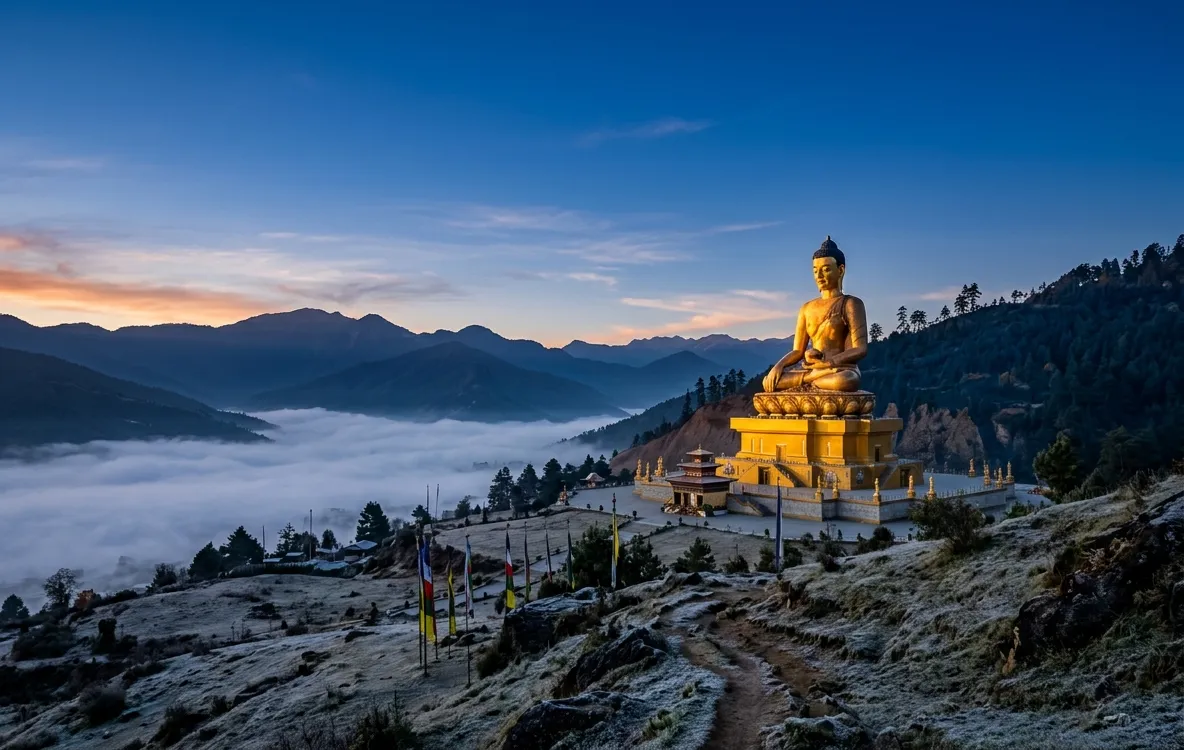
On my last evening I walked down Doebum Lam past Changlimithang stadium as the valley lights came on, and the Buddha Dordenma - all 51.5 m of gilded bronze - floated above the ridge like a second moon. Somewhere below it, Thimphu's stray dogs started their nightly argument, the one that runs from 11 pm until roughly 3 am no matter where you sleep. Pack earplugs. The fee covers a remarkable amount in Bhutan, but silence is not on the list.
Tags
Map-o-World Editorial Team
Travel Research & Editing
Our guides are researched from official tourism sources, local operators, transport authorities and recent traveller reports, drafted with AI assistance and reviewed by our editors before publishing. Prices, opening hours and entry rules change often - please double-check before you travel, and tell us if you spot something out of date.
Read our editorial policy arrow_forward