5 Best Monsoon Day Trips From Pune to Lonavala 2026
Quick answer: The standout monsoon day trip from Pune is Bhushi Dam in Lonavala, a stepped overflow that turns into a roaring water staircase from July to September. Take the 6:50 a.m. local from Pune Junction to Lonavala (about 90 minutes, 15 rupees), then a 12-minute auto to the dam. Go before 9 a.m. to beat the crowd.
I have done this run six times, twice in the same week last August when the rain would not quit. The thing nobody tells you about monsoon day trips from Pune is that the train beats the expressway by a mile when the ghats fog over and the Mumbai-Pune traffic stacks up at Khandala. Cars crawl. The local just keeps climbing.
So skip the cab debate. Here is exactly what works, what costs what, and which of these five to drop if your knees or your patience give out first.
Bhushi Dam - the overflow everyone films, and how to actually enjoy it
Bhushi Dam is the reason your Instagram feed floods every July. Water sheets down a wide masonry staircase, people sit on the steps with the current breaking around their shins, and the spray hangs in the air like a held breath. It is loud. It is chaotic. It is genuinely good fun if you time it right.
How to get there: From Lonavala station, an auto-rickshaw to Bhushi runs 120-150 rupees (about $1.75) one way, or 700 rupees for a half-day round trip with waiting. The road is 6 km of switchbacks. On peak Saturdays the police close vehicle access from around 11 a.m. and you walk the last stretch, so the early train pays off twice.
Cost: Entry is free. Budget 300 rupees for corn, hot bhajji, and chai from the stalls lining the approach. The roasted bhutta with lime and chilli, eaten in a downpour, tastes like cumin and rust and is worth every paisa.
Time needed: Two hours, no more. The novelty of cold water and shouting strangers wears off.
Fair warning: by noon on a weekend there are easily a thousand people on those steps, the algae makes the lower stones treacherous, and I went down hard on my tailbone in August 2024 reaching for a dropped phone. Hold the railing. Wear shoes with grip, not flip-flops.
Tiger Point - the cliff drop that disappears into cloud
Tiger Point (officially Tiger's Leap) is a sheer 650-metre drop where the valley falls away and, in good monsoon flow, a reverse waterfall blows back up the cliff face when the wind catches it. On a clear break between showers you can see three villages and a reservoir below. On a thick day you see white. Both are worth it for different reasons.
How to get there: 12 km from Lonavala station, around 25 minutes by auto. Expect 800-900 rupees round trip with waiting time, or club it into a half-day point-tour package the drivers hawk outside the station for 1,200-1,500 rupees covering Tiger Point, Lion's Point, and the lakes.
Cost: No entry fee. A small parking and a few maggi stalls at the top. A plate of hot Maggi noodles with extra masala runs 60 rupees.
Time needed: 45 minutes if the view holds. Honestly, less if it is socked in.
Here is the counter-consensus call: everyone races to Tiger Point and skips Lion's Point two minutes further down the same road. Lion's Point has the wider, more dramatic panorama and a fraction of the crowd. If a driver tries to end the tour at Tiger Point, insist on Lion's Point too.
Bhaja Caves - the quiet 2,200-year-old trip people drive straight past
This is the one to do if Bhushi Dam's noise has fried your nerves. The Bhaja Caves are a set of 22 rock-cut Buddhist chambers from around the 2nd century BCE, carved straight into the hillside, with a waterfall that only shows up properly in monsoon, splitting the rock right beside the stupas.
How to get there: Bhaja is closer to Malavli station than Lonavala. Take the same local one stop back toward Pune to Malavli (5 minutes), then it is a 20-minute walk or a 100-rupee auto to the base, followed by a 15-minute climb up stone steps.
Cost: Entry is 25 rupees for Indians, 300 rupees for foreign nationals. The climb is free and the monsoon waterfall beside the caves is the best free shower in the district.
Time needed: Two to two and a half hours including the climb and the caves.
When I climbed those steps last July, the rain had loosened a smell of wet stone and bat guano from the chaitya hall, and the only sound was water and a single ringing drip echoing off a 22-century-old ceiling. Nobody filming. Nobody shouting. That is rare around Lonavala in monsoon, and it is exactly why I send people here.
An old caretaker at Bhaja told me, in Marathi, "Paaus aala ki dagad bolto" - when the rain comes, the stone speaks. He was right. You hear the hill before you see the water.
Pawna Lake - the camp-and-kayak detour that needs your own wheels
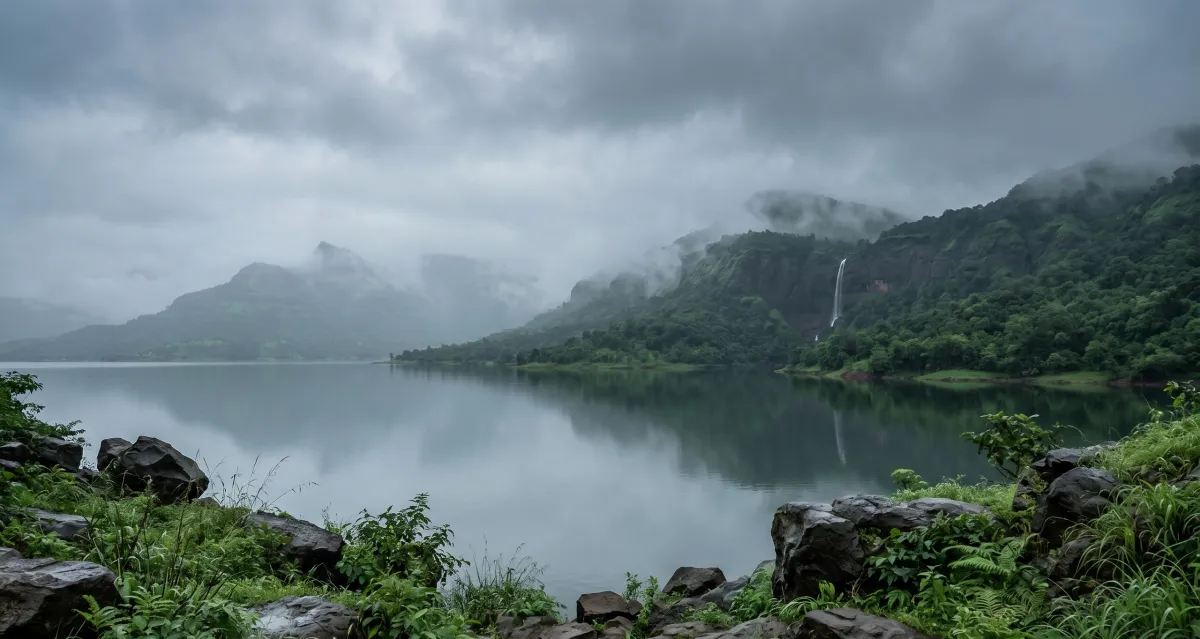
Pawna Lake is the backwater reservoir where the lakeside camping crowd goes. Tents pitched on green slopes, kayaks on grey water, the Tikona and Tung forts standing in the mist across the water. In full monsoon the grass is almost luminous and the surrounding hills run with thin temporary waterfalls.
How to get there: This is the honest catch. Pawna is poorly served by train. From Lonavala it is roughly 25 km and you genuinely need a cab (1,800-2,200 rupees round trip) or your own car or bike. Public transport here is patchy and will eat your day.
Cost: A lakeside tent stay with dinner, breakfast, and a bonfire runs 1,200-1,800 rupees per person. Day visitors can usually use a campsite's kayaks for 150-300 rupees.
Time needed: This one resists being a day trip. It wants an overnight.
Who this is NOT for: if you are doing a tight Pune-Lonavala train day trip with no car, drop Pawna. The transport maths does not work and you will spend more time negotiating with drivers than looking at the lake.
Lonavala town - chikki, the bazaar, and the view from the fort
The town itself anchors all of this. Most people treat it as a station to pass through. They miss that the Lonavala market on the main bazaar road is where you stock up on fresh chikki - the jaggery-and-peanut brittle the town is built on. Maganlal Chikki and a dozen rivals will hand you slivers to taste until you cave.
How to get there: You are already here. The bazaar is a 10-minute walk from the station.
Cost: A 250-gram box of dryfruit chikki is around 180-250 rupees. A vada pav from a station-road stall is 20 rupees and better than it has any right to be.
Time needed: An hour to shop, longer if you add Lonavala Lake or Rajmachi viewpoint.
Which monsoon day trip should you skip if you are short on time?
Skip Pawna Lake. It is the genuine standout for an overnight, but as a same-day train trip from Pune it forces a long cab ride and a transport headache that swallows your afternoon. If you have one day and the 6:50 local, do Bhushi Dam and Bhaja Caves instead and save Pawna for a weekend when you have a car.
I will also say the quiet part out loud about the lonavala monsoon waterfalls hype: half the "secret" waterfalls tagged on reels are just runoff that vanishes by mid-September. Bhushi and the Bhaja cave fall are the dependable two.
How do you chain two of these in one day from Pune?
The clean pairing is Bhaja Caves plus Bhushi Dam, because Malavli and Lonavala are one stop apart on the same line. Take the 6:50 a.m. Pune local, get off at Malavli, do Bhaja in the cool morning, then ride one stop forward to Lonavala and hit Bhushi before the afternoon crush. Train back by 5 p.m.
Here is the timing that works. Reach Malavli by 8:20 a.m. Climb to Bhaja, out by 11. Local to Lonavala, eat, auto to Bhushi by 12:30. Leave Bhushi by 2:30 before the steps turn to a standing crowd. There are frequent locals back to Pune through the evening, roughly every 45-60 minutes, with the last comfortable one around 8 p.m.
If you have a car, the other strong chain is Tiger Point plus Lion's Point plus a Pawna sunset, because they sit along the same western ridge road. That one is not a train trip. Know which kind of day you are buying before you book.
Is the Pune to Lonavala train worth it over driving in monsoon?
Yes, in monsoon the pune lonavala train day trip beats driving most weekends. The local costs 15 rupees against 400-plus rupees in fuel and tolls, it climbs the ghat in about 90 minutes regardless of traffic, and you are not white-knuckling a wet expressway. The trade-off is rigid timings and packed weekend compartments.
Buy a second-class ticket at the counter or on the UTS app. Sit on the left side heading up from Pune for the valley views past Kamshet and Kusgaon. And carry a dry bag. Everything you own will be damp by Malavli, including, somehow, the things inside two plastic layers.
Map-o-World Editorial Team
Travel Research & Editing
Our guides are researched from official tourism sources, local operators, transport authorities and recent traveller reports, drafted with AI assistance and reviewed by our editors before publishing. Prices, opening hours and entry rules change often - please double-check before you travel, and tell us if you spot something out of date.
Read our editorial policy arrow_forward