Phuket First-Timer Tips: What I Wish I Knew (2026)
Quick answer: First-time visitors to Phuket should skip metered-taxi myths (there are almost none), download the Bolt app to dodge tuk-tuk overcharging, base themselves outside Patong for a saner trip, carry cash for local kitchens, and rent a scooter only if already confident. Budget 1,500-2,500 baht a day (about $42-70) mid-range.
A tuk-tuk driver on Bangla Road quoted me 600 baht (about $17) to go two kilometres back to my hotel. I laughed, opened the Bolt app, and got the same ride for 55 baht (about $1.55) four minutes later. He saw the screen and shrugged. That exchange, more than any sunset, is the real Phuket welcome for a first-timer.
I spent three weeks here across February and March 2024, mostly on the west coast, one stretch in the old town. Loved a lot of it. Got scammed twice, sunburned once, and ate the best meal of the trip standing up at a plastic table. Here is what actually matters.
How Do You Get Around Phuket Without Getting Ripped Off?
Use ride-hailing apps. Bolt and Grab both work across the island, and a cross-town fare that a tuk-tuk mafia driver quotes at 500 baht runs 60-120 baht (about $1.70-3.40) in the app. That single habit saved me more than my flight home cost.
Phuket has almost no metered street taxis, which trips up everyone arriving from Bangkok. The tuk-tuks and "limousine" cars near the beaches run a cartel with fixed, inflated prices, and they have physically blocked Grab drivers from some Patong pickups. Workaround: walk two or three streets inland, away from the beach strip, then order your car. Drivers accept the ping happily where the cartel can't see.
Scooters are the local answer. A 125cc Honda Click rents for 200-250 baht a day (about $6-7) long-term, less if you take it for a week. Fair warning: Phuket's roads killed a lot of tourists, the hills around Kata and Karon are steep, and police run helmet checkpoints where a no-helmet fine is 500 baht (about $14). If you have never ridden, Phuket is a terrible place to learn. I watched two backpackers with gauze-wrapped "Phuket tattoos" limping through 7-Eleven on the same morning. Do not become that.
A local guesthouse owner in Rawai told me: "The beach is free. Everything between you and the beach costs money. Learn the difference fast."
Where Should a First-Timer Actually Stay?
Not Patong, unless you came specifically for the nightlife. Bangla Road at 11pm is a wall of ping-pong-show touts, decibel-heavy bars, and rolling beer buckets. Fun for one night. Exhausting as a base.
I stayed three nights in Patong and moved. Here is the honest breakdown for a first trip:
- Kata and Karon: the sweet spot for beginners. Real beaches, calmer streets, decent cheap food, still walkable to some nightlife. My guesthouse near Kata Noi ran 850 baht a night (about $24).
- Phuket Old Town: Sino-Portuguese shophouses on Thalang Road, coffee culture, the best photos, no beach. Base here if you care about food and character over swimming.
- Rawai and Nai Harn: quieter, more local, better for a second visit or anyone renting a scooter. Thin on nightlife.
- Bang Tao and Surin: pricier, resort-heavy, good if you want to spend money and not think.
Who Phuket is NOT for: anyone chasing an empty, undiscovered island. This place sees millions of visitors a year and it shows. If that is your dream, fly to Koh Yao Noi from the Bang Rong pier instead and thank me later.
What Should You Eat, and What Should You Skip?
Skip the beachfront restaurants with laminated photo menus and a guy waving you in. The pad thai there costs 250 baht (about $7) and tastes like an apology. Walk one block back.
The best meal I had cost 60 baht (about $1.70): a plate of khao man gai (Hainanese chicken rice) at a nameless stall near the Kata Center 7-Eleven, run by a woman who ladled extra ginger sauce when she saw me sweating through it. Look for stalls where Thai taxi drivers eat. Empty tourist restaurant at 1pm, bad sign. Twelve motorbikes parked outside a tin-roofed kitchen, order whatever they are having.
Two dishes to hunt down specifically in Phuket, because they are local and most first-timers miss them entirely:
- Moo hong: pork belly braised dark and sweet in soy and pepper, a Phuket Old Town specialty. Try it at Kopitiam by Wilai on Thalang Road, roughly 120 baht (about $3.40).
- Roti with condensed milk from a night-market cart, 40 baht (about $1.15). The smell is butter and caramelised sugar and diesel from the generator running the griddle. Weirdly perfect.
Counter-consensus: everyone photographs the fresh fruit shakes and thinks they are getting a health drink. Half those carts pour in sugar syrup by the ladle. Ask for "mai sai nam-tan" (no sugar) and you get the actual fruit. The mango is honest enough on its own.
How Much Does a Phuket Trip Cost Per Day?
Budget travellers can survive on 1,000-1,500 baht a day (about $28-42) including a guesthouse, street food, and app rides. Mid-range with a nicer room, a couple of drinks, and one activity lands around 2,500-3,500 baht (about $70-98). It is cheaper than most of Europe but not the two-dollar-meals Thailand of a decade ago.
Where the money quietly leaks: beach chairs and umbrellas (100-200 baht a day where they charge, though the law technically limits this), overpriced airport transfers, and jet-ski operators. That last one is a documented scam. They film you, then "find" pre-existing damage and demand 10,000-20,000 baht (about $280-560). Just don't rent the jet skis. There is no version of this where you win.
Money tips that actually helped me:
- Withdraw from ATMs in bigger amounts. Every Thai ATM charges a flat 220 baht (about $6) foreign-card fee regardless of amount, so pull 10,000 baht at once, not 2,000.
- Carry cash. Street kitchens, songthaews, and small shops are cash-only. Cards work in malls and resorts.
- Keep 100-baht notes handy for change. Vendors love claiming they can't break your 1,000.
When Is the Best Time to Visit Phuket?
November to February is dry season and the reliable window: warm days around 32C, calm seas, low humidity. December and January bring the crowds and the highest room prices. February hits the sweet spot, still dry, thinner crowds, seas flat enough for the islands.
Here is the thing about the May-to-October monsoon everyone tells you to avoid: it is green, cheap, half-empty, and often only rains hard for an hour or two a day. I would happily go back in June. But the west-coast surf gets serious, and those red flags on Kata and Karon are not decoration. People drown here every rainy season ignoring them. If a lifeguard planted a red flag, the sea will out-muscle you. No debate.
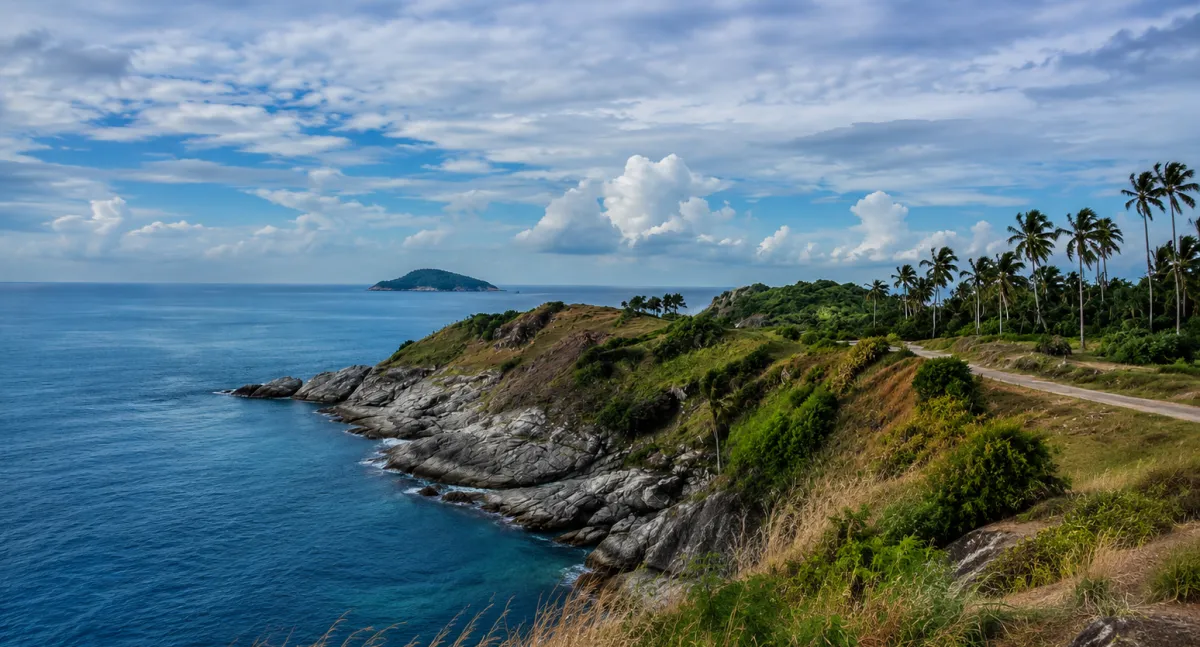
Best light for the postcard shot: come to Promthep Cape at the island's southern tip about 40 minutes before sunset, roughly 6pm in February. The crowd thins after the sun drops, and the ten minutes of afterglow over the Andaman turns the whole headland copper. Skip the actual sunset scrum at the viewpoint car park and walk five minutes down the ridge trail instead.
A Few Things Nobody Warned Me About
The airport is 45 minutes from the west-coast beaches, and the pre-paid taxi counter charges 800-1,000 baht (about $22-28). Order a Bolt from the departures level upstairs instead and pay half. Small rebellion, real savings.
Bring a light rain layer even in dry season. My one "dry season" afternoon in Kata turned into a 20-minute downpour that flooded the soi ankle-deep and left me sheltering under a laundry awning with four Thai teenagers who found my situation hilarious.
And this surprised me most: Phuket is genuinely huge. It is Thailand's largest island, roughly 50km top to bottom, and getting from Old Town to Nai Harn is a real hour-plus of driving. Do not book activities on opposite ends of the island on the same day. Pick a zone, stay in it, slow down.
The 600-baht tuk-tuk driver is still out there, idling near Bangla Road, waiting for the next person who hasn't downloaded the app yet. Don't be that person on day one. Be that person on day five, when 600 baht for a story feels like a fair trade.
Tags
Map-o-World Editorial Team
Travel Research & Editing
Our guides are researched from official tourism sources, local operators, transport authorities and recent traveller reports, drafted with AI assistance and reviewed by our editors before publishing. Prices, opening hours and entry rules change often - please double-check before you travel, and tell us if you spot something out of date.
Read our editorial policy arrow_forward