Reykjavik Eclipse 2026: Where to Stand on Aug 12
Quick answer: Reykjavik sits inside the path of totality for the 12 August 2026 total solar eclipse, with totality starting around 17:48 local time and lasting about 60 seconds at a sun altitude of roughly 14 degrees. It's free to watch, but August cloud odds in Reykjavik run near 60-70 percent, so mobility matters more than location.
I asked a woman selling wool at Kolaportid flea market whether she was planning anything for the eclipse. She looked at me the way you'd look at someone asking if they planned to attend the weather. "We will see if we see it," she said, and went back to folding sweaters. That is, honestly, the single most useful piece of eclipse advice anyone gave me in Iceland.
Here's the thing about the Iceland solar eclipse 2026: the astronomy is settled and the meteorology is a coin flip weighted against you. Reykjavik hasn't had a total solar eclipse since 1433. Iceland as a whole last got one on 30 June 1954, over the Westfjords. Next one after this? 2196. So the scarcity is real, and so is the booking panic - I checked in June 2025 and a mid-range Reykjavik double for the night of 11 August 2026 was already running 68,000-95,000 ISK, roughly $490-$685, against the 24,000 ISK ($173) I paid for a comparable room in August 2025.
Is the Reykjavik eclipse on August 12 2026 actually worth flying for?
Short version: yes if you can move on eclipse day, no if you're locked to a hotel. Totality in Reykjavik runs about 1 minute at 17:48, with the sun low at 14 degrees above the northwest horizon. That low angle is the whole story - it means a single ridge, a cloud bank, or Esja's shoulder can eat your eclipse.
Compare it to the 2027 Luxor eclipse: 6 minutes 23 seconds, sun near the zenith, desert skies with under 5 percent August cloud probability. Reykjavik gives you a sixth of the duration and roughly ten times the cloud risk. On pure eclipse-chasing maths, Iceland is a bad bet.
But nobody comes here for a good bet. A 14-degree sun means the moon's shadow arrives visibly across the water, sweeping in from the Atlantic at over 4,000 km/h, and you can watch it come. High-altitude eclipses don't give you that. The shadow approach at low sun angle over open ocean is, for my money, the most physically frightening thing I have ever seen described by people who've witnessed it - and this one is set up perfectly for it, because in Reykjavik the shadow comes at you off Faxafloi bay.
Who this is not for: anyone with fixed-itinerary group tours, cruise passengers who can't leave the ship, or travellers unwilling to drive 200 km on four hours' notice. If that's you, book Spain instead. Central Spain gets the same eclipse at 20:30 with about 1 minute 45 seconds of totality and dramatically better August skies.
What it actually costs, and why the rental car is the real ticket
There is no ticket. Nobody gates the sky. Your costs break into flight, bed, wheels, and the small stuff.
Flights: Icelandair and Play both fly Keflavik. I paid 41,000 ISK ($296) round trip from London Gatwick on Play in August 2025 booking six weeks out. For August 2026 I'm seeing 2-3x that on the same route, worse from North America. Book by autumn 2025 or accept the gouge.
Beds: this is where the panic is real. Kex Hostel on Skulagata, my usual, was 11,500 ISK ($83) for a dorm bunk last August. Their 2026 eclipse-week rates when I checked were roughly triple. Guesthouses in Borgarnes and Stykkisholmur - the drive-west towns - went first, mostly gone by spring 2025.
Cars: book the car before the room. A room you can replace with a bad room. A car you cannot replace with anything. Blue Car Rental quoted me 14,900 ISK ($108) a day for a Dacia Duster in August 2025; equivalent August 2026 quotes are running 28,000-35,000 ISK ($200-$250) a day with three-night minimums, and the small independents in Keflavik were sold out for 11-13 August by mid-2025.
- Fuel: 315 ISK/litre ($2.27) at N1 in Borgarnes as of August 2025. Reykjavik to Snaefellsnes and back is about 380 km round trip, roughly 9,500 ISK ($69) in a small diesel.
- Eclipse glasses: buy them at home. I found none in Reykjavik outside the Perlan gift shop and one optician on Laugavegur in 2025. Expect price gouging and dubious ISO 12312-2 certification in August 2026.
- Food on the road: the grill at Vegamot in Snaefellsnes does a lamb burger for 3,200 ISK ($23). Not exciting. Open till 21:00 in summer, which matters if you're driving back after totality.
How much does an eclipse trip to Reykjavik cost?
Budget 450,000-600,000 ISK ($3,250-$4,350) per person for five nights in August 2026 including inflated flights, a mid-range room, a shared rental car, fuel, and food. Solo travellers with no car-share partner should add roughly 90,000 ISK ($650). Camping cuts it to about half.
Where to stand in Reykjavik - and the three spots I'd actually use
You need an unobstructed northwest horizon down to about 10 degrees. In Reykjavik that means water in front of you, facing across Faxafloi toward Snaefellsjokull.
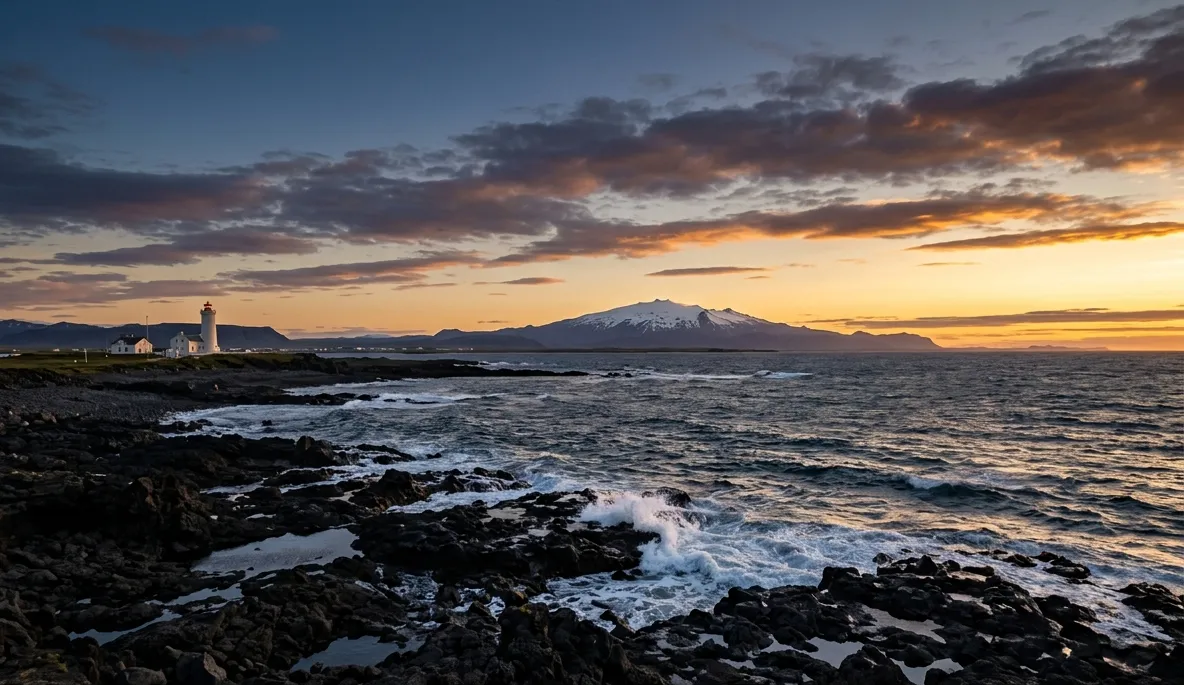
My first pick is the shoreline at Grotta on the Seltjarnarnes peninsula, 4.5 km from Hallgrimskirkja, about 12 minutes by car or 50 minutes walking the Ae shore path. Flat, open, black basalt and shore grass, a small lighthouse, and nothing between you and the northwest but the North Atlantic. Bus 11 runs there from Hlemmur roughly every 30 minutes and takes 18 minutes. Fair warning - Grotta will be mobbed. Parking is maybe 60 cars. Arrive by 15:30 or walk.
Second: the stretch of Saebraut waterfront between Harpa and Hofdi. Less romantic, more parking, and the horizon works. The Sun Voyager sculpture will be a photographer scrum; walk 400 m northeast and you'll have space.
Third, and this is the counter-consensus pick: Videy island. Everyone will tell you Grotta. What they miss is that Videy's ferry from Skarfabakki takes 5 minutes, costs 2,300 ISK ($17) return, and puts you on an island with 360-degree horizon and a hard cap on how many humans can be there. The trade-off is brutal and specific - the last ferry back. In 2025 the summer schedule had ferries running until 18:30, and totality ends at 17:49. If they don't add sailings, you are betting your ride home on a boat schedule. Check the Elding timetable in July 2026 before you commit.
"Whatever the forecast says at eight in the morning, drive at noon anyway. The forecast will be wrong by lunch." - Gunnar, a farmer near Borgarnes who let me park in his field and told me twice that Icelandic weather owes nobody anything.
Should I skip Perlan and Hallgrimskirkja tower?
Yes. Skip both. Perlan's observation deck charges 4,490 ISK ($32) and will be capacity-limited and sold out; more importantly, the glass and the crowd will ruin your view of a 14-degree sun. Hallgrimskirkja's tower faces the wrong problem entirely - narrow windows, small platform, and a queue. Height gains you nothing when the sun is nearly on the horizon. Go to sea level and face northwest.
The cloud gamble nobody puts in the headline
Reykjavik's mean August cloud cover sits around 65 percent. That is the number that should govern every decision you make. Not the hotel. Not the camera. The clouds.
What surprised me in August 2025: the weather divides along the Snaefellsnes peninsula almost like a wall. I drove out of Reykjavik under low grey at 09:00, hit sunshine at Borgarnes 74 km later, then drove into fog again at Vatnaleid pass, and came out the north side of the peninsula at Grundarfjordur into hard blue sky with Kirkjufell throwing a shadow across the road. Four weather systems, 200 km, three hours. My glasses fogged, unfogged, and fogged again.
That's the whole strategy. The path of totality on 12 August 2026 runs across west Iceland including the entire Snaefellsnes peninsula, so driving west keeps you in totality while changing your sky. Reykjavik to Olafsvik is 190 km, about 2 hours 20 minutes on Route 1 then Route 54. Leave a four-hour buffer and check the Vedur.is cloud-cover maps, which update roughly hourly.
The thing nobody warns you about: everyone else will be doing this too, on a two-lane road with single-lane bridges and no passing lanes. On a normal August Tuesday I hit 12 minutes of stopped traffic behind a camper at Borgarfjordur bridge. On eclipse day, with tens of thousands of visitors converging, assume the Hvalfjordur tunnel and Route 54 will be genuinely bad. Leave Reykjavik by 12:00 if you're going west. Not 14:00.
Also: the sun sets at 21:47 that day, so post-totality you have hours of light. And it will be cold. I wore a fleece and a shell at Grotta in August at 17:00 and my hands went numb in twenty minutes with wind off the water at maybe 8 degrees C.
Where to watch the eclipse in Iceland if Reykjavik clouds over
Snaefellsnes is the obvious drive-west answer, and within it I'd point at three places rather than the peninsula generally.
- Arnarstapi, on the south coast of the peninsula. 175 km from Reykjavik, roughly 2 hours 10. Basalt cliffs, a clean southwest-to-northwest ocean horizon, and a small harbour car park. The coastal walk to Hellnar is 2.5 km and takes 45 minutes. Bardur's stone troll statue is the meeting point everyone uses.
- Djupalonssandur black pebble beach, 12 km further west. Smaller car park, roughly 40 spaces, open horizon, and the lifting stones on the beach to keep you busy while you wait. My honest note: the pebbles are miserable to sit on for three hours. Bring a foam mat.
- Rif and the road between Olafsvik and Hellissandur on the north coast. Least scenic of the three, best odds statistically - the peninsula's north side gets more clear sky in a southerly airflow. If the forecast says southerly wind, go north.
If you'd rather not fight Snaefellsnes traffic at all, the alternative is going the other way to the Reykjanes peninsula - Gardur lighthouse or the Reykjanesviti area, 50 km from Reykjavik, right on the coast, with the same water-to-the-northwest geometry and a fraction of the crowd. It's flatter, bleaker, smells faintly of sulphur and salt near the geothermal fields, and it is 40 minutes from Keflavik airport if you're flying out the next morning. Totality there is marginally shorter, but you keep your evening.
One more: Akranes. 49 km from Reykjavik through the Hvalfjordur tunnel, about 45 minutes. Two lighthouses on a spit, wide-open northwest water, and a town that will not be prepared for you but has parking. The seafood soup at Galito on Stillholt runs 3,400 ISK ($25). Nobody puts Akranes in eclipse articles. That is exactly why I'd consider it.
Plan for cloud. Pack for wind. Then stand on wet basalt at 17:47 with the light going wrong in a way that makes your skin feel it before your brain names it - and if the sky is grey, note that the darkness still comes, still moves, still leaves. Just faster than you'd like.
Map-o-World Editorial Team
Travel Research & Editing
Our guides are researched from official tourism sources, local operators, transport authorities and recent traveller reports, drafted with AI assistance and reviewed by our editors before publishing. Prices, opening hours and entry rules change often - please double-check before you travel, and tell us if you spot something out of date.
Read our editorial policy arrow_forward