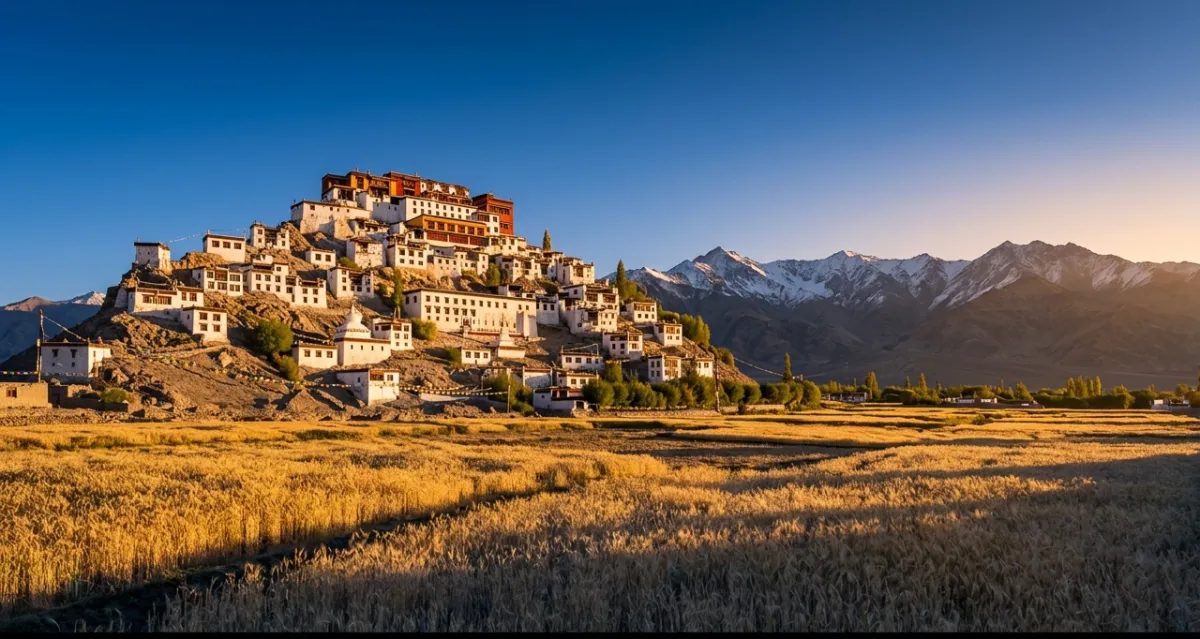
Leh 7-Day Itinerary From Delhi | Under Rs 35,000
Quick Answer: This Leh Ladakh itinerary for September 2026 covers Leh town, Sham Valley, Nubra and Pangong in 7 days for about Rs 30,000 per person from Delhi, timed to the Ladakh Festival (September 21-24, 2026), when airfares fall after the August rush and both highways into Leh stay open.
August visitors pay peak fares to queue for photos at Khardung La. Land three weeks later and the same trip costs a third less, the barley fields around Leh turn gold for harvest, and the town stages its biggest cultural event of the year. Prices are approximate as of August 2026, and every figure below assumes two people sharing rooms and four sharing cabs, because that is how budget Ladakh actually works.
September also wins on logistics. The Ladakh Festival runs September 21-24 in Leh, the Manali-Leh and Srinagar-Leh roads stay driveable into early October, and the school-holiday crowds are long gone. This is the last clean driving window before winter shuts the passes, and surprisingly few Indian travellers have caught on.
Why September 2026 Beats August in Ladakh
Three things stack up in your favour. Airfares first: Delhi-Leh one-way fares that sit at Rs 7,000-9,000 in mid-August routinely slide to Rs 3,500-4,800 by the third week of September, so watch fares from mid-June and book by early July. Weather second: Leh days hold at 15-20C, skies turn sharper once the faint late-summer haze clears, and Pangong photographs a deeper blue. The festival is the third reason, and honestly the best one, which is why this Leh Ladakh itinerary for September is built around its dates rather than around a weekend.
Is September a good time to visit Ladakh?
Yes, and for Indian travellers it might be the best month of all. Roads from Manali and Srinagar stay open until early October, daytime temperatures hold at 15-20C, flights cost 30-40 percent less than in August, and the Ladakh Festival adds masked dances, archery and polo to your trip for free.
The trade-off is night cold. Leh drops to about 5C after dark by late September and Pangong flirts with zero, so pack a proper fleece, a windproof shell and thermals for the lake night. In exchange you get harvest season: villagers cutting golden barley in Sham Valley, apricots drying on flat rooftops in Alchi, poplars going yellow along the Indus. Photographers who keep going back quietly rate late September above any other window in Ladakh.
Ladakh Festival 2026 - Dates and What Actually Happens
The dates to build around are September 21-24, 2026, in Leh. Opening morning is the show: a procession pours down Main Bazaar Road with cham dancers in carved wooden masks, women in turquoise-studded perak headdresses and drummers from villages across the district, ending at the Polo Ground for folk performances. The following days bring archery contests, polo matches and handicraft stalls, and everything is free to watch. Grab a kerbside spot on Main Bazaar by 9 am on the 21st, order butter tea from a bakery behind you, and stay put.
Day 1 - Land in Leh and Do Absolutely Nothing (September 20)
Your flight lands around 8 am at 3,500 metres, and altitude does not care how fit you are. Check into a guesthouse in the Changspa or Karzoo lanes (Rs 1,000-1,200 per person, twin share, breakfast included), drink water constantly and rest. Here's the thing: the single most common mistake on any Leh Ladakh itinerary is scheduling Khardung La for day two, when acclimatisation genuinely takes 48 hours - AMS headaches have ruined more Ladakh trips than bad weather ever has. By evening, if your head feels clear, stroll the flat 15 minutes to Main Bazaar for veg thukpa at Tibetan Kitchen (Rs 180).
Day spend: Rs 2,400
Day 2 - Ladakh Festival Opening Day (September 21)
Now the scheduling trick pays off. Festival opening day is standing-and-watching, not climbing, which makes it the perfect second-day acclimatisation activity: you absorb the biggest event on the Ladakhi calendar while your body adjusts. Watch the procession from Main Bazaar around 9:30 am, follow the crowd to the Polo Ground, then spend the afternoon at Leh Palace (Rs 25 entry), a nine-storey mud-brick hulk from the 1600s with old-town views from its upper terraces. Take a taxi up to Shanti Stupa for sunset (Rs 350 return) rather than climbing the 500-odd steps; save your lungs for the passes.
Walk like an old man for two days, then walk wherever you like - the acclimatisation advice every Leh guesthouse owner repeats to arriving guests.
Day spend: Rs 2,600
Day 3 - Sham Valley Loop, Evening Archery (September 22)
Book a shared Sham Valley taxi through your guesthouse (Rs 1,000-1,200 per person). The circuit runs west along the Srinagar highway: the Hall of Fame army museum (Rs 100), Gurudwara Pathar Sahib, the rolling-uphill illusion at Magnetic Hill, and the Indus-Zanskar confluence at Nimmu, where the two rivers meet in visibly different colours. Rafting on the Zanskar costs Rs 1,500 extra; skip it on this budget and put the money toward Pangong. End at Alchi, whose 11th-century murals (Rs 100) survive in dim chapels that smell of butter lamps and old wood. Return by 4 pm for festival archery at the Polo Ground, then a veg thali at Lamayuru Restaurant on Fort Road (Rs 220).
Day spend: Rs 3,000
Day 4 - Over Khardung La to Nubra (September 23)
The big shared-cab leg starts here. A three-day Nubra-Pangong circuit taxi costs about Rs 19,000 at Leh taxi union rates; split four ways that is Rs 4,800 each, and your guesthouse can match you with co-travellers a day ahead. Carry your Inner Line Permit photocopies for the South Pullu checkpoint. Khardung La sits at 5,359 metres, so spend 15 minutes there, not 45, whatever the selfie queue is doing. Descend to Diskit Monastery, where a 32-metre Maitreya statue watches over the Shyok river, then reach the Hunder dunes by late afternoon for a Bactrian camel ride (Rs 500 for 30 minutes) on double-humped descendants of the old Silk Route caravans. Sleep at a Hunder guesthouse (Rs 1,000).
Day spend: Rs 3,900
Day 5 - The Shyok Road to Pangong (September 24)
Leave Hunder by 8 am for the river-hugging Shyok village road: four to five hours of gorge, gravel and sudden green oases. You reach Spangmik on Pangong's western shore by lunch, and the lake spends the afternoon cycling through slate, turquoise and near-navy as clouds move. A late-September tip that saves real discomfort: book a village homestay in Spangmik or Man (Rs 1,500 with dinner and breakfast) instead of a tented camp, because homestay kitchens stay warm and the blanket piles are serious. Dinner is simple veg - dal, rice, a local sabzi - so carry theplas or khakhra if you want variety. Step outside after 10 pm; the Milky Way at 4,250 metres with zero light pollution needs no filter.
Day spend: Rs 3,400
Day 6 - Pangong Sunrise, Back for the Festival Finale (September 25)
Sunrise brings mirror-flat water before the wind wakes around 8 am; this is the photograph you came for. Depart by 8:30 am over Chang La (5,360 metres), stopping at Thiksey Monastery (Rs 50), a stacked whitewashed complex often compared to the Potala, rising above golden barley fields. Reach Leh by 3 pm, in time for closing performances at the Polo Ground. Evening is for Main Bazaar shopping: dried apricots (around Rs 400 a half-kilo), seabuckthorn juice, woollen socks from the Women's Alliance shop. Fair warning - pashmina under Rs 2,000 in a tourist shop is not pashmina.
Day spend: Rs 3,300
Day 7 - Fly Out With the Zanskar Below (September 26)
All Leh departures leave in the morning before valley winds pick up. A taxi to the airport runs Rs 500 at fixed union rates, and check-in moves slowly thanks to mandatory hand-baggage screening, so leave your guesthouse two and a half hours early. Ask for a right-side window seat flying to Delhi; the Zanskar range stays with you for twenty minutes. Worth it? Absolutely.
Day spend: Rs 900
Getting There From India
IndiGo and Air India fly Delhi-Leh nonstop several times daily, 1 hour 25 minutes, with all departures between 5:30 am and 10:30 am. For late-September 2026 travel, one-way fares sit at Rs 3,500-4,800 if booked by early July, so a return under Rs 9,500 is realistic - against Rs 14,000-16,000 in peak August. From Mumbai, Bangalore, Hyderabad or Chennai, add a Delhi connection and budget Rs 12,000-15,000 return. The hardcore-budget alternative: an HRTC Volvo from Delhi to Manali (about Rs 1,500, overnight), then the HRTC Manali-Leh bus (about Rs 1,800) over two days with a night halt at Keylong. It adds three days but costs a third of flying and acclimatises you gradually on the climb.
How much does a Ladakh trip from Delhi cost in September?
Budget Rs 29,000-33,000 per person for 7 days covering return flights, guesthouse stays, shared taxis and food, which is why a September Leh Ladakh itinerary fits under Rs 35,000 comfortably. Solo travellers using private cabs should plan for Rs 55,000-60,000. The Manali bus route drops the total under Rs 25,000 but needs ten days.
Permits, Veg Food and the Final Money Math
Do Indians need a permit for Nubra and Pangong?
Yes. Indian citizens need an Inner Line Permit for Nubra, Pangong, Tso Moriri and Hanle, though Leh town and Sham Valley need none. Apply online or through any Leh travel agent within an hour; the environment fee, Red Cross contribution and daily charge total roughly Rs 600 for this route. Carry a government photo ID and six photocopies.
Checkposts at South Pullu, Khardung village and Tangtse collect a copy each, so running out mid-circuit means backtracking. Aadhaar or a driving licence works, and children need ID too. Your cab driver will know the drill; hand him the copies on day one and forget about it.
Vegetarians eat well in Leh. Tibetan Kitchen and Gesmo on Fort Road do reliable veg momos and thukpa, Neha Snacks near the Jama Masjid serves a famous pure-veg chole bhature breakfast for about Rs 120, and most guesthouse kitchens cook simple North Indian food on request. Jain travellers should brief the guesthouse each morning for no-onion-no-garlic dinners - kitchens oblige happily in Leh, less reliably in Nubra and at Pangong, so pack theplas, khakhra and dry fruit for the two circuit nights.
Here is the full arithmetic for one person from Delhi, twin sharing, four to a cab.
| Head | Cost (INR) |
|---|---|
| Flights (Delhi-Leh return) | Rs 9,000 |
| Stay (6 nights, twin share) | Rs 7,000 |
| Food (7 days) | Rs 4,000 |
| Transport (shared cabs, transfers) | Rs 7,500 |
| Activities and permits | Rs 2,000 |
| Total | Rs 29,500 |
That leaves a Rs 5,500 cushion under the Rs 35,000 headline for a rafting run, extra shopping or a fare spike. Book the flight by the first week of July, reserve festival-week rooms in Leh by mid-August, and lock your cab-share group on day one. September 2026 hands you open roads, falling fares and Ladakh's biggest festival in the same week; the only real mistake is treating it as a fallback for August.
Map-o-World Editorial Team
Travel Research & Editing
Our guides are researched from official tourism sources, local operators, transport authorities and recent traveller reports, drafted with AI assistance and reviewed by our editors before publishing. Prices, opening hours and entry rules change often - please double-check before you travel, and tell us if you spot something out of date.
Read our editorial policy arrow_forward