Masai Mara Travel Guide From India 2026: Visa, Cost, Time
Kenya is visa-free for Indian passport holders in 2026, with stays of up to 90 days. A 6-day Masai Mara Great Migration safari from Mumbai costs Rs 1.2 lakh to Rs 1.8 lakh per person in September, covering return flights (around Rs 42,000), park fees, game drives, and camps that serve proper Indian vegetarian food.
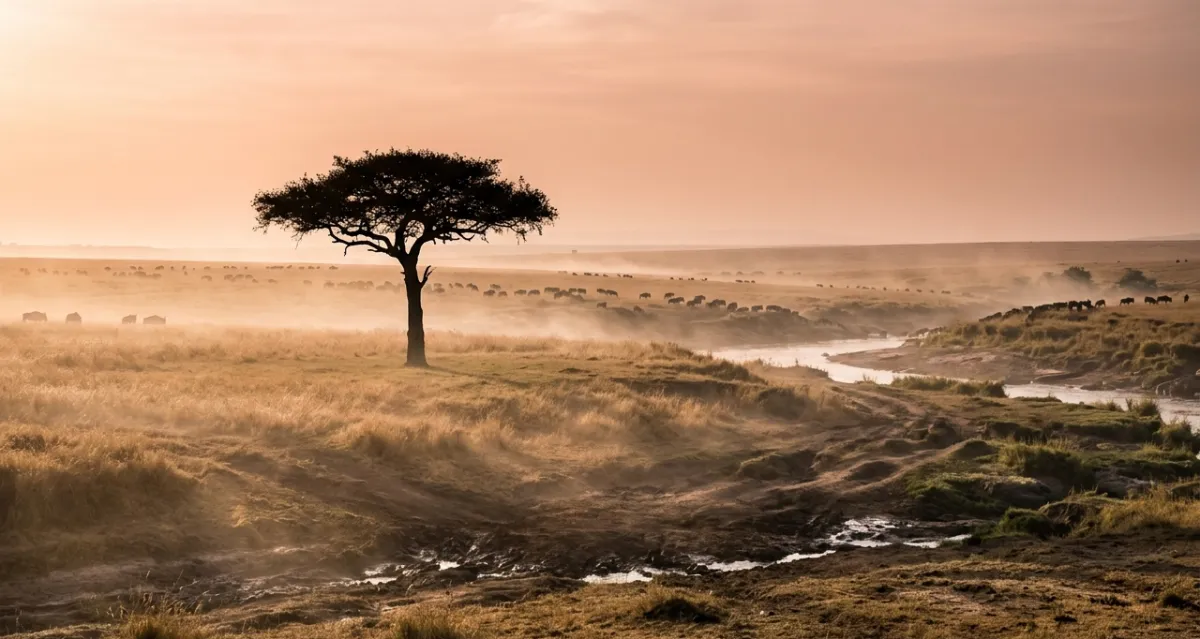
September in the Masai Mara smells of dust and crushed grass. By 7 am the light is already gold, the air still cold enough that guides hand out blankets in open Land Cruisers, and somewhere near the Mara River a column of wildebeest two kilometres long is working up the nerve to cross water patrolled by crocodiles the size of dining tables. Travellers who have stood on that riverbank describe the sound first: a low grunting drone from a hundred thousand animals, punctured by the slap of bodies hitting water. No fence, no ticket queue, no glass between you and it.
For Indian travellers, 2026 is the year this stopped being complicated. Kenya has dropped its visa requirement for Indian passport holders entirely, Kenya Airways flies nonstop from Mumbai in under seven hours, and the time difference is a gentle 2.5 hours behind India, so there is no jet lag to sleep off. Add the quiet fact that Kenya's safari industry has deep Indian roots, which means dal and rotis at camps in the middle of the savannah, and the Mara starts looking less like a bucket-list splurge and more like a slightly ambitious long holiday.
Visa for Indian Passport Holders
Kenya is visa-free for Indians. The old $51 e-visa, and the electronic travel authorisation fee that briefly replaced it, are gone for Indian passport holders, and you can stay up to 90 days. You still fill a short digital arrival declaration online before flying, but it is free and takes about ten minutes. Carry a passport valid for six months beyond travel, a return ticket, and your hotel or safari confirmations, because immigration officers at Nairobi's Jomo Kenyatta airport do ask for them.
Here is the part most people miss, and it bites on the way home, not the way out. India requires a yellow fever vaccination certificate from anyone arriving from Kenya. Get the shot at a government-designated centre at least 10 days before departure; in Mumbai, the Airport Health Organisation near the international terminal and public centres like the one at Seth GS Medical College administer it for roughly Rs 300 to Rs 1,000. Skip it and you risk quarantine on arrival back in India. Slots at government centres fill up two to three weeks ahead in peak season, so book this before you book anything else.
Why September 2026 Is the Month to Go
The Great Migration is not one event. It is a slow, chaotic loop of about 1.5 million wildebeest and several hundred thousand zebra grinding between Tanzania's Serengeti and Kenya's Masai Mara all year. The herds usually pour into the Mara from late July and stay through October, and the river crossings, the scenes every wildlife documentary is built on, happen repeatedly through this window whenever a big group masses at the water.
August gets the fame and the crowds. September is the smarter month. The herds are fully spread across the Mara, crossings are still frequent, the grass has been grazed short so predator sightings improve, and camp rates dip slightly once the August surge passes. Guides who have worked the reserve for decades will tell you the light gets better too, with clearer mornings after the last of the July drizzle. It also lines up neatly for Indians: September 2026 sits after the school reopening rush and before the Dussehra and Diwali fare spikes, which keeps Mumbai-Nairobi flights at their sanest prices.
When do the Mara River crossings happen?
Crossings happen unpredictably between late July and October, at any hour of daylight, whenever a large herd builds up at the riverbank. September offers among the highest odds. No guide can promise one; you improve your chances by staying at least three nights and being patient near the river.
This is the mistake to avoid: booking two nights and expecting the documentary. Wildebeest can mill at a crossing point for six hours and then wander off. Regulars swear by a minimum of three nights inside or beside the reserve, with full-day game drives carrying packed lunches rather than returning to camp at noon. A crossing witnessed on day three feels earned in a way no scheduled attraction ever does.
The river decides, not the guide. You wait for the wildebeest; they do not wait for you. That is the first thing Maasai guides tell guests who arrive with a shot list.
How Much Does It Cost From India?
A 6-day trip from Mumbai in September 2026 lands between Rs 1.2 lakh and Rs 1.8 lakh per person for most travellers, which is why the kenya safari cost from india conversation has changed so much since flights and visas got cheaper. Prices are approximate as of August 2026.
| Style | 6 days, per person | What you get |
|---|---|---|
| Budget | Rs 1.2 lakh | Shared group safari in a 4x4 or van, tented camps outside the gates, road transfers from Nairobi |
| Mid-range | Rs 1.5 - 1.8 lakh | Private or small-group 4x4, established camps like Sarova Mara or Zebra Plains, some fly-in options |
| Luxury | Rs 3 lakh and up | Fly-in safari, premium tented camps inside the reserve or conservancies, all meals and drives included |
The two big line items are fixed. Return flights from Mumbai run Rs 38,000 to Rs 48,000 booked three months out. Masai Mara park fees for non-residents are Rs 17,500 (USD 200) per adult per day in peak season, so three days inside the reserve means roughly Rs 52,500 (USD 600) in fees alone. Most packaged safaris bundle these fees, which is why a 3-day group safari from Nairobi priced at Rs 57,000 (USD 650) is actually reasonable value once you do the arithmetic. Add Rs 8,000 to Rs 12,000 for a Nairobi hotel night on either side, Rs 5,000 for tips (budget USD 10 per day for your driver-guide; it is expected, not optional), and the yellow fever shot and travel insurance at home.
Forex works differently in Kenya than in Southeast Asia, so plan it before you fly. Carry US dollars, not rupees; INR is not exchangeable anywhere useful. Take crisp USD notes printed after 2009, because older series get refused, and load a forex card with dollars for hotels and bigger camps. Park fees are cashless and usually handled by your operator through Kenya's eCitizen system. Kenyans themselves pay for nearly everything with M-Pesa mobile money, so small vendors may struggle with cards; keep Rs 8,000 to 10,000 worth of Kenyan shillings (about KES 15,000) in cash for curios, snacks and roadside stops. Exchange at banks in Nairobi rather than the airport counters, where the spread is noticeably worse.
How to Reach From India
Kenya Airways flies nonstop Mumbai to Nairobi daily, about 6 hours 45 minutes, typically departing just after midnight and landing at dawn, which positions you perfectly for a same-day drive to the Mara. Return fares in September 2026 hover around Rs 38,000 to Rs 48,000 if booked by June; last-minute fares cross Rs 60,000. From Delhi, Bangalore or Hyderabad, connect through Mumbai, or take Ethiopian Airlines via Addis Ababa or Emirates and flydubai via Dubai, which sometimes undercut the nonstop at Rs 32,000 to Rs 40,000 but stretch travel time to 11 hours or more. And honestly? For a first safari, the nonstop is worth the small premium just to arrive fresh.
Nairobi to the Mara is the second leg, and you have two options. The road route takes 5 to 6 hours through the Great Rift Valley, with a jaw-dropping viewpoint stop on the escarpment above Mai Mahiu, and costs little because it is bundled into most packages. The fly-in option from Wilson Airport on Safarilink or AirKenya takes 45 minutes and costs about Rs 22,000 (USD 250) return. Here is the counterintuitive call: unless you are badly short on time, take the road at least one way. The descent into the Rift Valley, the acacia plains, the roadside Maasai markets near Narok, these are part of the trip, and travellers who fly both ways consistently say they felt they teleported into a wildlife park rather than arrived in Kenya.
Best Time to Visit
For the migration, July to October, with September as the sweet spot for crossings, weather and price. Outside the migration window the Mara is still a superb big-cat destination, and rates fall sharply.
Mapped to Indian holiday calendars, it looks like this. September 2026 needs you to take leave, but fares are lowest and the wildlife payoff is highest; a 6-day trip needs only four working days off. Dussehra falls in late October 2026, when the tail end of the herds may still be crossing back south, so it is a workable gamble at higher fares. Diwali and the Christmas-New Year window miss the migration entirely, though December brings green scenery, newborn gazelles and fine resident-cat viewing at 20 to 30 percent lower camp rates. The May-June school break sits in the long rains and their aftermath; roads inside the reserve get sloppy and some camps close, so avoid it for a first visit. Skip Holi-season March too, unless you are chasing low-season photography light on a tight budget.
Vegetarian Food, Indian Camps and Ground Reality
Kenya's tourism industry has a century of Indian-origin history, and it shows. The Sarova group, which runs the popular Sarova Mara Game Camp, was built by a Kenyan-Indian family, and several Mara camps keep dedicated Indian chefs through the migration season. Jain meals, no onion no garlic, and full vegetarian buffets are routine requests, not exotic ones; mention dietary needs at booking and confirm again a week before travel. In Nairobi, spend your buffer evening at Diamond Plaza in Parklands, the city's Little India, where the chaat and dosa stalls draw queues of local Kenyan-Indian families and a plate of pav bhaji costs about Rs 400 (KES 600).
Is Masai Mara safe for Indian families?
Yes. The reserve and its camps are heavily geared to families, drives are vehicle-based with trained guides, and thousands of Indian tourists visit each migration season without incident. In Nairobi, use hotel taxis or Uber, avoid walking after dark, and keep valuables in the camp safe, standard big-city sense.
Children take to the Mara surprisingly well, though most camps set a minimum age of 5 or 6 for game drives, and the 5 am wake-ups test everyone by day three. Malaria prophylaxis is recommended for the region, so see a travel physician two weeks out. Pack layers rather than bulk: September mornings in the Mara drop to around 12 degrees Celsius, afternoons touch 27, and the dust gets into everything, which is why guides laugh at white clothing. Fair warning: mobile data inside the reserve is patchy at best, and that turns out to be the thing travellers end up grateful for.
Worth it? Absolutely. Few trips on earth deliver this much spectacle for Rs 1.5 lakh, and none of the others let you board a midnight flight in Mumbai and watch a million animals argue with a river before your next dinner.
Map-o-World Editorial Team
Travel Research & Editing
Our guides are researched from official tourism sources, local operators, transport authorities and recent traveller reports, drafted with AI assistance and reviewed by our editors before publishing. Prices, opening hours and entry rules change often - please double-check before you travel, and tell us if you spot something out of date.
Read our editorial policy arrow_forward