Hampi Heritage Guide: Exploring Vijayanagara Before the Heat
The first thing you notice about Hampi isn't the ruins. It's the boulders. Enormous granite formations stacked on top of each other like a god got bored playing with building blocks, their surfaces warm to the touch even at seven in the morning. I arrived on a March dawn expecting a dusty archaeological site and found something closer to another planet - one where 14th-century temples grow directly out of the rock and the Tungabhadra River cuts a lazy green line through it all.
Here's the thing: most guides will tell you Hampi is a two-day stop between Goa and Bangalore. That's wrong. I spent five days and still left feeling like I'd rushed it. With over 1,600 surviving structures from the Vijayanagara Empire spread across 26 square kilometers, this UNESCO World Heritage Site rewards patience. If you're planning a visit, get here before April. Once temperatures push past 42 degrees Celsius, the exposed ruins become genuinely punishing to walk through.
Where the Empire Still Stands - The Sacred Center
Start at the Virupaksha Temple on Hampi Bazaar Road. It's the only structure here that's been in continuous worship since the 7th century, and the difference shows - bright paint covers the gopuram (tower gateway) rather than the weathered grey of everything else. Entry costs 25 rupees for Indian nationals, 500 rupees for foreign visitors. Get there by 6:30 AM when the priests perform the morning aarti while the temple elephant, Lakshmi, takes her bath at the river steps nearby.
Walking south along Hampi Bazaar - a 700-meter colonnaded street where merchants once sold diamonds and spices - you'll hit the monolithic Nandi statue within ten minutes. The proportions are almost comically massive. A single carved bull, nearly five meters tall, sitting in a small pavilion as though it wandered in and decided to stay.
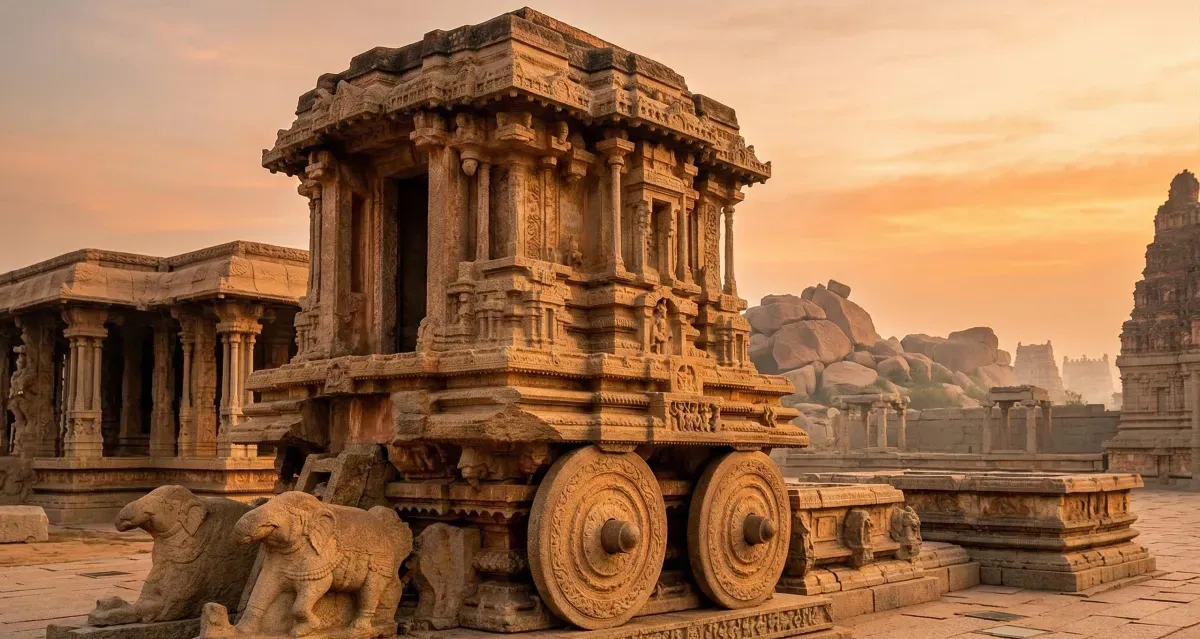
The Vittala Temple complex sits a twenty-minute walk east, or you can hire a bicycle near the bazaar for 150-200 rupees per day. Everyone comes for the stone chariot out front, and it's earned its fame. But the real draw is the musical pillars inside the main hall - tap them and they produce distinct notes, SaReGaMa style. Gates open at 8:30 AM and close at 5:30 PM - arrive right at opening to have the pillars nearly to yourself.
The Royal Enclosure - Power Written in Stone
Cross the main road south from the sacred center and everything changes. This was the civic and royal quarter, and the scale of ambition is staggering. Eleven domed elephant stables stand in a row, each designed in a slightly different style, mixing Hindu and Islamic elements freely. The Vijayanagara rulers were practical about borrowing what worked.
Five minutes on foot brings you to the Lotus Mahal, and I'll be honest - this building stopped me cold. A symmetrical pavilion with arched windows and lotus-bud turrets, it turns a shade of amber in late afternoon light that photographs cannot accurately capture. The queens used this as their recreational space. Standing inside with warm air moving through the open arches, you understand why.
"Don't try to see everything in one day. The stones here have waited six hundred years. They can wait one more morning while you drink your chai." - Ravi, a local guide near the Royal Enclosure, 800 rupees for a half day.
The stepped tank near the enclosure, sometimes called the Pushkarni, deserves a longer look than most visitors give it. Geometric stone steps descend into the water creating a kind of optical trick - your eye gets pulled down and inward. Restoration work completed in late 2025 cleared algae from the lower steps, and new LED lighting means the tank is now illuminated after dark on weekends. A recent addition worth catching if your timing allows.
Across the River - What Most Visitors Skip
Here's my counterintuitive take: the best part of Hampi isn't technically in Hampi. Cross the Tungabhadra by coracle - those round wicker boats that feel like sitting in a floating basket - for about 100 rupees per person from the ghat near Virupaksha Temple. The village of Anegundi on the far bank sits among ruins older than the Vijayanagara Empire itself. Most tourists never make it over, and the difference in crowd levels is dramatic.
Walk or cycle to the Durga Temple on Anjanadri Hill, believed locally to be the birthplace of Hanuman. The climb is 575 steps, about 30 minutes at a steady pace. I did this at sunset and sat on warm rock at the summit for nearly an hour, watching the ruins turn gold then pink then grey. Fair warning - there is no railing on some sections, so watch your step coming down in low light.
In Anegundi village, look for the Huttari Cafe (painted yellow wall on the main road) for filtered coffee at 40 rupees and banana chips fried in coconut oil. A local women's cooperative runs the place, and the money goes directly back into the community. And honestly? Best coffee I found in the entire Hampi area, which is saying something given how seriously South Indians take their filter coffee.
Practical Notes for a March Visit
March temperatures hover between 25 and 38 degrees Celsius. Mornings are comfortable but by 1 PM you'll want shade. Plan your ruin walks for early morning and late afternoon, using midday for lunch and rest at your guesthouse. New walking trails installed in early 2026 along the riverbank between the sacred and royal centers now provide a shaded route that didn't exist two years ago - look for the marked path behind the ASI ticket counter.
Stay on the Virupapur Gaddi side (across the river) for budget guesthouses in the 800-1,500 rupee range, or book at Evolve Back on the Hampi side if your wallet allows rates starting around 18,000 rupees per night. My pick is the Anegundi side - quieter than Virupapur Gaddi, more character than the Hampi Bazaar hotels. You wake up to the sound of the river rather than auto-rickshaw horns.
One last thing. Carry water - more than you think you need. The ruins are spread across open ground with very little shade between major sites, and the only reliable water sellers cluster around the Vittala Temple entrance and the Royal Enclosure ticket booth. Two liters minimum. Three if you're crossing to Anegundi and back.
Tags
Map-o-World Editorial Team
Travel Research & Editing
Our guides are researched from official tourism sources, local operators, transport authorities and recent traveller reports, drafted with AI assistance and reviewed by our editors before publishing. Prices, opening hours and entry rules change often - please double-check before you travel, and tell us if you spot something out of date.
Read our editorial policy arrow_forward