Heraklion to Knossos: Crete's UNESCO Minoan Palaces 2026
The first time I walked through Knossos, in 2019, I had the site mostly to myself on a late-March Tuesday. The guard at the west court entrance was reading a newspaper. A cat dozed on a fallen column drum. That version of Knossos is gone. When UNESCO added Crete's six Minoan Palace sites to the World Heritage List last year, it changed the equation entirely. Search interest spiked. Tour operators scrambled. And the Greek Ministry of Culture responded by pouring serious money into Knossos - new digital storytelling installations, revamped walkways, and a visitor flow system that actually works.
Here's the thing: most coverage focuses on Knossos alone. But the UNESCO designation covers six sites spread across the island, and some of the quieter ones hit harder than the famous palace. I spent three weeks last October driving between all six, and I'm heading back in April. This is what I wish someone had told me before my first trip.
Knossos in 2026 - What the New Exhibits Actually Look Like
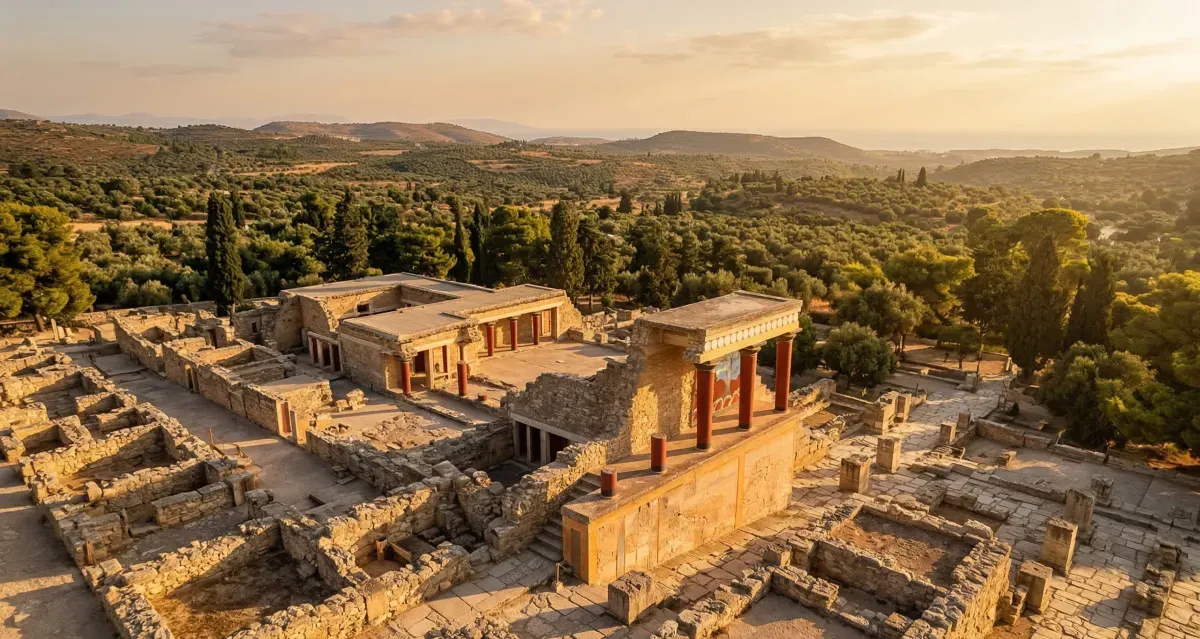
The big change at Knossos isn't structural. The palace ruins look the same as they did when Arthur Evans controversially reconstructed parts of them a century ago - those red Minoan columns still photograph beautifully against a cloudless Cretan sky. What's different is the interpretation layer. At seven points along the main route, you'll find projection stations that map animated reconstructions onto the actual ruins. The Throne Room sequence, where painted griffins appear to shift across the gypsum walls, gave me genuine chills on a warm afternoon.
Tickets cost 15 euros for the palace alone, or 20 euros for a combo that includes the Archaeological Museum of Heraklion on Xanthoudidou Street - and you should absolutely get the combo. The museum holds the originals of everything you see referenced at the site: the snake goddess figurines, the bull-leaping fresco, the Phaistos Disc. Without it, Knossos feels like a movie set. With it, you understand the civilization that built the thing.
Get there when gates open at 8:00 AM from April through October. By 10:00, tour buses from the cruise port fill the parking lot on Knossos Avenue, and the site transforms. The digital stations have a 15-person capacity, so early visitors cycle through quickly while latecomers queue in full sun. I learned this the hard way. One counterintuitive tip: skip the audio guide. The new digital installations replace most of what the old guide covered, and trying to sync both creates an awkward loop where you're standing in spots you've already passed. Save the 5 euros.
The Other Five - and Why Phaistos Might Be the Best of All
The six UNESCO-listed sites are Knossos, Phaistos, Malia, Zakros, Agia Triada, and Gournia. Most visitors hit Knossos and call it done. That's a mistake.
Phaistos sits on a hill in the Mesara Plain, about 60 kilometers southwest of Heraklion. The drive takes roughly an hour along the national road, then a winding stretch past olive groves where the air smells like warm herbs and dry dust. Unlike Knossos, Phaistos was never reconstructed. You're walking on 3,700-year-old flagstones, looking at foundations and staircases that nobody prettied up for visitors. The west court at Phaistos, with the Mesara stretching out below and Mount Ida rising behind, is the single most moving archaeological view I've experienced in Greece. Admission is 8 euros.
Malia, 35 kilometers east of Heraklion along the coast road, has the party-town reputation. Ignore that. The Minoan palace at the edge of town is remarkably well-preserved and rarely crowded. The famous kernos stone - a round offering table with 34 small hollows carved into it - sits in the open, unprotected. You can get close enough to run your fingers along its rim if nobody's watching. Entry is 6 euros.
Zakros requires commitment. It's out on the far eastern tip of Crete, a solid three-hour drive from Heraklion. Fair warning - this one is a genuine expedition. But the palace sits at the bottom of the Valley of the Dead (named for the Minoan burial caves in its cliffs, not for the drive), and the hike down through the gorge before reaching the ruins is extraordinary. Pack water and sturdy shoes. Entry is 4 euros, and on my October visit, I counted exactly three other people all day.
Agia Triada and Gournia are smaller, faster visits. Agia Triada sits just 3 kilometers from Phaistos, so pair them on the same morning. Gournia, on the road to Zakros near Agios Nikolaos, is technically a Minoan town rather than a palace - low walls and narrow streets laid out in a grid that feels strangely modern for something built 3,500 years ago.
A taxi driver in Heraklion told me: 'Knossos is where Greeks take tourists. Phaistos is where Greeks take their children.'
Planning the Spring Route from Heraklion
April is ideal. Daytime temperatures hover around 20 degrees Celsius, wildflowers blanket every hillside, and the summer crowds haven't materialized. Hotel prices in Heraklion's old town drop 30-40 percent compared to July. The light is softer too - better for photographs, easier on the eyes when you're staring at exposed stone for hours.
Rent a car. There's no practical way to reach all six sites by public transit, and the KTEL bus schedules from Heraklion's Bus Station A on the harbor only reliably serve Knossos and Malia. Budget 3-4 days to see everything without rushing. My suggested route:
- Day 1: Knossos at 8 AM, then the Heraklion Archaeological Museum in the afternoon. Dinner at the tavernas along the old Venetian harbor.
- Day 2: Drive to Phaistos and Agia Triada. Pack lunch - the single taverna at Phaistos charges tourist prices for mediocre food.
- Day 3: Malia palace in the morning, then continue east toward Agios Nikolaos and stop at Gournia on the way.
- Day 4: Early start for Zakros. Hike the gorge, explore the palace, make the long drive back. You'll earn your dinner.
For accommodation, base yourself in Heraklion's old town near the Koules Fortress for the first two nights. The area around 25th of August Street has reliable mid-range hotels from 70-90 euros per night in April. For the eastern sites, Agios Nikolaos makes a comfortable overnight stop with better restaurants than you'd expect.
One last thing. There's been talk of a unified ticket for all six UNESCO sites launching in summer 2026, but as of early March, it hasn't materialized. Buy tickets individually at each gate. Cash works everywhere, and most sites now accept cards. Carry both - the card reader at Zakros was broken on two of my three visits.
Tags
Map-o-World Editorial Team
Travel Research & Editing
Our guides are researched from official tourism sources, local operators, transport authorities and recent traveller reports, drafted with AI assistance and reviewed by our editors before publishing. Prices, opening hours and entry rules change often - please double-check before you travel, and tell us if you spot something out of date.
Read our editorial policy arrow_forward