3 Days in Kotor, Montenegro: Budget Itinerary 2026
This three-day Kotor Montenegro itinerary covers the medieval Old Town, a full day around the Bay of Kotor, and a mountain drive to Lovcen National Park. Come between late March and April for thin crowds, warm weather, and prices 40-60% below peak summer rates on the Adriatic coast.
I wasn't supposed to stay three days. The plan was one night, maybe two, before catching a bus to Dubrovnik. But on my first morning in Kotor, I walked through the Sea Gate at 7 a.m., smelled fresh bread from the bakery on the main square, and heard nothing but my own footsteps echoing off limestone walls that have stood since the 12th century. I canceled the bus.
That was the right call. The Bay of Kotor - sometimes called Europe's southernmost fjord, though geologists will argue it's technically a submerged river canyon - could fill a week of exploring on its own. Three days hits a sweet spot. You get the Old Town, the water, the mountains, and enough downtime to sit with a 1.50 EUR espresso and watch the light shift on the stone. Here's the thing about Kotor in 2026: Montenegro's EU accession talks have brought fresh infrastructure money, and the cruise ships keep getting bigger each summer. Between June and September, up to four ships a day dock in the bay, flooding the Old Town with day-trippers who vanish by 5 p.m. Come in April, and you share the streets with local cats and a handful of travelers who did their research. This Kotor Montenegro itinerary is built around that window.
What's the Best Time to Visit Kotor?
Late March through April delivers warm days between 15 and 22 degrees Celsius, almost no cruise ship traffic, and shoulder-season pricing on everything from hotels to grilled fish. May is decent, but hotel rates jump noticeably. By June the first mega-ships start anchoring in the bay.
I visited in early April. Daytime temperatures sat around 18 C, perfect for the steep fortress hike without overheating. Rain? You'll get a shower or two. Pack a light waterproof layer and move on - the sky clears fast here, and the rain makes the Old Town stone smell like wet earth and centuries. Build your Kotor Montenegro itinerary around late March or April and you'll have the best version of this place.
One thing most Kotor travel guides skip: shoulder season also means restaurant prices drop. A seafood risotto at Galion, right on the waterfront facing the islands, cost me 12 EUR in April. The same dish runs 18-20 EUR in July. Accommodation follows the same curve. A double room in a stone guesthouse inside the Old Town walls goes for 45-55 EUR per night in spring. In August, good luck finding anything under 100 EUR.
Day 1 - Old Town Walls and the Fortress at Golden Hour
Start early. I cannot stress this enough. Kotor's Old Town is a UNESCO site compressed into about 280 meters at its widest point, and by mid-morning even in shoulder season, tour groups from Dubrovnik begin filing through the Sea Gate. At 7 a.m., the place belongs to you and maybe three stray cats.
Walk through the main Sea Gate and head straight for the Clock Tower on the Square of Arms. From there, lose yourself in the side streets. I mean this literally - put the phone away for 30 minutes and just wander. Some alleys are so narrow you can touch both walls with outstretched arms, and every turn reveals a different church or crumbling palazzo with laundry hanging from a second-floor window. By mid-morning, stop at the Cats Museum, a tiny collection of cat-related art and oddities near the main square. The 2 EUR entry fee supports the local cat population. Kotor has hundreds of street cats, and they run this town. Locals feed them. Tourists photograph them. The cats remain spectacularly indifferent to both.
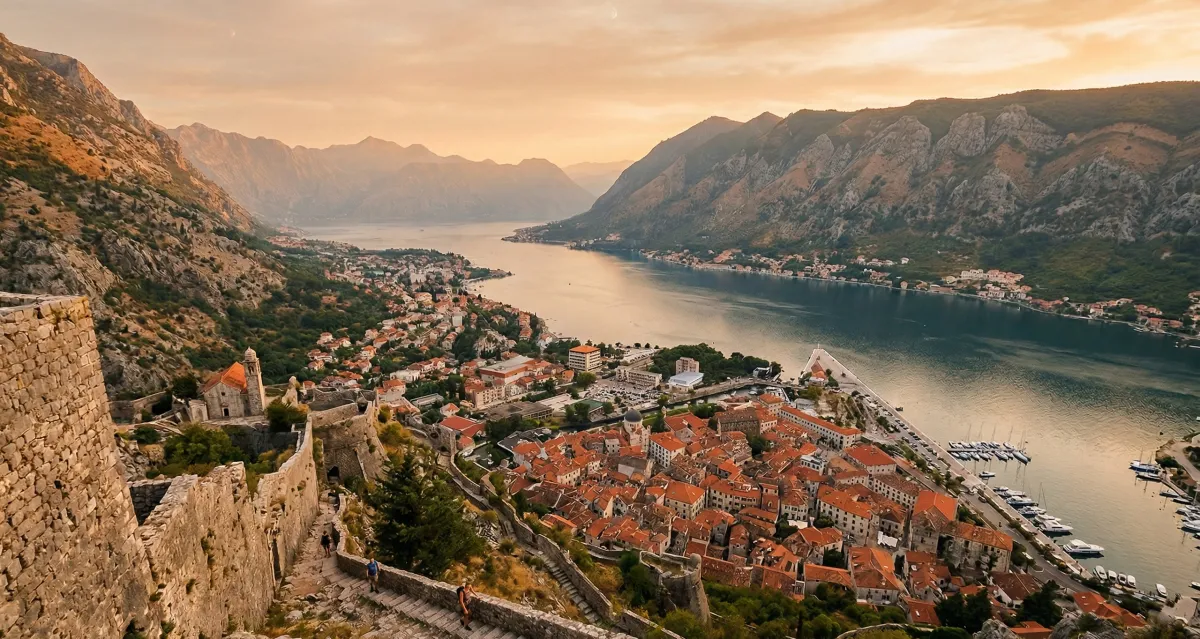
After lunch, tackle the Fortress of San Giovanni. Start your climb no later than 4:30 p.m. in spring to catch sunset from the top. The roughly 1,350 steps take 45-60 minutes at a steady pace, and the last section gets steep enough that you'll want both hands free. Entry costs 8 EUR. Bring water because there's nowhere to buy it on the way up.
Here's my counterintuitive tip: don't start the fortress climb from the main entrance near the Church of Our Lady of Health, where everyone else goes. Walk around to the south side of Old Town and find the older trail that starts near the Gurdic Gate. It's rougher, steeper, and you'll have it almost to yourself. The views from the top are the same either way - a sweep of red rooftops, the bay curving between mountains that drop straight into water so dark it looks black from above, until you're close enough to see it's a deep, improbable teal.
Come back down as the light fades and grab dinner at Konoba Scala Santa on the street behind St. Tryphon's Cathedral. The grilled squid is simple and right. A full meal with local Vranac wine runs about 15-18 EUR per person.
Day 2 - Bay of Kotor Day Trips by Bus and Boat
The bay is the whole reason Kotor exists where it does. This fjord-like inlet cuts 28 kilometers into the Montenegrin coast, and the towns scattered around its edges have been trading, fighting, and building churches since before Venice was a proper city. Catch the 9:00 a.m. Blue Line bus from Kotor bus station to Perast. The ride takes 20 minutes and costs about 1.50 EUR. Perast is the single-street village you've seen in every Montenegro Instagram post, backed by faded Baroque palaces with two tiny islands sitting just offshore.
Our Lady of the Rocks, the man-made island with a blue-domed church, is the main draw. Boats leave from the Perast waterfront every 20-30 minutes for 5 EUR return. Inside the church, votive paintings from grateful sailors cover every surface - one from 1796 shows a merchant ship surviving a storm, and you can still see smoke damage from centuries of candle soot. Back on shore, walk the waterfront past the boat dock toward the far end of town. Most visitors cluster near the landing. But the last few palaces before the road curves away have the best views of both islands, and a small konoba at the far end serves fried calamari and a cold Niksicko beer for about 8 EUR total.
Afternoon: take the bus back toward Kotor but get off at Dobrota, the next settlement over. It's basically Kotor's quiet suburb - a coastal promenade, a few old churches, and kayak operators renting boats for roughly 15 EUR per two hours. Paddling across the Bay of Kotor at sunset, with the mountains turning pink on both sides, was one of those moments where I kept stopping mid-stroke just to look around and confirm it was actually happening.
Day 3 - Lovcen and the Road Above the Clouds
"If you want to understand Montenegro, go up." That's what the woman at my guesthouse told me on my second night. She wasn't wrong.
Rent a car for Day 3. The serpentine road from Kotor to Lovcen National Park is one of the great drives in Europe, and doing it by tour bus limits your flexibility in ways that matter. Rental cars in spring start around 25-30 EUR per day from agencies on the Kotor waterfront. From town, the road climbs through 25 hairpin turns, each one opening up a wider view of the bay below. Pull over at the viewing platform near the first set of switchbacks - you'll know it by the cluster of parked cars. At 800 meters up, the perspective borders on absurd: the entire Bay of Kotor laid out beneath you, cruise ships reduced to bathtub toys, the red roofs of Old Town a postage stamp at the water's edge.
Lovcen National Park charges a vehicle entry fee of about 5 EUR. Drive to the parking area for the Njegos Mausoleum, the mountaintop tomb of poet-king Petar II Petrovic-Njegos. From the lot, a tunnel carved through rock leads to 461 steps ascending to the summit at 1,657 meters. The mausoleum is dark granite and gold, with a massive statue inside and a circular viewing platform that, on clear days, shows you the Adriatic Sea and the Albanian Alps in a single slow turn. Entry runs about 5 EUR. Fair warning - this one is a bit of a trek. The altitude means temperatures run 8-10 degrees cooler than the coast, and spring wind at the summit can be fierce. Bring layers. Wear proper shoes, not the sandals I watched one couple attempt the stairs in.
On the way back down, stop in the village of Njeguski for lunch. This is where Montenegrin prsut and cheese come from - the real stuff, not the tourist version. Roadside restaurants here serve enormous platters of smoked ham, local cheese, and prsut-stuffed veal for about 10-12 EUR. Portions are sized for people who just climbed a mountain, which is to say: large.
Do You Need a Car in Kotor?
For Days 1 and 2, no. Old Town is entirely walkable, and local Blue Line buses run along the bay coast to Perast and nearby towns for under 2 EUR each way. Day 3 is the exception. Renting a car for the Lovcen drive gives you freedom that the bus schedule simply can't match, and at 25-30 EUR for the day it's well worth the cost.
How Much Does 3 Days in Kotor Actually Cost?
The total for this Kotor Montenegro itinerary comes in around 250-350 EUR per person, including accommodation. That covers a stone guesthouse in Old Town, meals at local konobas, all transport, entry fees, and a rental car for one day. Here's a rough breakdown for a mid-range solo traveler in spring:
- 3 nights in a stone guesthouse: 135-165 EUR
- Food and drink across 3 days: 60-90 EUR
- Fortress entry: 8 EUR
- Boat to Our Lady of the Rocks: 5 EUR
- Car rental for Lovcen, including fuel and park entry: 35-40 EUR
- Njegos Mausoleum: 5 EUR
- Local bus rides: 5-6 EUR
- Kayak rental in Dobrota: 15 EUR
- Coffee, beer, incidentals: 20-30 EUR
Compare that to three days in Dubrovnik, 50 km up the coast, where accommodation alone runs 150-200 EUR per night in the same season. Montenegro on a budget makes a compelling case for itself. And since the country adopted the euro, there's no exchange rate math to deal with either.
Map-o-World Team
Travel Writers & Destination Experts
We're a team of passionate travelers and writers who have explored destinations across 7 continents. Our guides combine first-hand experience with deep local research to help you plan unforgettable trips. Every recommendation comes from real visits and genuine insights.
Learn more about us arrow_forward