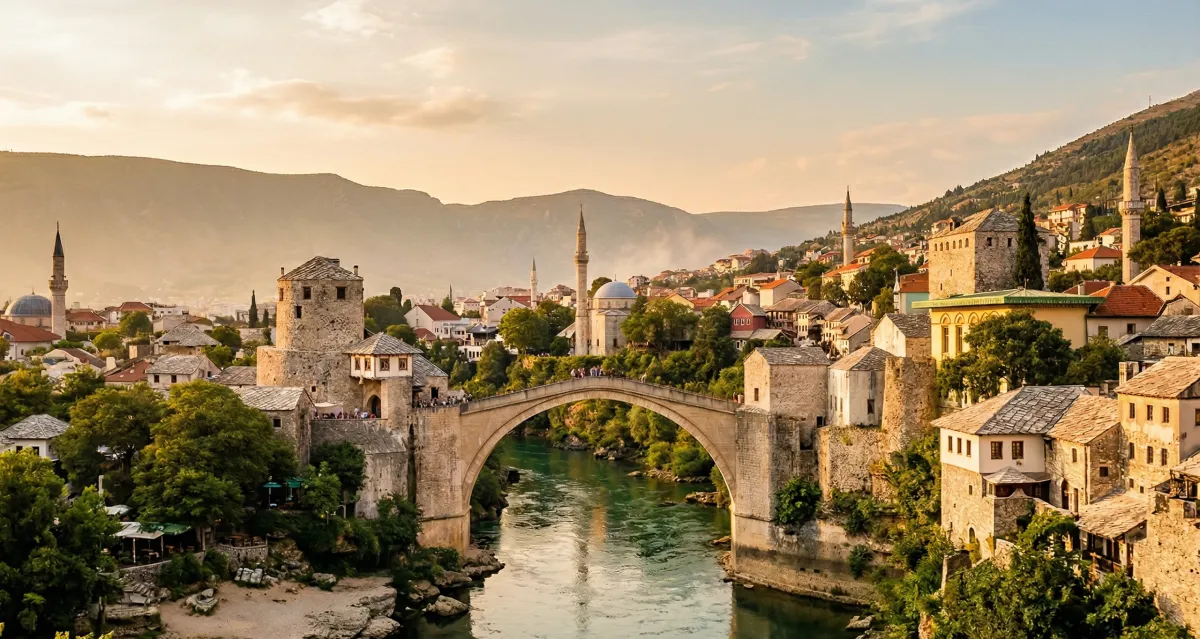
Mostar in Spring 2026: The Perfect 2-Day Itinerary
Two days in Mostar is the sweet spot. Day one covers Stari Most, the Old Bazaar, and the east bank's Ottoman-era core. Day two takes you to Blagaj and local swimming spots along the Neretva River. Spring 2026 brings warm weather, thinner crowds than summer, and the Stari Most bridge diving season kicks off in April. This Mostar 2 day itinerary covers both days in full.
I first walked into Mostar on a Wednesday morning in April, and the smell hit me before the view did. Woodsmoke and fresh bread from a pekara near the bus station, cutting through cool valley air that still carried some bite. Ten minutes later I was standing on Stari Most, the 16th-century Ottoman bridge, watching the Neretva run a shade of green I have never seen reproduced in a photograph. No filter, no editing. That water really is that color.
Here's the thing: most travel sites lump Mostar in as a day trip from Dubrovnik, and that is a mistake. You need two full days here. One for the famous stuff everybody shows up for, and one for the places nobody mentions - the swimming holes, the riverside spots where locals actually hang out, the Dervish monastery built into a cliff face at Blagaj. Consider this your Mostar travel guide for spring 2026, written by someone who has walked every street listed below.
Day 1 - Stari Most, the Old Bazaar, and the Ottoman East Bank
Morning - Kujundziluk Street Before the Crowds
The single most important tip I can give you: get to the Old Bazaar by 8:30 AM. By 10:00 it fills with tour buses from the Croatian coast, and the narrow stone lanes of Kujundziluk become shoulder-to-shoulder. Early morning is different. You hear your own footsteps on the cobblestones. Shop owners are just opening their shutters, setting out copperware and hand-painted ceramics on wooden tables that have probably been in the same spot for decades.
Grab a Bosnian coffee (2-3 KM, roughly $1.10-1.70 USD) from one of the small cafes on the east bank and drink it slowly. The grounds settle to the bottom. Do not stir them. Just sip, watch the light move across the stone facades, and ease into the day.
Walk south along Kujundziluk toward Stari Most. The bridge itself is steep - the stones are polished smooth from five centuries of foot traffic, and they get slippery when damp. Wear shoes with grip. I watched two people in sandals nearly go down on a cool April morning. From the apex, look downriver toward the minarets, the stone rooftops, the green water below. This is the photograph everyone takes, and for good reason. It is genuinely that good.
Stari Most bridge diving is a local tradition that dates back centuries. Professional divers from the Mostari diving club launch themselves 24 meters into the Neretva, and during spring and summer you can usually catch them practicing late morning. The official season opens in April. If you pay 25 EUR, the club will organize a jump for brave tourists. Fair warning - the water is cold. Painfully cold. Even in June it rarely climbs above 15 degrees Celsius.
Late Morning - Koski Mehmed Pasha Mosque and the Best View in Town
Walk back to Koski Mehmed Pasha Mosque on the east bank (entry 12 KM, about $6.70 USD). Climb the minaret. The staircase is tight and dark, barely wide enough for one person, and it winds up what feels like forever. But when you step out onto that tiny balcony at the top, you get an unobstructed view of Stari Most framed by the river valley. Every postcard, every Instagram reel of Mostar - it comes from right here. Go before 11 AM when the light comes from the east and the bridge glows against the darker hills behind it.
Afternoon - Cross to the West Bank
Lunch first. I recommend cevapi at Tima-Irma on Onescukova Street, a plate of ten with somun bread and raw onion for around 8-10 KM. And honestly? It might be the best cevapi I had in all of Bosnia - the meat has a char on the outside and stays soft through the middle, and the somun is baked fresh every couple of hours.
After lunch, cross to the west bank. The mood changes over here. Buildings carry more visible war damage. Bullet holes pock the concrete facades, and some structures still stand partially destroyed, left that way on purpose. The Museum of War and Genocide Victims (10 KM entry) is small but devastating. Plan for at least an hour. The photography exhibits on the second floor are difficult to look at and impossible to walk away from unchanged.
Walk north along the Bulevar - the former front line during the 1993 siege. The contrast between the reconstructed Ottoman east and the still-scarred west is the most honest thing about Mostar. It tells you what this city survived without sanitizing any of it.
Evening - Dinner at Hindin Han
Book a riverside table at Hindin Han, right next to the bridge. Yes, it is touristy. Yes, the prices run higher than average (mains 15-25 KM). I do not care. Sitting on that terrace with the bridge lit up at night, eating slow-cooked lamb under a sac lid, drinking a cold Mostarsko beer - every convertible mark is well spent. The bridge lights up after dark, and from this angle you see the reflection ripple across the Neretva's surface. Get there by 7:30 PM to secure a good table.
Day 2 - Blagaj, the Neretva Gorge, and Local Swimming Spots
Morning - Blagaj Tekke and the Buna River Source
Take a taxi or local bus (about 7 KM south of town by road) to Blagaj. The Blagaj tekke is a 16th-century Dervish monastery built directly into a limestone cliff where the Buna River surfaces from underground. The water here is absurdly clear - you can see every stone on the riverbed four meters down. Entry costs 10 KM, and the building itself is small (two rooms), but the setting is unlike anything else I have come across in the Balkans.
Here is the counterintuitive tip nobody gives you: do not eat at the restaurants directly in front of the tekke. They charge double and the food is average at best. Walk five minutes upstream along the gravel path to the smaller family-run spots. Same river view, half the price, and the grilled trout is better. Order it with a side of kajmak - a creamy dairy spread that goes on everything in this part of the world - and a basket of bread.
Afternoon - Swimming in the Neretva
Back in Mostar, the afternoon belongs to the water. Locals swim in the Neretva from late April through September, and in spring the spots are nearly empty. The most accessible swimming area sits directly below Lucki Most, a smaller bridge about 800 meters north of Stari Most. A set of concrete steps leads down to the river on the east side. The current runs moderate here, the water is chest-deep near the banks, and on a warm April afternoon with the sun hitting the gorge walls, it feels like your own private pool in the middle of a city.
For something more adventurous, head south to the area near Bunur. Ask any local and they will point you the right way. Flat rocks line the bank for sunbathing, and a deeper channel lets you swim properly rather than just wade. Bring water shoes - the riverbed is rocky, and the Neretva does not forgive bare feet. Bring a dry bag for your phone and wallet too. The river runs fast in spring, and I watched more than one tourist's belongings float downstream during my last visit.
Evening - Marsala Tita and Local Cafe Culture
Wrap up this Mostar 2 day itinerary on Marsala Tita, the main boulevard on the west bank. This is where locals go after work. A macchiato costs 2 KM, a beer about 3-4 KM. Try Oscar, a bar popular with younger Mostarians, or sit at any of the open-air terraces and watch the evening promenade. Nobody is in a rush. The pace of life here is something you feel in your shoulders - they drop about two inches the moment you sit down.
How Much Does 2 Days in Mostar Cost?
Mostar is one of the most affordable destinations in Europe right now. A comfortable two-day trip costs roughly 120-180 KM ($67-100 USD) per person per day, covering accommodation, meals, transport, and sightseeing. Budget travelers can cut that below 80 KM ($45 USD) daily by staying in hostels and eating street food. Here is a rough breakdown:
- Accommodation runs 60-120 KM per night for a double room in a solid guesthouse (about $33-67 USD). Hostels go for 20-35 KM a dorm bed.
- Expect 25-40 KM per day on meals ($14-22 USD). A plate of cevapi costs 7-12 KM. A full restaurant dinner with drinks, 20-30 KM.
- Most mosques and museums charge 6-12 KM entry. Budget around 30-50 KM total for two days of sightseeing.
- Taxis within Mostar cost 5-10 KM per ride. Getting to Blagaj and back runs about 15-20 KM round trip by taxi.
Mostar on a budget is genuinely easy. This is not one of those places where "affordable" means cutting corners. The cheap food here is excellent. Free things to do in Mostar - walking the old town, swimming in the Neretva, watching bridge divers - are actually the highlights.
When Is the Best Time to Visit Mostar?
April through mid-June is the window. Temperatures sit between 18-28 degrees Celsius, the Neretva runs high and green from snowmelt, and the summer crowds have not arrived yet. July and August bring 40-degree days and packed streets in the old town. Spring is when Mostar is at its best.
Spring 2026 is particularly well-timed. Balkans spring travel is having a real moment - Bosnia picked up serious buzz among American travelers looking for affordable European alternatives after the 2025 visa simplification announcements. April is when the Stari Most bridge diving season officially opens, and the energy around the bridge shifts from quiet contemplation to something electric. You hear the crowd before you see the diver standing on the edge.
September works as a backup. Heat breaks, afternoon light turns golden, and accommodation prices drop. Winter (December through February) has its own appeal - snow on the surrounding mountains, almost no tourists, the Old Bazaar wrapped in fog at dawn - but many restaurants and shops close or reduce hours significantly.
"You come to Mostar for the bridge, but you stay for the river." - A cafe owner on the east bank told me this on my first morning in town. He has lived there his whole life, and he was right.
Tags
Map-o-World Team
Travel Writers & Destination Experts
We're a team of passionate travelers and writers who have explored destinations across 7 continents. Our guides combine first-hand experience with deep local research to help you plan unforgettable trips. Every recommendation comes from real visits and genuine insights.
Learn more about us arrow_forward