Yoshino Cherry Blossom 2026: Ultimate Hanami Guide
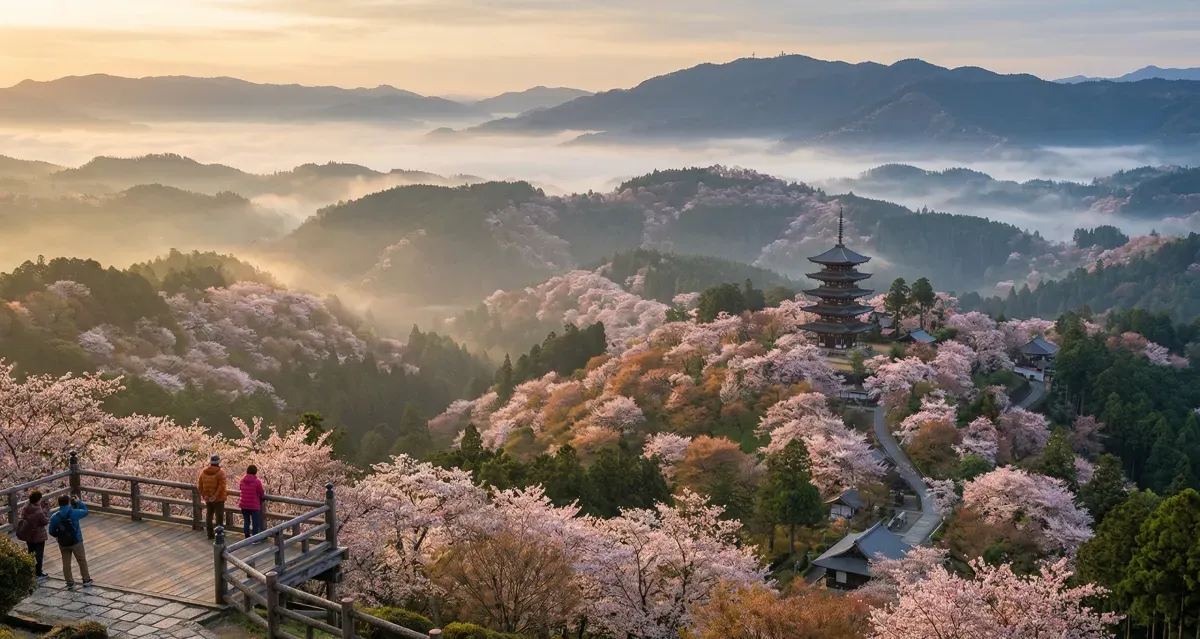
I first heard about Yoshino from a retired train conductor in Osaka who told me, with complete sincerity, that it was the only place in Japan where the mountains turn pink. He was not exaggerating. Mount Yoshino holds roughly 30,000 cherry trees planted across its slopes in four distinct zones, and when they bloom in sequence from the base to the summit, the entire mountain shifts color over the course of two to three weeks. I have seen cherry blossoms in Kyoto, Tokyo, and half a dozen smaller towns across Honshu. Yoshino is different. It is not a park with pretty trees. The whole mountain becomes the blossoms.
There is a specific moment - standing at the Hanayagura viewpoint around 6:30 in the morning, fog still sitting in the valley below, the Naka-senbon zone in full bloom at eye level - where you understand why Japanese poets have written about this place for over a thousand years. This is the original hanami destination. The tradition started here, centuries before anyone thought to picnic under the trees along the Meguro River.
The Four Zones of Mount Yoshino - and Why They Matter
Here is the thing most guides get wrong about Yoshino: they treat it as a single destination with a single bloom date. It is not. The mountain is divided into four zones - Shimo-senbon (lower), Naka-senbon (middle), Kami-senbon (upper), and Oku-senbon (inner) - and each blooms roughly three to five days after the one below it. This staggered pattern means the Yoshino cherry blossom season stretches from late March through mid-April, depending on the year.
Shimo-senbon, the lowest section near Yoshino Station, is where most day-trippers concentrate. Around Zao-do Hall, food stalls sell kuzumochi (a local kuzu-starch sweet, around 400 yen per serving) and sakura ice cream. The trees here are mostly Shiroyama-zakura, a wild mountain cherry variety with pale pink petals that open alongside copper-colored young leaves. Visually, it is subtler than the Somei Yoshino cultivar you see in Tokyo - less cotton candy, more watercolor.
Naka-senbon is where Yoshino hits its stride. The concentration of trees is highest here, and the famous Hanayagura lookout sits at the edge of this zone. If you have seen a photograph of Yoshino - thousands of pink and white trees rolling across a mountainside - it was probably taken from this spot. The walk from Shimo-senbon to Naka-senbon takes about 25 minutes at a comfortable pace, and the path passes through a stretch of old ryokan and small temples that smell like cedar and incense.
Kami-senbon and Oku-senbon require more effort. The trail steepens considerably, and by the time you reach Oku-senbon - the highest and most remote zone - the crowds have thinned to almost nothing. I spent an afternoon up here during my second visit, sitting on a bench near Nishi Gyoja-do temple with exactly three other people in sight. The silence was remarkable. Wind through cherry trees sounds different than wind through other kinds of forest. Lighter, somehow.
When Is the Best Time to Visit Yoshino for Cherry Blossoms?
Peak bloom at Yoshino typically falls between late March and mid-April, with Shimo-senbon opening first around March 28 and Oku-senbon reaching full bloom by April 12-15. These dates shift every year with temperature patterns, so checking the Yoshino cherry blossom forecast on sites like japan-guide.com or the Yoshino Town official page before booking is essential.
For the Yoshino cherry blossom 2026 season, early forecasts suggest a slightly earlier bloom than average, with Shimo-senbon expected to begin opening around March 25-28. Weekly updates from the Japan Meteorological Corporation begin in early March, and I would recommend checking their site starting around March 1. The best time to visit Yoshino Japan in 2026 will likely be the first week of April if you want to catch multiple zones in bloom simultaneously.
A counterintuitive tip: do not aim for absolute peak bloom. Seriously. The two or three days of mankai (full bloom) at any given zone are also the two or three days when the mountain is most crowded. I prefer to arrive when the lower zones are at 70-80% bloom and the middle zones are just opening. You get variety across the mountain, shorter lines at food stalls, and a better chance of snagging a room at one of the ryokan in Naka-senbon without booking three months ahead.
Early morning is non-negotiable. The ropeway (cable car) from Yoshino Station to the lower slopes opens at 7:40 AM during cherry blossom season. Be on the first car. By 10:00 AM, the main path through Shimo-senbon is shoulder-to-shoulder on weekends. Before 8:30? You will share it with photographers and monks.
A 3-Day Yoshino Itinerary That Actually Works
Day 1 - Arrival and Shimo-senbon
Take the Kintetsu Railway from Osaka-Abenobashi Station to Yoshino Station. The limited express takes about 1 hour 15 minutes and costs 1,500 yen (reserved seat). Arrive by early afternoon, then walk or take the ropeway (450 yen round trip) up to Shimo-senbon and orient yourself. Visit Kinpusen-ji temple - the main hall, Zao-do, is one of the largest wooden structures in Japan, and it looms over the lower slopes in a way that photographs never quite capture. The entrance fee is 800 yen, and it is worth every coin.
Check into your accommodation. If budget allows, the ryokan in the Naka-senbon area are extraordinary during cherry blossom season - many rooms look directly out onto blooming hillsides. Expect to pay 18,000-25,000 yen per person per night including dinner and breakfast. For something more affordable, several minshuku (guesthouses) near the station run 8,000-12,000 yen. Book early. I cannot stress this enough. Places fill up months in advance for peak season.
Spend the late afternoon walking the main approach road through Shimo-senbon. Grab a bag of kaki no tane (rice crackers) from one of the shops near Copper Torii gate. Find a bench. Watch the light change on the trees as the sun drops. This is what you came for.
Day 2 - Naka-senbon to Oku-senbon
Wake up early. Really early. Leave your accommodation by 6:00 AM if possible and head for the Hanayagura viewpoint before the crowds arrive. The morning light hitting Naka-senbon at this hour produces that specific pink-gold glow you have seen in every Yoshino photograph. Bring a thermos of coffee and give yourself at least 30 minutes here.
Continue uphill through Kami-senbon toward Oku-senbon. The full hike from Naka-senbon to the top takes about 90 minutes at a moderate pace. Fair warning - the last stretch to Oku-senbon is a proper mountain trail, not a paved path. Wear decent shoes. At the top, Kinpu Shrine sits quietly among the oldest trees on the mountain. The priests here sell small sakura-shaped omamori (protective charms) for 500 yen that make better souvenirs than anything in the tourist shops below.
On the way back down, stop at one of the small restaurants in Naka-senbon for lunch. Kakinoha-zushi - sushi wrapped in persimmon leaves - is the local specialty and genuinely delicious. A set of 8 pieces runs about 1,200-1,500 yen. The persimmon leaf imparts a faint woody fragrance to the rice that I have not found replicated anywhere else.
Ichimoku senbon - one glance, a thousand trees. That is what the Japanese say about the view from Hanayagura. Stand there once and you will understand it is not a metaphor.
Day 3 - Yoshino's Quieter Side
Most visitors do Yoshino as a day trip and miss the surrounding area entirely. On your third day, take a bus from Yoshino to Yoshino Mikumari Shrine (about 15 minutes, 300 yen). This Shinto shrine, a UNESCO World Heritage site, sits above Kami-senbon and sees a fraction of the foot traffic. The architecture is striking - a mix of styles accumulated over centuries, including a rare covered corridor connecting the main buildings.
If you have time, walk from there along the Omine Okugake trail for even just 30 minutes. The trail is part of the Kumano Kodo pilgrimage network, and once you are on it, the tourist buzz of Yoshino evaporates completely. Just forest, birdsong, and the occasional stone marker left by pilgrims centuries ago.
Catch an afternoon train back to Osaka or Nara. The Kintetsu line runs roughly every 30 minutes, so there is no rush. I would suggest a stop in Asuka village on the way back if your schedule allows - it is only 30 minutes from Yoshino and has some of the oldest historical sites in Japan, with almost no foreign tourists.
How Much Does a Trip to Yoshino Cost?
A 3-day trip to Yoshino from Osaka runs approximately 45,000-75,000 yen per person, depending on accommodation choices. Transport is around 3,500 yen round trip. The biggest variable is lodging - a ryokan with meals during peak bloom is a splurge, but sleeping in a room overlooking 30,000 cherry trees while eating kaiseki dinner is an experience I still think about years later.
Daily food costs are reasonable by Japanese standards. Expect 2,000-3,500 yen per day if you eat at local restaurants and street stalls. Temple entrance fees total about 1,500-2,000 yen if you visit the main sites. The ropeway is 450 yen round trip but optional - the walk up is pleasant and only adds 15 minutes. No admission fee for the mountain itself, which feels almost absurd given what you get.
Practical Tips for Yoshino Cherry Blossom Season 2026
Bring layers. Yoshino sits at elevation, and mornings in late March can hover around 5-8 degrees Celsius even when Osaka is already warm. By midday you might be in a t-shirt. The temperature swing catches a lot of people off guard.
The Yoshino tourist information office near the station has English-language maps and current bloom status boards updated daily. Staff speak some English. They can also help with same-day accommodation if you are stuck, though during peak bloom your options will be limited.
Cell signal is patchy on the upper mountain, especially around Oku-senbon. Download offline maps before you go. Google Maps works but does not capture all the smaller trails accurately - the paper map from the tourist office is genuinely better for hiking routes.
One mistake I see constantly: people trying to do Yoshino as a half-day trip from Kyoto. The train connection requires a transfer in Kashihara-jingu-mae and takes about 2 hours each way. By the time you arrive, walk up, take some photos, and head back, you have spent four hours on trains for two hours on the mountain. Give it at least a full day. Two or three if you can.
Mount Yoshino is a UNESCO World Heritage site as part of the Sacred Sites and Pilgrimage Routes in the Kii Mountain Range. This is not a theme park. The temples and shrines here are active places of worship, and the mountain itself holds deep spiritual significance. Keep noise levels reasonable, stay on marked paths, and do not break branches for photos. I watched someone snap a blooming branch off a tree for a selfie during my first visit and the look on a nearby priest's face was enough to make me want to apologize on behalf of all tourists everywhere.
For the Yoshino cherry blossom forecast 2026, bookmark the Yoshino Town official website and the Japan Meteorological Corporation's sakura forecast page. Updates become increasingly accurate from mid-March onward. The Yoshino Town tourism association also posts real-time photos to their social media accounts during bloom season, which is the most reliable way to gauge current conditions before your visit.
Map-o-World Editorial Team
Travel Research & Editing
Our guides are researched from official tourism sources, local operators, transport authorities and recent traveller reports, drafted with AI assistance and reviewed by our editors before publishing. Prices, opening hours and entry rules change often - please double-check before you travel, and tell us if you spot something out of date.
Read our editorial policy arrow_forward