Majuli Island 5-Day Itinerary: See It Before It Vanishes
What Five Days on a Disappearing Island Actually Feels Like
The ferry from Nimati Ghat takes about an hour, sometimes two if the river's being difficult. You'll share the deck with motorcycles, sacks of rice, a few goats, and travelers who look slightly nervous about the whole situation. The boat groans. The water is the color of milky tea. And when you step off at Kamalabari Ghat, the air hits you — thick, warm, smelling of wet earth and woodsmoke even in March.
Here's the thing: Majuli doesn't greet you with drama. No soaring cliffs, no turquoise lagoons. It's flat. Impossibly, stubbornly flat. Rice paddies stretching to the horizon, bamboo houses on stilts, dirt roads that turn to mud if you look at them wrong. The beauty here is quiet and it takes a day or two to recalibrate your eyes.
The island has shrunk from roughly 1,250 square kilometers in 1901 to about 352 today. That's not a statistic you read and forget once you're standing on the eroded banks watching chunks of earth calve into the Brahmaputra like slow-motion icebergs.
The Itinerary, Day by Day
Day 1 — Kamalabari and Getting Your Bearings
Rent a bicycle from your guesthouse. Most charge ₹100–150 per day (La Maison de Ananda and Ygdrasill Bamboo Cottage are both solid bases, roughly ₹800–1,500 per night). Cycle to Kamalabari Satra in the afternoon — it's the most accessible of Majuli's 22 surviving satras, the Vaishnavite monasteries that have defined this island's identity for five centuries, and the monks are used to visitors without being jaded by them. Evening prayer starts around 5:30 PM. Sit in the back, listen to the borgeet devotional songs, and let the rhythm settle into your bones.
Dinner will be simple. Dal, rice, some fish if you're lucky, maybe a pork dish with bamboo shoot that burns slow at the back of your throat. Don't expect menus. Expect warmth.
Day 2 — The Satras, Properly
This is your deep-dive day. Hire a local guide (₹500–800 for the full day) and visit Auniati Satra in the morning. The museum here holds centuries-old Assamese artifacts, royal utensils, and jewelry that would sit behind climate-controlled glass in any European institution but here rests in a wooden cabinet a monk unlocks with a regular key. Then head to Samaguri Satra, where you'll find the island's famous mask-making tradition. Artisans shape bamboo, clay, and cow dung into towering mythological masks that can take weeks to finish. You can watch them work. Don't rush this.
Afternoon: Dakhinpat Satra. Quieter, fewer visitors, better architecture. The prayer hall has aged teak columns that smell faintly of incense and centuries. The carved doorways are worth the ride alone.
Day 3 — Mising Villages and Ali Aye Ligang
March is when the Mising tribe celebrates Ali Aye Ligang, their spring festival marking the start of the agricultural season. If your timing lines up (dates shift slightly each year, usually mid-February to mid-March), you'll see traditional Gumrag dancing, rice beer flowing freely, and an entire community dressed in hand-woven textiles that took months to complete.
Even outside festival time, visiting a Mising village on stilts is essential. The chang ghors creak in the wind. Women weave on backstrap looms beneath the houses, producing textiles with geometric patterns in indigo and red. You can buy a handwoven mekhela chador for ₹800–2,000 directly from the weaver — no middleman, no markup.
Common mistake travelers make: trying to see everything by car or auto-rickshaw. The diesel engines shatter the quiet that makes Majuli what it is. Cycle or walk. Your legs will complain. Your memory won't.
Day 4 — Pottery, Erosion, and the Edges
Morning at Salmora village, where families have made pottery without a wheel for generations. They shape red clay with wooden paddles, dry the pots in the sun, then fire them in rice-husk kilns. The whole process takes about a week per batch. A simple pot costs ₹30–50. Buy one. It'll weigh almost nothing in your pack and remind you of the smell of warm clay and husk smoke for years.
After lunch, ride to the southern edge of the island. This is where erosion hits hardest. You'll see bamboo anti-erosion structures that look hopelessly inadequate against the scale of the Brahmaputra. Concrete embankments in various states of failure. Relocated families rebuilding further inland. It's sobering but important — you didn't come to Majuli to look away from this.
Day 5 — Sunrise and Departure
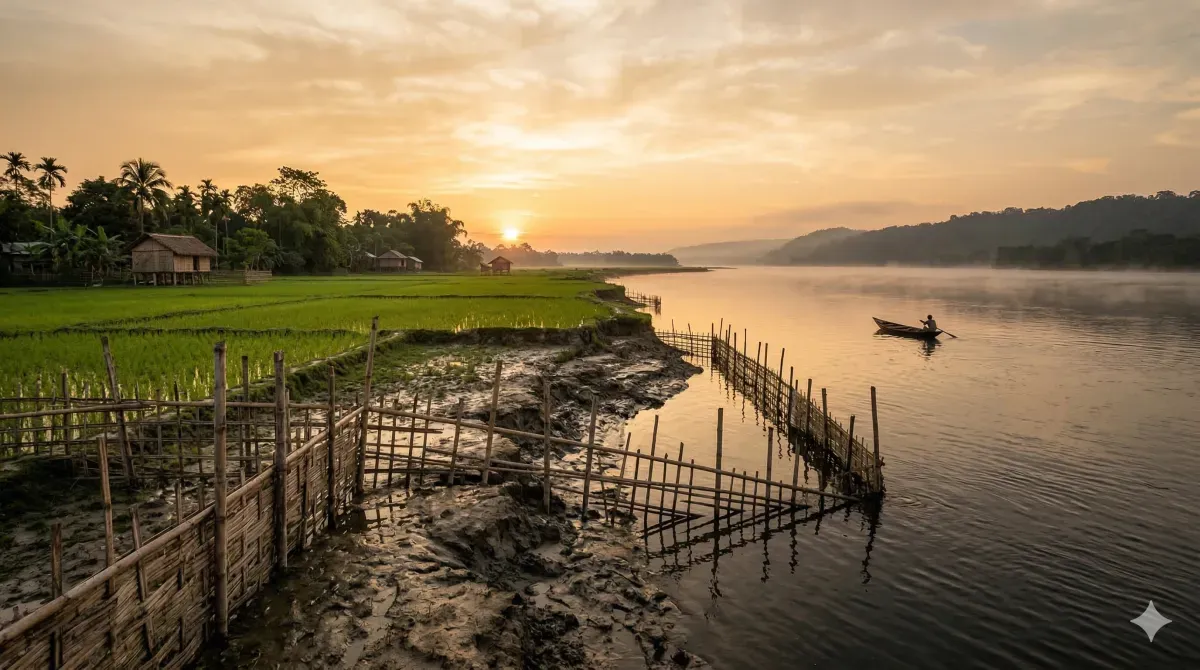
Wake at 4:30 AM. Cycle to the riverbank nearest your guesthouse. The sunrise over the Brahmaputra in March is slow and golden, the mist lifting off the water like the island is exhaling. No crowds. Maybe a fisherman casting a net in silhouette. The silence is so complete you can hear the current pulling at the sand.
"A river island doesn't die all at once. It just gets a little smaller every monsoon, and one day the maps have to be redrawn." — an Auniati Satra monk, over evening tea
Take the afternoon ferry back to Jorhat. The Nimati Ghat ferry schedule is loose — boats typically run between 9 AM and 3 PM, but confirm locally the day before. Don't cut it close.
What Most Travel Blogs Get Wrong About Majuli
Do not fly into Guwahati and try to reach Majuli the same day. It's a 6–7 hour drive from Guwahati to Jorhat, or a short flight to Jorhat airport (limited connections via Air India Regional and IndiGo). Build in a night in Jorhat. You'll need it, and the town has decent hotels near the airport for ₹1,200–2,500.
The best months are October through March. The island floods during monsoon season from June through September, and most guesthouses close entirely. March sits in a sweet spot: dry paths, green fields, comfortable days around 22–28°C, and the tail end of festival season when the island feels most alive.
Pack light. ATMs on the island are unreliable at best — bring cash from Jorhat, at least ₹3,000–5,000 for five days if you're staying budget. Airtel has the best mobile signal, though "best" is relative. Pharmacies are basic. If you need something specific, buy it on the mainland.
And honestly? Five days might feel like too many when you read an itinerary on a screen. On the island, surrounded by that particular Majuli silence — part river, part wind, part something you can't quite name — five days will feel like not nearly enough.
Map-o-World Editorial Team
Travel Research & Editing
Our guides are researched from official tourism sources, local operators, transport authorities and recent traveller reports, drafted with AI assistance and reviewed by our editors before publishing. Prices, opening hours and entry rules change often - please double-check before you travel, and tell us if you spot something out of date.
Read our editorial policy arrow_forward