Free Things to Do in Munnar During Monsoon: 2026 Guide
Quick answer: The best free thing to do in Munnar during monsoon is walking the old tea-estate footpaths above Nullatanni and Lockhart Gap, where mist sinks into the bushes by 7 am and no gate charges a rupee. Add the no-ticket Pothamedu viewpoint and the 1910 CSI Christ Church, and you have a full day for the price of chai.
Three British-era survey stones, knee-high and furred with green moss, mark the corner of a tea block above Lockhart Gap. My guide, Bibin, scraped the moss off one with his heel until the carving showed. 1897. He'd walked these lanes since he was nine, and he said the stones were here before his grandfather picked his first leaf. It was August 2024, the rain came sideways, and I had the whole hillside to myself.
Here's the thing about Munnar in the monsoon: the buses of selfie-takers thin out, the famous viewpoints fog over to a flat white wall, and the cheapest experiences quietly become the best ones. If you came for context and old stone rather than guaranteed blue-sky panoramas, July to September is your season. The munnar monsoon free things below are the ones I'd actually walk back to do again.
The Best Free Thing in Munnar This Monsoon: The Old Tea-Trail Walk
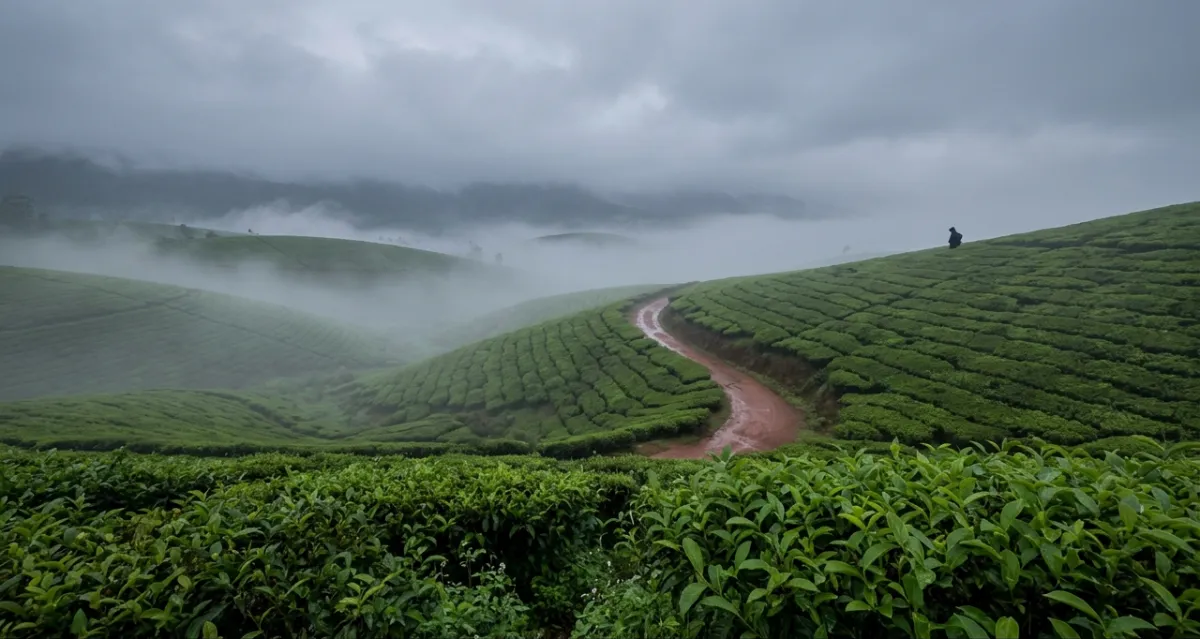
Start above the town on the Kannan Devan estate lanes, the maintenance footpaths that the pluckers use between blocks. These are not a manicured attraction. They are working roads of packed red laterite, and during the rains they run like shallow streams over your shoes. A munnar tea trail walk here costs nothing, opens whenever you can drag yourself out of bed, and rewards the early riser with the exact scene that floods Instagram every August: rows of clipped green bushes vanishing into grey cloud, a lone woman in a plastic cape stooping over the leaves.
For a culture buff, the payoff is the layering. You are walking on land the Scottish planter John Daniel Munro leased in the 1870s, on hills the Kannan Devan Hills Produce Company carved into a colonial machine, now run as an employee-owned estate. Bibin pointed out the older bushes, gnarled and waist-high, that he said were planted before Independence, and the squat stone culverts the British engineers cut to drain the slopes. None of it is signposted. That is the point.
'In the rain the tea drinks first, then us,' Bibin said, watching a plucker fill her basket. 'The hills only look like this three months a year. The rest is sun and tourists.'
Free Tea-Trail Walks and No-Ticket Viewpoints, One by One
Lockhart Gap to the 1897 Survey Stones
What it is: a 4 km stretch of estate road near Lockhart Gap, about 9 km south of Munnar town on the Adimali road, where you can walk straight into the tea blocks. When it's free: always, no gate, no ticket. The catch: leeches. I pulled four off my ankles in 90 minutes, and the rain means there is no dry hour to wait for. Wear long socks tucked into trousers, carry a small pouch of salt or tobacco, and check your shins every ten minutes. Worth it? Absolutely. Just don't wear white socks like I did.
Pothamedu Viewpoint at First Light
What it is: a roadside ridge about 4 km from town toward Idukki, looking over tea, cardamom and coffee slopes folding away to the south. When it's free: the viewpoint itself takes no ticket, unlike the manicured paid lookouts further out. The catch: there's a small parking charge if you arrive by car, I paid 30 rupees (about 35 cents), and after roughly 9 am the cloud usually swallows the whole valley. Go at 6:45 am. The light comes in low and silver for maybe 40 minutes before the mist closes the curtain, and you'll share the rail with two or three people instead of forty.
CSI Christ Church and the Old Tablets
What it is: a granite Anglican church on the hill above town, consecrated in 1910, with brass memorial tablets inside that read like a roll-call of the planting families who died young in these hills. When it's free: entry is free during daylight; a donation box sits by the door. The catch: it's a living parish, so check there's no service before you wander, and the interior is dim, bring no expectations of grandeur. For anyone who wants the human story under the scenery, 20 quiet minutes here beats any viewpoint. The teak pews still carry the names of estate managers.
The Pallivasal Tea Lanes Below Town
What it is: low-elevation estate paths near the Pallivasal hydro settlement, Kerala's first hydroelectric project from the 1930s, a short drive down from Munnar. When it's free: open lanes, no charge. The catch: it's less dramatic than the high ridges, and the engineering heritage is fenced and not open to casual visitors. Counter to the consensus: everyone tells you to chase altitude for the big monsoon views, but the low lanes stay clear of the worst whiteouts and put you eye-level with the pluckers. That's where the real photos are.
When is the best time to visit Munnar for free monsoon walks?
Mid-July to early September gives you the heaviest mist and the greenest bushes, the signature kerala monsoon viewpoints look. Walk between 6:30 am and 9 am, before the cloud thickens and the afternoon downpours arrive. Carry a real rain jacket, not an umbrella, the wind here turns umbrellas inside out within minutes.
One honest warning about the rhythm of the day. By late morning the valley often vanishes into a flat grey nothing, and the rain settles into a steady drum that doesn't lift until evening. I learned to treat mornings as the active window and afternoons as time for the Tea Museum, a long lunch, or the church. Plan around the weather, not against it, and the monsoon rewards you. Fight it and you'll spend three days sulking in a homestay watching water sheet off the roof.
Free Days at Munnar's Paid Attractions
Munnar does not run a formal free-admission day the way big city museums do, so don't go hunting for one. What you can do is time the paid sites for their cheapest, quietest version and lean on the genuinely free heritage instead.
KDHP Tea Museum
The Kanan Devan Hills Plantations Tea Museum is the one paid stop a history buff should still pay for. Entry was 220 rupees (about $2.60) in August 2024, and it's closed Mondays. You get the original 1900s tea-rolling machinery, a working demonstration, and the colonial photographs that make sense of every lane you walked that morning. There's no free day, but go on a wet weekday afternoon and you'll nearly have it to yourself. The factory tour smells of warm dust and cut leaf, a combination that stuck with me longer than any view.
For free alternatives to the ticketed lookouts, skip Echo Point and Top Station entirely in monsoon, see below, and use Pothamedu and the estate lanes. The trade-off is honest: you lose the railed convenience and the snack stalls, and you gain solitude and a hillside that doesn't ask for your wallet.
How much does a free day in Munnar actually cost?
Realistically, around 100 to 250 rupees, roughly $1.20 to $3.00. Parking at Pothamedu ran me 30 rupees, three glasses of strong cardamom chai from a roadside shack near the bus stand cost 15 rupees each, and the church donation was whatever I chose to drop. Everything else, the walking, the views, the survey stones, was genuinely free.
If you want a guide for the tea lanes, and a first-timer probably should for the leech-prone stretches, expect to pay 500 to 800 rupees for a half-morning. Bibin was worth every rupee for the history alone. Skip him only if you're confident reading estate paths and don't mind getting lost, which in fog is easier than it sounds. I took one wrong fork above Lockhart and spent 20 minutes walking back uphill in the rain, swearing quietly.
What's Free but Not Worth Your Monsoon Hours
Top Station. Everyone sends you there for the panorama into Tamil Nadu, and the viewpoint itself is free, but in July and August it's a wall of moving cloud nine mornings out of ten. I drove the 32 km up, paid for nothing, and stared at solid white for half an hour while a busload of damp honeymooners did the same. Save the petrol.
The roadside 'Photo Point' pull-offs are the other skip. They're free, sure, but they're just laybys with a tea backdrop and a man selling fridge magnets, and in the rain they turn to mud soup. You'll get a better, quieter version of the same shot 200 metres down any working estate lane. This monsoon trip is also not for you if you need guaranteed clear views, dry feet, or a packed itinerary of attractions, the season simply doesn't deliver those.
By my last morning the leeches had won twice and my one pair of trail shoes never fully dried. I sat on the church steps with a paper cup of chai going cold in my hand, watching the cloud climb back up the valley toward the 1897 stones, and decided the wet socks were a fair trade. Bring a second pair. You'll need them.
Map-o-World Editorial Team
Travel Research & Editing
Our guides are researched from official tourism sources, local operators, transport authorities and recent traveller reports, drafted with AI assistance and reviewed by our editors before publishing. Prices, opening hours and entry rules change often - please double-check before you travel, and tell us if you spot something out of date.
Read our editorial policy arrow_forward