Gion Matsuri Photography: 8 Best Kyoto Spots 2026
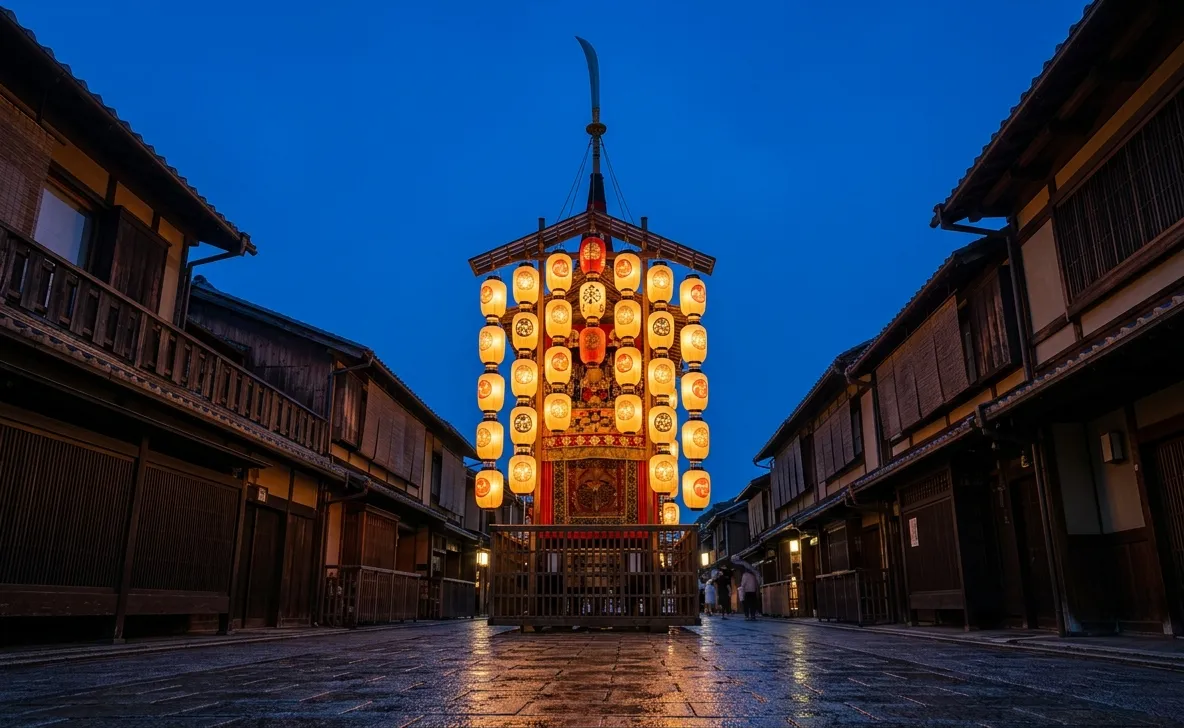
The shot to get at Gion Matsuri is the Naginata Hoko float glowing under 500 paper lanterns on Shijo Street around 7pm on July 16, the Yoiyama eve. For the July 17 Yamaboko parade itself, stand at the Shijo-Kawaramachi corner by 8:30am to catch the tsuji-mawashi wheel-turn. Soft, overcast light beats midday sun every time.
Twenty men leaned on wet bamboo poles and dragged twelve tonnes of 400-year-old float sideways across an intersection, one bamboo slat splitting under the iron-shod wheels with a crack like a rifle shot. The crowd went silent. Then it roared. My shutter was half-pressed and I still nearly missed the frame, because I was watching with my own eyes instead of the viewfinder. That is the real trap of Gion Matsuri photography: the thing in front of you is so old and so loud that you forget to work.
Last July I spent nine days in Kyoto shooting the festival end to end, in 34C heat and a humidity that fogged my lens every single time I stepped out of an air-conditioned konbini. What follows is where to stand, when the light turns, and which celebrated spot I would tell you to walk straight past.
When is the best time to photograph Gion Matsuri?
The strongest window is Yoiyama eve, July 16, from 6:30pm to 8pm, when the Yamaboko floats light their tiered lanterns and Shijo Street closes to cars. Parade day, July 17, peaks at the Shijo-Kawaramachi turn between 9am and 10am. Avoid the flat 11am-to-3pm sun completely.
Here is the thing most guides get wrong. They funnel everyone toward the July 17 procession, the Yamaboko Junko, and treat the eve as a warm-up. For a culture and history shooter it is the reverse. Parade day gives you moving floats against a wall of phone screens and 200,000 strangers. The eve gives you stationary floats, families in cotton yukata, and machiya townhouses with their fronts thrown open, the same tableau a photographer would have found in 1890. If you only have one night, spend it on the eve.
Each float spot, the light it wants, and how to reach it
1. Naginata Hoko at Shijo-Karasuma, lantern hour
The frame: the tallest hoko in the festival, a 25-metre spear-topped tower, framed head-on down Shijo Street as its lanterns ignite against a cobalt post-sunset sky. Best light is that 20-minute band around 7:10pm when the sky still holds colour and the paper glows warm. Wait for full dark and you lose the sky; the lanterns blow out to featureless dots.
How to get there: Karasuma Line subway to Shijo Station, 220 yen (about $1.40), then walk east. Arrive by 6:15pm to claim a spot on the north pavement. By 7pm you will not move.
2. The tsuji-mawashi turn at Shijo-Kawaramachi
This is the money shot of parade day, July 17. The floats have no steering. To pivot 90 degrees, the pullers lay wet bamboo strips under the wheels and wrench the whole tower around by brute force. It happens three or four times per float at this corner, roughly 9am to 10:30am. Shoot from the northeast side, a 70-200mm lens compressing the leaning bodies against the float. Overcast mornings are a gift here; direct sun throws hard shadows across the pullers' faces.
Getting there: Hankyu Kyoto Line to Kawaramachi Station, exit 9. Be barricade-side by 8:15am or you are shooting over heads.
3. Fune Hoko on Shinmachi Street
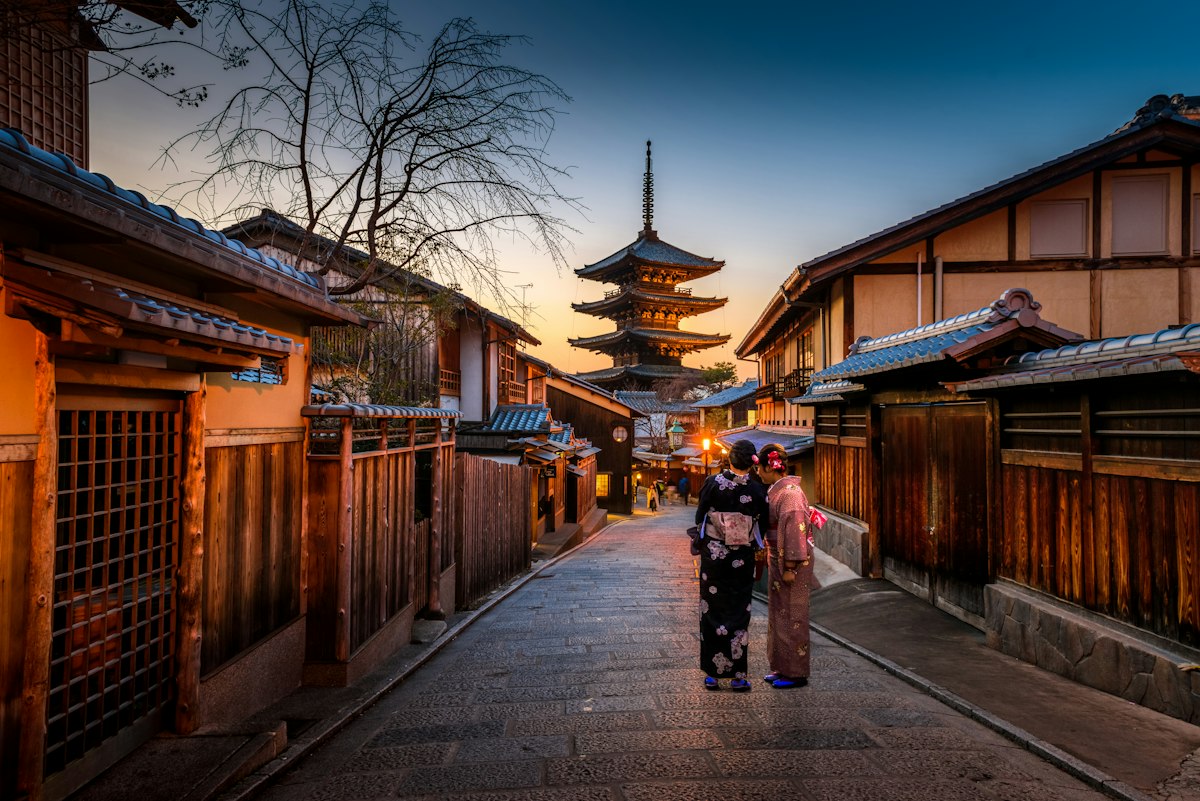
Everyone crowds Shijo. Slip one block south to narrow Shinmachi Street, where the boat-shaped Fune Hoko sits wedged between two-storey machiya, wooden lattice on both sides. The lane is tight enough that a 24mm lens fills the frame with float and old timber and nothing modern. Morning of July 16 gives soft directional light down the corridor before the crowds thicken around 10am.
4. Yasaka Shrine, the origin
The floats get the cameras, but the festival is really a 1,150-year-old plague-purification rite for the gods of Yasaka Shrine at the east end of Shijo. Shoot the three golden mikoshi portable shrines in the shrine forecourt, vermilion gates and stone lanterns behind them. Late afternoon, around 4:30pm on July 17, the low sun rakes gold across the lacquer. This is the context frame that turns a float snapshot into a story.
The angle almost nobody shoots: Ato Matsuri and the folding screens
Two things the July 16-17 mob misses entirely.
First, the Ato Matsuri, the second, smaller parade on July 24. Ten floats instead of twenty-three, maybe a fifth of the crowd, and the great Ofune Hoko rebuilt only a decade ago after 150 years gone. You can actually stand where you want. For a history buff who wants breathing room and the same tsuji-mawashi drama, this is the better day, full stop.
Second, the Byobu Matsuri, the Folding Screen Festival. On the eve nights, the old merchant families along Shinmachi and Muromachi streets slide open their townhouse fronts and display heirloom folding screens, some 300 years old, lit by a single warm bulb. Many are free to view from the street; a few interiors charge around 1,000 yen (about $6.50). Shoot from the pavement with a fast prime at f2.8, no flash, and you get an image of Kyoto's private history that not one tourist in a hundred bothers to frame.
An old float carpenter on Shinmachi told me, wiping his hands, "The float is not the festival. The float is how we remember the festival." Shoot the remembering, not just the wood.
Gear and settings that actually survive a Kyoto July
Two bodies if you have them, because you will not want to swap lenses in that humidity with dust and crowds. My working pair: a 24-70mm f2.8 for the lantern-hour street scenes and a 70-200mm f2.8 for compressing the parade pullers.
- Lantern hour (July 16 eve): 1/125s, f2.8, ISO 3200, and drop your white balance to about 3200K so the lanterns keep their amber warmth instead of going sickly yellow.
- Tsuji-mawashi turn: 1/500s to freeze the strain, f5.6, auto-ISO capped at 6400 on an overcast morning.
- Rain: Kyoto throws afternoon thunderstorms in July without warning. A simple rain cover saved my 70-200 on July 17 when the sky opened at 2pm.
Leave the tripod at the hotel. The eve streets are shoulder to shoulder and a tripod is both useless and rude; a monopod is tolerated at the edges. Bring a lens cloth and expect to wipe fog off the front element for the first ten minutes every time you leave a cooled building.
How much does Gion Matsuri photography access cost?
Almost nothing, and that is the honest answer. The eve streets and every float-turn corner are free. The subway across town is 220 yen (about $1.40) a ride. A konbini rice ball to eat standing in your spot runs 150 yen. Your only real cost is arriving early enough to hold ground.
Which brings me to the one thing I would tell you to skip: the paid reserved grandstand seats on Oike Street, around 4,100 yen (about $26) for parade day. They are fine for spectators. For photographers they are a trap. You are pinned to one fixed, elevated, straight-on angle, the floats pass at a distance, and you cannot get the low, tight, human frame of the pullers heaving at the wheel. I paid for a seat my first year and spent the whole time wishing I was down on the barricade for free. Never again.
Etiquette and access, so you do not become the ugly photographer
Do not touch the floats or the chimaki charm bundles the crews hand out; they are sold to support each neighbourhood's float and are not props. Stay behind police barriers at the turns, and never step into the intersection during a tsuji-mawashi, no matter how good the angle looks. The pullers cannot stop twelve tonnes for you.
If you photograph geiko or maiko near Yasaka Shrine, ask first or shoot wide and unobtrusive; harassing them for portraits has gotten whole streets closed to cameras. Stand where you block no one, keep your elbows in, and let the yukata families with kids in front.
Fair warning: this festival is not for you if you hate crowds or wilt in wet heat. July in Kyoto is punishing, the eve streets hit crush density, and there is no shortcut around either. But stand at the Shijo-Kawaramachi corner at 9am on the seventeenth, watch a 400-year-old spear-tower groan around on wet bamboo, and tell me your hands aren't shaking on the shutter.
Map-o-World Editorial Team
Travel Research & Editing
Our guides are researched from official tourism sources, local operators, transport authorities and recent traveller reports, drafted with AI assistance and reviewed by our editors before publishing. Prices, opening hours and entry rules change often - please double-check before you travel, and tell us if you spot something out of date.
Read our editorial policy arrow_forward