Naoshima Weekend Itinerary: Art Island on a Budget
Quick answer: A weekend on Naoshima suits budget backpackers who can rent a bike, sleep in a dorm, and book the big museums weeks ahead. Two days covers the new Naoshima New Museum of Art, the Art House Project, and a Kusama pumpkin or two for roughly 12,000-15,000 yen (about $80-100) all in, ferry included.
The woman at the Tsutsujiso reception looked at my bike and then at the sky. "Rain by four," she said, in September 2025, and she was right to the minute. I had built a whole naoshima weekend itinerary around clear light on the pier, and the Seto Inland Sea had other plans. That is Naoshima in two sentences: world-famous concrete and contemporary art, run on island time, weather that does what it wants. You adjust, or you sulk in a cafe paying 600 yen for an iced coffee.
I came for the buzz. The Naoshima New Museum of Art opened at the end of May 2025, Setouchi Triennale was mid-season, and the yen was weak enough that my dollar stretched like it was 2012. What I did not expect was how easy it is to do all of this cheaply, if you ignore most of the advice online.
Who should actually spend a weekend here?
This island rewards people who like looking at one Monet for twenty minutes and people who like riding a rattling rental bike between fishing villages. It does not reward people who need nightlife, vegetarians who refuse to plan, or anyone allergic to advance booking. Half the magic is timed-entry. Turn up unprepared and you will stand outside Chichu Art Museum watching ticket-holders walk in.
Backpackers do well here for one reason: the expensive part is the art, and you can ration the art. The cheap parts (the ferry, the bikes, the bathhouse, the convenience-store onigiri) are genuinely cheap. The naoshima art island budget question is really about which two or three museums you pay for and which you skip without guilt.
The hour-by-hour two-day plan
Day 1 - Ferry in, Honmura, and the new museum
Start at Uno port on the mainland. The ferry to Miyanoura runs roughly hourly, takes about 20 minutes, and cost me 300 yen (about $2). Coming from Takamatsu instead? That is around 520 yen and 50 minutes. Grab a window seat on the left for the first pumpkin sighting.
Off the boat, skip the queue at the official bike shop. Walk two minutes inland to a smaller rental place and grab a basic pedal bike for 500 yen a day, or an e-bike for around 1,500 yen. Get the e-bike. The island is small but the hill up to Benesse will humble you, and your calves are on holiday too.
Ride to Honmura, about 10 minutes east. This is where the Naoshima New Museum of Art sits, Tadao Ando's newest building on the island, all raw concrete and angled light. Admission ran me about 1,500 yen (roughly $10). Go in the late morning when the upper galleries catch hard sun through the slots Ando cuts into the walls. Give it ninety minutes. Then spend the early afternoon on the Art House Project, where seven old village houses have been gutted and turned into installations. The multi-site ticket is around 1,050 yen. Minamidera, the pitch-black James Turrell room, is the one. You sit in total darkness until your eyes invent a light that was there all along. My breath actually caught when the shape appeared.
Late afternoon, ride back toward Miyanoura. Dinner is a 150-yen onigiri and a tin of something from the convenience store, eaten on the seawall. End the night at the I Love Yu bathhouse, the technicolour public bath designed by artist Shinro Ohtake. Entry is 660 yen. There is an elephant statue mounted above the dividing wall between the men's and women's baths. You scrub off the day's sweat under it. Nowhere else does this.
Day 2 - Benesse, Chichu, and the pumpkins
Wake early. The first town bus climbs toward the Benesse area for 100 yen, or ride your bike if your legs forgive you. This is museum-heavy morning, so eat before you go; there is one cafe up there and it knows it.
Book Chichu Art Museum the moment your trip is confirmed. Timed slots sell out a week or more ahead in Triennale season. Admission is about 2,100 yen, and it is the priciest single thing I paid for. Inside, Ando buried the whole museum underground and lets daylight do the work. The Monet room, where you pad across thousands of tiny marble cubes in slippers, is silent in a way that made a German tourist next to me whisper an apology for breathing.
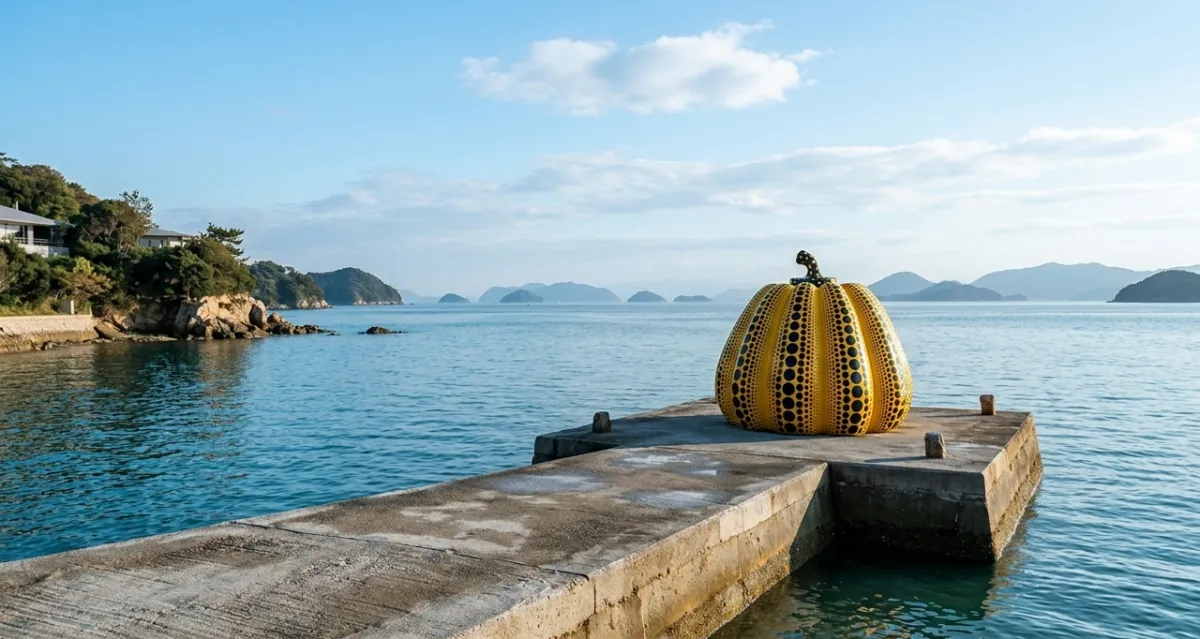
If the budget is tight, choose between Chichu and the Lee Ufan Museum (around 1,050 yen) rather than doing both. Then walk down to the Benesse House Museum (about 1,300 yen), where the art spills outdoors onto the coast for free. The yellow Kusama pumpkin sits at the end of a short pier here. Go at golden hour, an hour before sunset, when the dots glow and the crowds thin to a handful. That is the shot.
Catch the late-afternoon ferry out, or stay one more night if your schedule allows. The last boats leave earlier than you think, often before 7pm, so check the printed timetable at the terminal, not a blog from 2019.
"The art doesn't move. You have to." - a bike-rental owner in Miyanoura, after I asked why nothing on the island has proper signage.
The one thing to prioritise above everything
If you do nothing else, sit inside an Ando building and let it work on you. The Naoshima New Museum of Art is the freshest reason to come right now, but the principle holds across Chichu and Lee Ufan too: these are not rooms with art in them, they are the art. Most visitors rush through chasing the pumpkin photo and treat the architecture as a hallway. They have it backwards.
Here is the counter-consensus bit. Everyone tells you Chichu is the unmissable one. It is extraordinary, yes. But the new museum is less mobbed, cheaper, and you can actually linger without a guard moving you along. For a backpacker counting coins, it delivers more minutes of awe per yen than anything else on Naoshima in 2025.
What to drop when the clock is against you
Two days is tight, so cut without mercy. The Ando Museum in Honmura is small and, honestly, skippable if you have already seen his bigger buildings; it is more shrine-to-the-architect than essential. Teshima, the neighbouring island with the famous water-droplet museum, deserves its own day trip and will wreck a 48-hour plan. Leave it.
I would also skip eating at the sit-down restaurants near Benesse. A set lunch there nudged 1,800 yen for something I would forget by dinner. The convenience-store and bakery route in Miyanoura is half the price and frees up your museum budget. One thing I would never drop: the bathhouse. It is the cheapest piece of art on the island and the only one you can soak in.
Where to stay central on a hostel budget
Stay in Miyanoura. It is the ferry hub, has the only real cluster of cheap food, and puts you minutes from your morning boat. Tsutsujiso is the legendary budget pick: you can sleep in a Mongolian yurt for around 3,500-4,000 yen, or a basic dorm bunk for a little less. Book months ahead in Triennale season or you will not get in. Naoshima hostels fill fast and the island has very few beds.
For a more standard dorm, look at the guesthouses dotted between Miyanoura and Honmura, generally 3,000-5,000 yen a night. The trade-off is that nothing here is dirt cheap by Japanese standards; the island knows its worth. If beds are full, the genuinely lesser-known move is to sleep on the mainland in Uno or Takamatsu, where business hotels run 4,000-6,000 yen, and ferry over each morning. You lose the evening island quiet. You save money and you always get a bed.
How much does a Naoshima weekend cost on a budget?
A lean two-day trip runs about 12,000-15,000 yen ($80-100), not counting travel to the region. That breaks down to roughly 600 yen of ferries, 1,500 yen for a bike, two nights at 3,500-4,000 yen, three museum tickets around 4,500 yen total, the 660-yen bathhouse, and convenience-store food at maybe 1,500 yen a day.
When is the best time to visit Naoshima?
Late spring and autumn, especially during the 2025 Setouchi Triennale autumn session running through November. Weekdays beat weekends for crowds. Avoid Mondays, when several museums and many island spots close. Summer is hot and humid; winter is quiet but some venues cut their hours.
One last practical note from the rain that owner predicted: pack a light shell and treat the ferry timetable like scripture. I missed a boat by four minutes once, sat on the seawall for fifty more, and watched the yellow pumpkin go dark across the water. Not the worst place to be stuck.
Map-o-World Editorial Team
Travel Research & Editing
Our guides are researched from official tourism sources, local operators, transport authorities and recent traveller reports, drafted with AI assistance and reviewed by our editors before publishing. Prices, opening hours and entry rules change often - please double-check before you travel, and tell us if you spot something out of date.
Read our editorial policy arrow_forward