Bukit Lawang Orangutan Trekking: Ethical 2026 Guide
Quick answer: book a small-group, no-feeding trek with an HPI-licensed local guide, hold a 7-metre distance from every orangutan, and sleep at a community-run lodge such as Green Hill or Sumatra Ecotravel. A full day runs about IDR 1,350,000 (around $84), plus the IDR 150,000 park permit. That single guide choice decides everything else about ethical bukit lawang orangutan trekking.
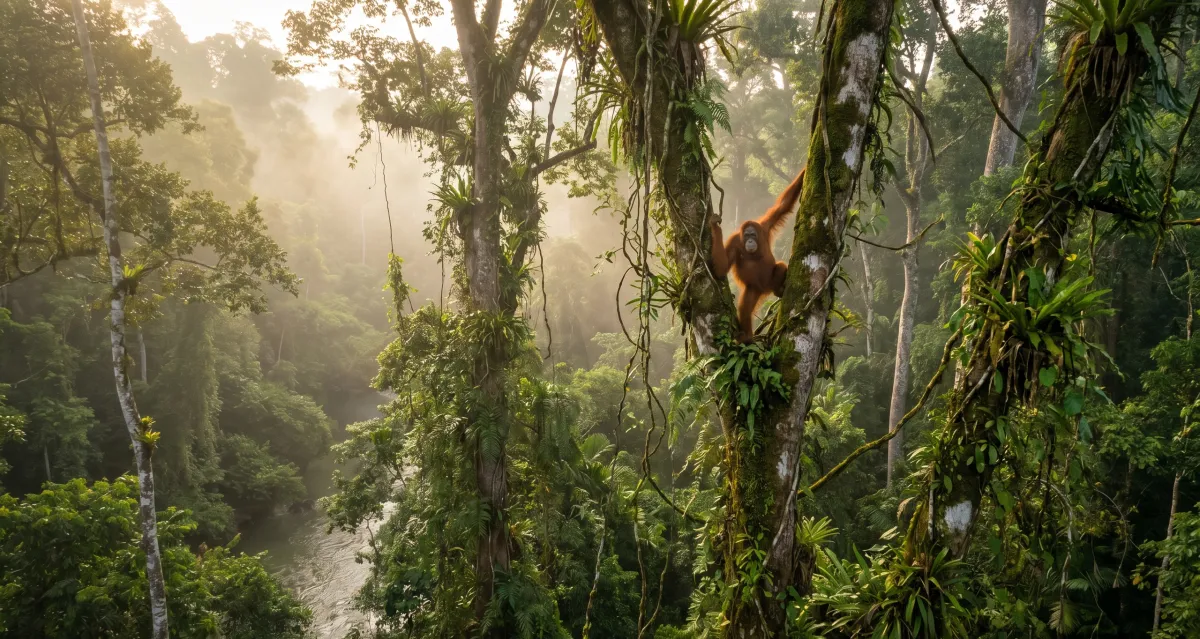
Mina came down the trunk faster than I could step back. She is a rehabilitated female with a long memory and a shorter temper, and on the morning of 14 September 2025 she decided my guide's daypack looked like breakfast. He did not feed her. He stood still, talked low, and walked our group of four sideways off the ridge while she huffed and rocked the branch above us. My pulse was loud in my ears. The forest smelled of wet bark and crushed ginger.
Here is the thing about this village on the river: the orangutans are wild, but some are semi-wild, descended from a 1970s rehabilitation station, and a few have learned that pink-skinned tourists sometimes mean bananas. Bad guides exploit that shortcut. Good ones spend the entire walk keeping you from becoming the next easy meal. The difference is not subtle, and it is the whole story.
The one choice that outranks everything: who walks you in
Pick the guide before you pick the dates, the lodge, or the camera lens. A licensed guide carrying no fruit, working a group of four or fewer, will give you a wilder, safer, and frankly better day than any "guaranteed sighting" package sold off a chalkboard near the river crossing.
Every legitimate guide here holds a card from the HPI, the Indonesian guides association, and is registered with the park office. Ask to see it. Ask, plainly, whether they feed or call orangutans closer. A good one will look mildly offended. My guide, Edi, runs with Sumatra Ecotravel and quoted IDR 1,350,000 for a full day in 2025; he turned us around twice rather than crowd a mother and infant feeding 20 metres off the trail. We watched her for eleven minutes from cover and left her eating. That restraint is what you are paying for in responsible jungle trekking.
Edi said it best, halfway up a root-tangled slope: "If the orangutan comes to you, you are doing it wrong."
Skip the IDR 250,000 half-day "orangutan guaranteed" trek near the entrance. Those sightings happen because the apes loiter where food has trained them to wait, and the crowds there can hit fifteen people around one stressed animal. You came for Gunung Leuser eco travel, not a petting zoo with a canopy.
Is it ethical to see orangutans in Bukit Lawang?
Yes, if you trek with a no-feeding guide, keep your distance, wear a mask near the apes, and skip operators who bait. Disease transfer and food-conditioning are the real risks here, not the act of watching. Your behaviour and your guide's ethics decide whether your visit helps the population or harms it.
Orangutans share roughly 97 percent of our DNA, which means a human cold can kill one. I carried surgical masks and put one on the moment we got within sight of any ape; Edi did the same without being asked. We never sat closer than seven metres, never blocked a travel route through the canopy, and never let anyone pull out a banana for a photo. The everyone-says line is that feeding gets you a guaranteed close encounter. What that misses: food-conditioned females like Mina and the late, famously aggressive Jackie have bitten tourists, and conditioned apes lose the wariness that keeps wild ones alive.
Where your rupiah actually lands
Money leaks out of tourism towns fast, usually into someone else's bank account three cities away. Bukit Lawang is small enough that you can watch where yours goes, and steer it.
Book direct with a village-based operator instead of an online aggregator that skims 20 to 30 percent. Sumatra Ecotravel, Green Hill, and a handful of family-run outfits hire local porters, cooks, and guides, and several plough a cut into reforestation and trash collection along the Bohorok. When I added a second night, the cook, Ibu Lia, made nasi goreng with foraged forest fern over a fire at the riverside camp; that IDR 120,000 dinner paid her, not a chain. Buy your sarong and carved napu from the stalls past the mosque, not the first three by the bridge that sell the same factory goods.
- Tip porters directly and in cash, IDR 100,000 to 150,000 per day is fair and lands in the right hands.
- Eat at warungs run by families, not the two riverfront cafes with English-only menus and double prices.
- Ask your guide which lodge funds the local school or the river clean-up. They know exactly who does and who only claims to.
Fair warning: a "community" label gets slapped on plenty of businesses owned by one well-connected family. Asking who employs whom, and where, sorts the genuine from the marketing in about two questions.
How much does orangutan trekking in Bukit Lawang cost?
Budget IDR 1,350,000 to 1,600,000 (about $84 to $100) for a guided full day, plus a IDR 150,000 daily park permit for foreigners. A two-day, one-night jungle camp runs IDR 2,200,000 to 2,800,000 including meals and a river-tube exit. Half-day treks are cheaper but cluster in the food-conditioned zones, so they are not worth it.
Prices held steady through 2025 and barely moved going into 2026. Cash is king here; the one ATM in the village ran dry the afternoon I needed it, so I paid Edi in rupiah I had pulled in Medan. Bring more than you think. The two-day camp is genuinely better value if your knees can take it, because the deepest, quietest sightings happen in the second hour out, well past where day-trippers turn back.
Getting in slow, and where to actually sleep
The village sits about 85 km from Medan's Kualanamu airport, a 3.5 to 4 hour drive on a road that alternates between palm-oil plantation and potholes. Your transport choice is also an emissions choice, and the slow option is the cheap one.
A shared tourist shuttle costs IDR 175,000 to 200,000 per seat and most lodges arrange it. The lower-impact, lower-cost route is the public bus from Medan's Pinang Baris terminal toward Bukit Lawang, around IDR 45,000, but it crawls for five hours and stops constantly. I did the shuttle on the way in, exhausted, and the public bus out, curious; the bus gave me a chicken farmer for a seatmate and a far better look at the country between the towns. Private cars run IDR 600,000 to 750,000 and split nicely between four.
For stays, cross the river. The bungalows on the main strip get road and generator noise; the quieter rooms sit on the far bank, reached by a swaying footbridge. I paid IDR 350,000 a night for a riverside room at a community-run place with a fan, a cold-water bucket shower, and a balcony where Thomas leaf monkeys raided the papaya tree at dawn. On The Rocks and Green Hill book out in peak weeks, so reserve ahead for July through October. This is not a destination for anyone who needs air-conditioning, a lift, or a flat dry path; the trails are steep, root-laced, and slick.
When is the best time to trek Gunung Leuser?
July to October is the strongest window for sumatra responsible jungle trekking. The forest is greener after early rains, fruiting trees draw orangutans lower and make them easier to spot, and the heaviest downpours of November and December have not yet arrived. Trails stay muddy but passable, and primates are noticeably more active.
The standard advice tells you to chase the driest months, full stop. What that overlooks: orangutans follow fruit, not tourist calendars, and the shoulder of the wet season often delivers more movement in the canopy than the parched peak of dry season. The trade-off is leeches and afternoon rain, both of which I met. Leech socks cost IDR 60,000 in the village and saved my ankles; pack them.
What "eco" actually buys you here
The word "eco" gets painted on signboards the way "fresh" gets stamped on bread. In Bukit Lawang it can mean a lodge that composts, hires locally, and limits group sizes, or it can mean a guy who printed a green leaf on his card. There is no binding certification policing it, so you have to test the claim yourself.
Real markers are concrete and checkable. Group sizes capped at five or six. Guides who refuse to feed or bait. A pack-in, pack-out trash policy you actually watch them follow. A cut of fees going to the local conservation fund or the orangutan monitoring teams. I asked four operators the same question, what does your eco label fund, and two gave specifics about river clean-ups and tree planting while two went vague and changed the subject. Trust the specific ones.
This guide is not for travellers who want a tidy zoo encounter on a schedule. It is for people willing to walk two sweaty hours, mask up, keep their distance, and accept that the best sighting might be a mother and infant 20 metres off, eating, indifferent to you. Worth it? On that ridge, watching Mina decide we were not worth the trouble and turn back into the green, my legs were shaking and I was grinning like an idiot.
Bring the leech socks. Carry small rupiah. And when a guide reaches into his bag for fruit, walk away and find another one.
Tags
Map-o-World Editorial Team
Travel Research & Editing
Our guides are researched from official tourism sources, local operators, transport authorities and recent traveller reports, drafted with AI assistance and reviewed by our editors before publishing. Prices, opening hours and entry rules change often - please double-check before you travel, and tell us if you spot something out of date.
Read our editorial policy arrow_forward