
Wheelchair Accessible Athens: Acropolis Lift Guide
Yes, you can reach the Acropolis in a wheelchair. A lift on the rock's north face plus a regraded 80-meter access path bring you to the Parthenon terrace, entry is free for disabled visitors and one companion, and the Acropoli metro station has a working elevator. The catch is the gradient and the cobbles, not the lift itself.
October 2025. I watched a man in a power chair roll within twenty meters of the Parthenon while a tour group from Ohio stood gawking, half of them whispering that he must have been carried up the sacred rock. He hadn't. He took the lift on the north face, the same morning I walked the new path beside him, and he reached the temple terrace before the tour group had finished arguing about audio guides.
Here's the thing about wheelchair accessible Athens: the headline is true, the details are where trips go sideways. This guide is for the history buff who came for the Periclean building program and the bones of the Erechtheion, not the beach bars on the islands you'll catch later. If you want a smooth, frictionless city, Athens is not for you. If you want the Parthenon and you're willing to plan around marble and slope, read on.
Is the Acropolis wheelchair accessible? The honest answer
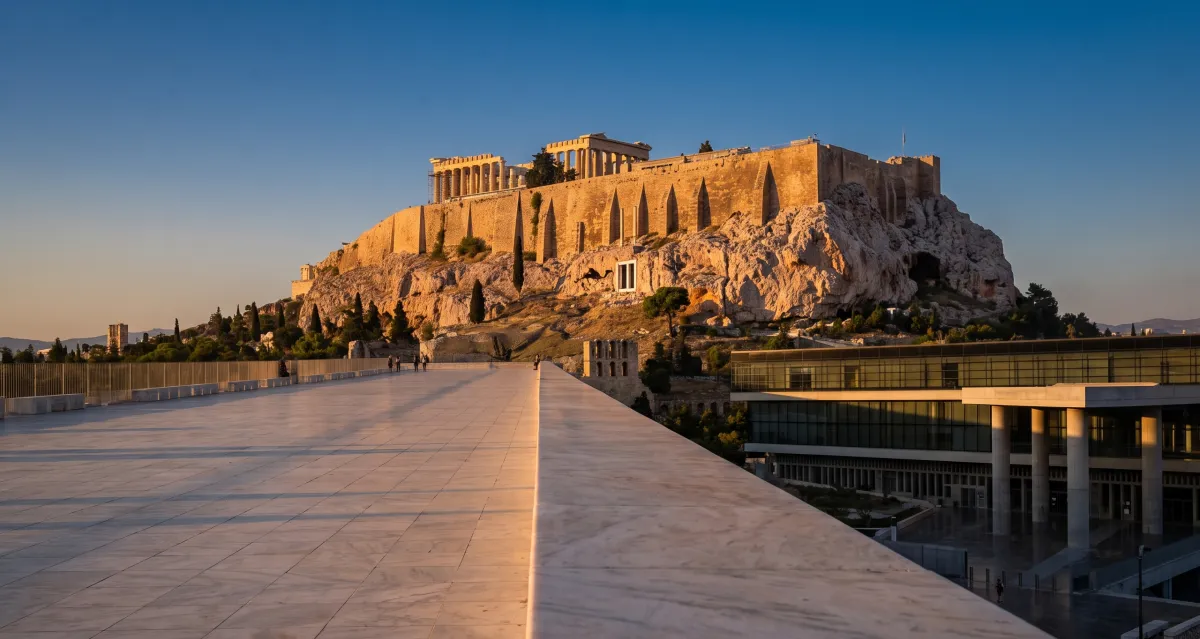
The Acropolis is genuinely wheelchair accessible via a glass-walled lift on the north slope and a wider, regraded path opened in late 2021. Entry costs nothing for disabled visitors plus one companion. You roll to within touching distance of the Parthenon's east facade. What stops some people is the slope, not the structure.
The lift sits off the main Theatre of Dionysus entrance, not the busy west ramp where everyone queues. You call ahead or ask a guard, and a staff member operates it. It carries one chair at a time. When it works, it's a two-minute ride that bypasses the entire climb. When it doesn't, you're stuck, and it does break, so I'll come back to that. The Acropolis lift access point also reaches the upper plateau where the new concrete path runs to the Parthenon and the Erechtheion porch.
That path drew fury from archaeologists in 2021 who said the poured concrete cheapened a 2,500-year-old site. I get the argument. Stand on it, though, watching someone reach the Parthenon for the first time, and the purist position feels thin. The surface is firm, even, and the only reason a manual-chair user can cross the plateau without a helper soaked in sweat.
Fair warning: the approach to the lift climbs at roughly a 12 percent grade in places. Manual users will want a companion or a power assist for that stretch. My friend's lightweight chair fought him the whole way up Dionysiou Areopagitou before we even reached the rock.
Getting around: Athens metro, taxis and the step-free reality
The Athens metro is your best friend and your occasional betrayer. Lines 2 (red) and 3 (blue) have lifts at most stations, including Acropoli, Syntagma, and Monastiraki, the three you'll use most as a history buff. A single ticket runs 1.20 EUR, about $1.30, and a 24-hour pass is 4.10 EUR, around $4.50. Acropoli station deposits you a flat, marble-paved 400 meters from the south entrance.
How do you get around Athens in a wheelchair?
Use the metro for distance and taxis for the gaps. Lines 2 and 3 have station lifts and level boarding; Line 1, the old green line, mostly does not. For door-to-door, book an accessible taxi through Athens Disabled Access or a WAV via the Taxiplon app, since standard street taxis rarely take a non-folding chair.
Skip the trams for sightseeing. They're technically low-floor, but the routes hug the coast toward Piraeus and the suburbs, useless for the ancient core. Buses 040 and 230 reach the historic center and most kneel with ramps, though the ramp deployment is hit or miss and I waited through two full buses on Amalias Avenue before a driver actually lowered one. The metro never made me wait like that.
One counter-consensus point: every accessibility blog tells you to base yourself near Syntagma for the metro. Syntagma's lift is deep, slow, and mobbed at rush hour. I found Acropoli and Monastiraki stations faster and far less crowded, and they put you closer to the ruins anyway.
Step-free history: museums and sites that actually deliver
The Acropolis Museum is the best-designed accessible building in the city and the single reason a history buff should pin this trip. Lifts reach all three levels, the staff lend wheelchairs at the cloakroom for free, and you roll across glass floors suspended over a live excavation of an ancient Athenian neighborhood. The top-floor Parthenon Gallery frames the temple through full-height glass, the marbles arranged to match the building you just visited. Entry is 15 EUR, about $16.50, and free for disabled visitors.
Give yourself two hours minimum. The light hits the Parthenon Gallery best in late afternoon, roughly 5 to 7 pm in October, when the low sun rakes across the frieze casts and the real temple glows orange through the glass. I sat there until a guard gently moved me along at closing.
The Ancient Agora is partially accessible. The main gravel paths are firm and flat near the reconstructed Stoa of Attalos, which has a lift and houses a small museum of pottery and the bronze ballots used to ostracize politicians. Roll to the Stoa, study the democracy artifacts, and accept that the Temple of Hephaestus up the slope is a rough, stony pull that defeated my friend's chair. Worth it for the Stoa alone? Absolutely.
A guard at the Agora told me, "The stones do not change for anybody. You change how you come to them." He meant it practically. He was right.
The National Archaeological Museum, a 15-minute taxi from the center, has lift access throughout and the Antikythera Mechanism, the 2,000-year-old bronze computer that no photo prepares you for. Cool, quiet, step-free, and far less crowded than the Acropolis Museum. If you read one room, read the Mycenaean gold.
The obstacles nobody warns you about
Plaka looks step-free on a map and lies to you in person. The lower streets near Adrianou are paved and manageable, but the famous lanes climbing toward Anafiotika turn to broken marble, loose cobbles, and stairs with no warning. I'd skip Anafiotika entirely in a chair. It's all steps cut into the rock, gorgeous and completely impassable, and pushing for it only ends in a dead-end turnaround.
Marble is the real enemy. Athens paves its pedestrian streets, including the grand Dionysiou Areopagitou promenade below the Acropolis, in marble slabs polished glass-smooth by a century of feet. Dry, they're fine. After the first autumn rain in October, they turn to ice. My friend's brakes barely held on a gentle downhill near the Herodion theatre, and I had to spot him the rest of the way.
- The Acropolis lift breaks down with no published schedule. Call the site or your hotel concierge the morning of your visit to confirm it's running before you commit the trip.
- Dropped curbs are inconsistent. Whole blocks around Plaka have none, forcing long detours to find a ramp.
- Summer heat is brutal. August afternoons hit 38 C, about 100 F, and the Acropolis rock has almost no shade. Aim for opening at 8 am or the last two hours before close.
- Sidewalk parking is a plague. Cars block narrow pavements constantly, pushing you into the road.
This trip is not for someone who needs guaranteed, predictable surfaces every meter of the day. It rewards flexibility and a companion. Solo power-chair users can absolutely do it, but build in slack and a backup plan for the lift.
Where to stay: accessible hotels within rolling distance of the ruins
Base yourself in the flat zone between Syntagma and the Acropolis so the metro and the ancient sites are both a short, level roll away.
Where should wheelchair users stay in Athens?
Stay in Plaka's flat lower edge or near Syntagma for step-free access to the metro and the Acropolis Museum. Electra Metropolis and AthensWas offer accessible rooms with roll-in showers and Acropolis views, while the Grande Bretagne delivers full luxury accessibility. All three sit on paved, level ground within a kilometer of the rock.
Electra Metropolis is my pick for the history buff on a mid-range budget. Accessible rooms run around 220 EUR a night, about $242, in shoulder season, and the rooftop bar looks straight at the floodlit Parthenon. The lobby lift and bathrooms are genuinely roll-in, not the token "accessible" room with a 4-inch shower lip I've cursed elsewhere in Europe.
AthensWas, on Dionysiou Areopagitou itself, puts you on that smooth marble promenade with the Acropolis Museum 300 meters away. Rooms from roughly 280 EUR, about $308. For a splurge, the Hotel Grande Bretagne on Syntagma has the best-trained accessibility staff in the city and a price to match, north of 450 EUR a night.
The lesser-known trade: book a serviced apartment in Koukaki, the residential quarter just south of the Acropolis Museum. Streets are flatter and quieter than Plaka, prices drop to 90 to 120 EUR a night, and you're a level 600-meter roll from the south slope. The trade-off is fewer staff to help if a lift or a doorway surprises you. I'd take that deal for a four-night stay, and I'd take the morning coffee at a Koukaki bakery over a hotel buffet every time.
Map-o-World Editorial Team
Travel Research & Editing
Our guides are researched from official tourism sources, local operators, transport authorities and recent traveller reports, drafted with AI assistance and reviewed by our editors before publishing. Prices, opening hours and entry rules change often - please double-check before you travel, and tell us if you spot something out of date.
Read our editorial policy arrow_forward