Jaisalmer 3-Day Itinerary From Delhi | Under Rs 15,000
A 3-day Jaisalmer itinerary from Delhi costs about Rs 10,000-13,000 per person in October-November: Rs 2,500 for a 3AC return train, Rs 600 for a guesthouse night, Rs 2,000 for a Sam sand dunes desert camp with dinner and camel ride, and roughly Rs 5,000 on food, autos, havelis and safaris. Easily under Rs 15,000.
Here's the thing about Jaisalmer: almost everything that makes it worth the trip is either free or costs less than a Delhi brunch. The fort has no ticket. The lanes inside it have no ticket. Gadisar Lake at sunrise has no ticket. What eats budgets is the desert camp, and even that drops to sensible money once you stop booking through the first Instagram ad you see. Prices are approximate as of August 2026, and they climb sharply over Diwali week, so book the train and the camp early.
This plan works for a couple, two friends, or a family that does not mind an upper berth. It assumes you leave Delhi on a Thursday evening, spend two nights in Jaisalmer, and board the return train on Sunday afternoon. Three full days on the ground, one office leave, done.
Getting There From India - Delhi to Jaisalmer by Train and Flight
The overnight train is the whole reason this trip fits the budget. Train 14659, the Delhi-Jaisalmer Runicha Express, departs Delhi Sarai Rohilla around 5:45 pm and reaches Jaisalmer close to 11:00 am the next morning. Sleeper class costs about Rs 480, 3AC about Rs 1,250, and 2AC about Rs 1,750. Check NTES for the exact timetable because Indian Railways tweaks this route every season, and book on IRCTC the day reservations open (60 days out) if you are travelling over Dussehra or Diwali. The return, train 14660, leaves Jaisalmer in the late afternoon and drops you at Sarai Rohilla the next morning in time for a quick shower before work.
Regulars on this route have a firm opinion: take 3AC in October and sleeper only from mid-November. The Thar stays warm after dark well into autumn, and a sleeper coach at 9 pm near Bikaner feels like a tandoor on wheels. By December the same coach is the opposite problem and you will want the railway blanket anyway.
Flights exist but break the maths. IndiGo flies Delhi-Jaisalmer nonstop in the winter season only, typically from October to March, and fares run Rs 5,500-9,000 one way. If you have the money and only two days, fly in and train back. For everyone else, the train is not a compromise. It is the best part of the first night.
How much does a Jaisalmer trip cost from Delhi?
Budget Rs 10,000-13,000 per person for 3 days from Delhi. The biggest fixed items are the 3AC return train (Rs 2,500) and one night at a Sam desert camp (Rs 1,800-2,500). Everything else - guesthouse, vegetarian thalis, autos, haveli tickets, a jeep safari - adds up to about Rs 5,500 if you are not reckless.
The version that costs more looks like this: a Rs 4,000 luxury camp tent, a private taxi to Sam at Rs 2,500, rooftop dinners at Rs 800 a head. Nice, but unnecessary. The version that costs less means sleeper class both ways and a Rs 1,200 camp, which gets you to about Rs 8,000. The Rs 15,000 headline leaves a Rs 2,000-4,000 cushion for a silver anklet at Sadar Bazaar or the rooftop beer your friends will demand.
Day 1 - The Living Fort, Three Havelis and Gadisar at Dusk
You step off the train into a station that smells faintly of diesel and frying kachoris. Ignore the taxi touts on the platform. Walk out to the road and take a shared auto to the fort area for about Rs 50, or a private one for Rs 120. Drop bags at your guesthouse first. The good budget ones cluster around Gandhi Chowk, the fort's lower lanes, and the Dhibba Para neighbourhood, with double rooms at Rs 900-1,400 a night. Split between two, that's Rs 600 each with a rooftop view of the fort for breakfast.
Then climb. Jaisalmer Fort, locally Sonar Qila, sits on Trikuta Hill and you enter through four successive gates - Akhai Pol, Suraj Pol, Ganesh Pol and Hawa Pol - each one a little tighter than the last. Entry is free because some 3,000 people still live inside. The lanes are barely wider than a cow, and a cow will confirm this by blocking one at exactly the moment you arrive. Morning light hits the yellow sandstone and the whole fort goes the colour of a ghee-soaked laddoo.
Inside, the seven Jain temples are the single best thing in the fort and most day-trippers skip them. The Parsvanath and Rishabhdev temples, built between the 12th and 16th centuries, have carving so dense it looks like lace. Timings for non-Jain visitors are roughly 8 am to 12 noon, with a nominal entry of Rs 50-100 and a camera fee on top. Leather belts and shoes come off at the door. Go before 10 am while the stone is cool under your feet.
Lunch is where Jaisalmer makes vegetarian travellers very happy. Nearly every local dish is meat-free by default: ker sangri (dried desert beans and berries cooked in curd and chilli), gatte ki sabzi, dal baati churma, and bajra rotis thick enough to bend a spoon. A full thali at a fort-area restaurant like the ones around the Jain temple lane runs Rs 200-300. For Jain travellers, most thali places will do a no-onion, no-garlic version if you ask before they start cooking, not after. Ker sangri is naturally Jain-friendly, which is why regular Jain pilgrims to the fort temples eat it three meals running.
Afternoon belongs to the havelis in the town below the fort. Patwon Ki Haveli, a cluster of five mansions built by a family of brocade traders from 1805 onwards, is the showpiece. Indian entry is Rs 100 for the main museum haveli, and the carved jharokha balconies on the outside cost nothing to stare at. Salim Singh Ki Haveli, five minutes away, charges about Rs 50 and has a peacock-shaped roofline that locals say the original owner built tall enough to peer into the maharawal's palace. Nathmal Ki Haveli, a short walk on, is free to see from outside and famous for the fact that two brothers carved its two halves separately without measuring, so nothing quite matches.
By 5 pm take an auto (Rs 60) to Gadisar Lake. This 14th-century reservoir was the city's only water source for centuries and is now where everyone goes to watch the light drain out of the sky. Entry is free, pedal boats cost Rs 100-200 for half an hour, and the catfish swarm the ghats for Rs 10 packets of atta. The Tilon Ki Pol gateway frames the sunset almost too neatly. Dinner back near the fort: a rooftop thali or a plate of dal baati at Rs 250, followed by a Rs 40 cup of saffron milk from a stall in Sadar Bazaar. Get to bed early. Tomorrow starts with an 8 am pickup.
Day spend: Rs 2,100 (guesthouse Rs 600, food Rs 650, havelis Rs 250, Jain temples Rs 100, autos Rs 300, boat and snacks Rs 200)
Day 2 - Bada Bagh, Kuldhara and a Night at a Sam Sand Dunes Desert Camp
Morning is the one time a scooter or shared taxi earns its keep. Hire a two-wheeler for Rs 400-500 a day from the shops near Hanuman Circle, or split a taxi with another couple from your guesthouse for Rs 1,000-1,200 per car for the half-day loop. The road north to Bada Bagh takes fifteen minutes and passes wind turbines that look absurd against the cenotaphs until you see them together at sunrise, and then they look fine.
Bada Bagh is a hillside of royal chhatris, memorial cenotaphs for the Bhati rulers, built from the 16th century onwards. Indian entry is Rs 100 and there is no shade, so go by 9 am. The sandstone here is darker and the silence is total except for goats. It takes 45 minutes. Most visitors give it 10 and that's a mistake: the best view is from the top terrace, looking back toward the fort on its hill, and nobody bothers to climb up.
Swing south-west to Kuldhara, the abandoned village on the Sam road, about 17 km from town. The entry is Rs 10-20 per person plus a small vehicle fee. The story every guide tells is that the Paliwal Brahmins who lived here walked out overnight in the 1820s to escape a diwan who wanted to marry the village chief's daughter, and cursed the place so nobody could ever settle again. Historians blame drought and taxes. Either way the ruined lanes and the one restored house give you a very precise sense of how people lived in this desert before tourism, which makes the camp that night feel earned rather than staged.
Lunch is in town before you leave for Sam: a Rs 150 plate of pyaaz kachori and a glass of lassi, or a proper thali if you skipped breakfast. Then the main event.
Is a Sam sand dunes desert camp worth the price?
Yes, if you pay Rs 1,500-2,500 per person for a Swiss tent with attached bathroom, dinner, breakfast, a camel ride and the folk show. Jaisalmer desert camp price goes up to Rs 4,000-6,000 for luxury camps, which buys you a nicer bed but the same dunes. Anything under Rs 1,200 usually means a shared toilet.
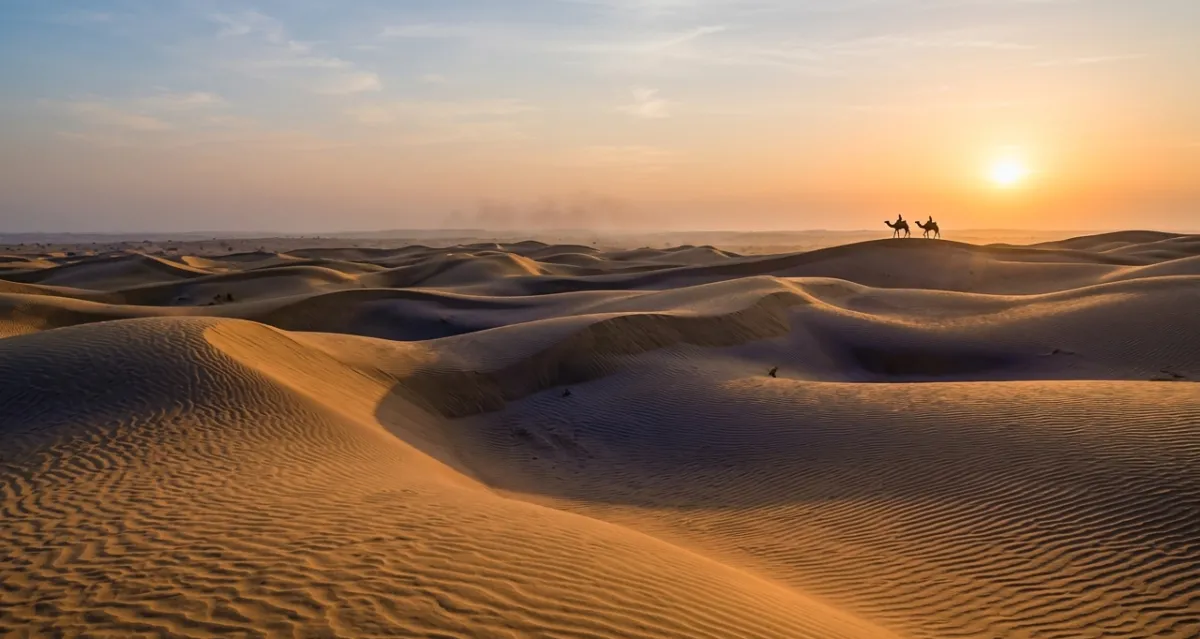
Sam is 40 km west of Jaisalmer. Nearly every camp includes a pickup from town in the price; if yours does not, the local bus from the Sam road stand costs about Rs 50 and a shared jeep Rs 200. Fair warning: this stretch becomes a traffic jam of tourist jeeps around 4 pm in peak season. Ask your camp to collect you by 2:30 pm so you reach before the convoy. October-November is the sweet spot, with daytime highs of 30-33 degrees and nights that dip to 15, which is exactly why Dussehra and Diwali weekends sell out.
The camel ride is usually 30-45 minutes out to a dune ridge for sunset and is included in the package. The counterintuitive tip from people who have done this several times: skip the camp's default ride and pay Rs 700-900 per jeep for a 20-minute dune bashing run instead, then walk the last 200 metres up the tallest ridge on foot. Camels in Sam tend to stop at the same crowded spot. Your own feet will take you over one more ridge, where the sand is unmarked and the noise drops to nothing. Sand here is fine enough to squeak underfoot, and it holds the day's heat for an hour after the sun goes.
Dinner is a buffet back at camp, almost always entirely vegetarian: dal, gatte ki sabzi, ker sangri, a dry aloo, rotis cooked on a flat tawa over coals, and churma for dessert. Jain travellers should confirm no-onion options at booking, because the buffet is one pot for everyone and some camps will make a separate sabzi only if warned a day ahead. The folk show runs from 8 pm: Manganiyar singers on the kamaicha, a Kalbeliya dancer, and a man who balances an alarming number of brass pots on his head. Some people find it kitschy. Honestly? The singing, when the wind drops and the bonfire cracks, is the memory that lasts.
Guides in Sam will tell you: the dunes are free, you are paying for the bed. Choose the camp for its bathroom and its singers, not its photos.
Day spend: Rs 4,400 (camp Rs 2,000, scooter or taxi share Rs 1,000, Bada Bagh Rs 100, Kuldhara Rs 70, jeep safari Rs 800, food and water Rs 430)
Day 3 - Sunrise on the Dunes, Vyas Chhatri, and the Train Home
Camps serve tea at 6 am for a reason. The sunrise at Sam is the better of the two shows - the colour runs from grey to pink to flat gold in about twelve minutes and the crowds from the previous evening are mostly still asleep. Walk out alone, no camel, and sit on the ridge. Breakfast at camp is usually poha or paratha with tea, included in your price, and checkout is 9-10 am with a drop back to town.
Back in Jaisalmer by 11, with a train that leaves in the late afternoon, you have four hours to spend on the things you walked past on Day 1. Go back into the fort for the Raj Mahal palace museum if you skipped it (Indian entry about Rs 100-250 with audio guide) or spend the time in Sadar Bazaar and the lane of fabric shops below Patwon Ki Haveli. Mirror-work cushion covers cost Rs 150-300, camel-leather jootis Rs 400-700, and a small block-printed quilt Rs 800-1,500. Bargain hard but do not be a bore about it; starting at 60 percent of the asking price and settling at 75 is normal.
Lunch is the one splurge this plan allows. A rooftop restaurant facing the fort will charge Rs 350-500 for a thali with a view, and on a Sunday afternoon in November with the sandstone glowing and a dust haze softening everything, you will not regret it. If you want something quicker, the ghotua laddoos at Dhanraj Bhatia Sweets near Gandhi Chowk, a local gram-flour sweet, cost about Rs 30 apiece and travel well in a tiffin for the train.
If your train departs after 4:30 pm, squeeze in Vyas Chhatri on the edge of town. These Brahmin cenotaphs (Rs 100 entry) sit on a low rise with an unobstructed westward view and are where Jaisalmer photographers go for golden hour. A common mistake is going at noon, when the stone bleaches out; even 3:30 pm is a better bet than midday. Then an auto to the station (Rs 100), a bottle of water, and the upper berth. You will be in Delhi before the Monday traffic.
Day spend: Rs 1,400 (jeep drop Rs 200 if not included, lunch and sweets Rs 650, Vyas Chhatri Rs 100, autos Rs 250, train snacks Rs 200)
When is the best time to visit Jaisalmer from Delhi?
Mid-October to end of February. Daytime temperatures stay between 22 and 32 degrees, desert nights are cool enough for a bonfire, and the Runicha Express runs daily. Dussehra and Diwali long weekends are peak and camp prices double. For the cheapest version of this Jaisalmer itinerary from Delhi, go in the first half of December or late January.
Avoid April to September. The mercury crosses 42 degrees from mid-April and most camps at Sam shut for the monsoon. The Jaisalmer Desert Festival in February (usually around Magha Purnima) is worth planning around if you like camel races and moustache competitions, but book rooms two months out. For a family with school-going kids, the Christmas-New Year week is cold in the best way and completely manageable with a couple of sweaters.
Trip Cost Summary - Jaisalmer 3 Days From Delhi
| Item | Cost per person (INR) |
|---|---|
| Flights / Train (3AC return on Runicha Express) | Rs 2,500 |
| Stay (1 guesthouse night shared + 1 desert camp night) | Rs 2,600 |
| Food (thalis, rooftop lunch, sweets, water) | Rs 1,750 |
| Transport (autos, scooter or taxi share, jeep to Sam) | Rs 2,050 |
| Activities (havelis, temples, Bada Bagh, Kuldhara, jeep safari, Vyas Chhatri) | Rs 1,500 |
| Total | Rs 10,400 |
That leaves about Rs 4,600 under the Rs 15,000 line. Spend it on shopping, a second jeep run, or upgrade the camp tent. Or, and this is what the smart travellers do, save it for the Rs 1,500 Diwali-week surcharge you will almost certainly meet if you travel on the long weekend. Either way, the Jaisalmer trip cost from Delhi stays comfortably inside what most of us would spend on a weekend at a Gurgaon mall.
Tags
Map-o-World Editorial Team
Travel Research & Editing
Our guides are researched from official tourism sources, local operators, transport authorities and recent traveller reports, drafted with AI assistance and reviewed by our editors before publishing. Prices, opening hours and entry rules change often - please double-check before you travel, and tell us if you spot something out of date.
Read our editorial policy arrow_forward