Rathyatra 2026 in Puri: A Local's Culture Guide
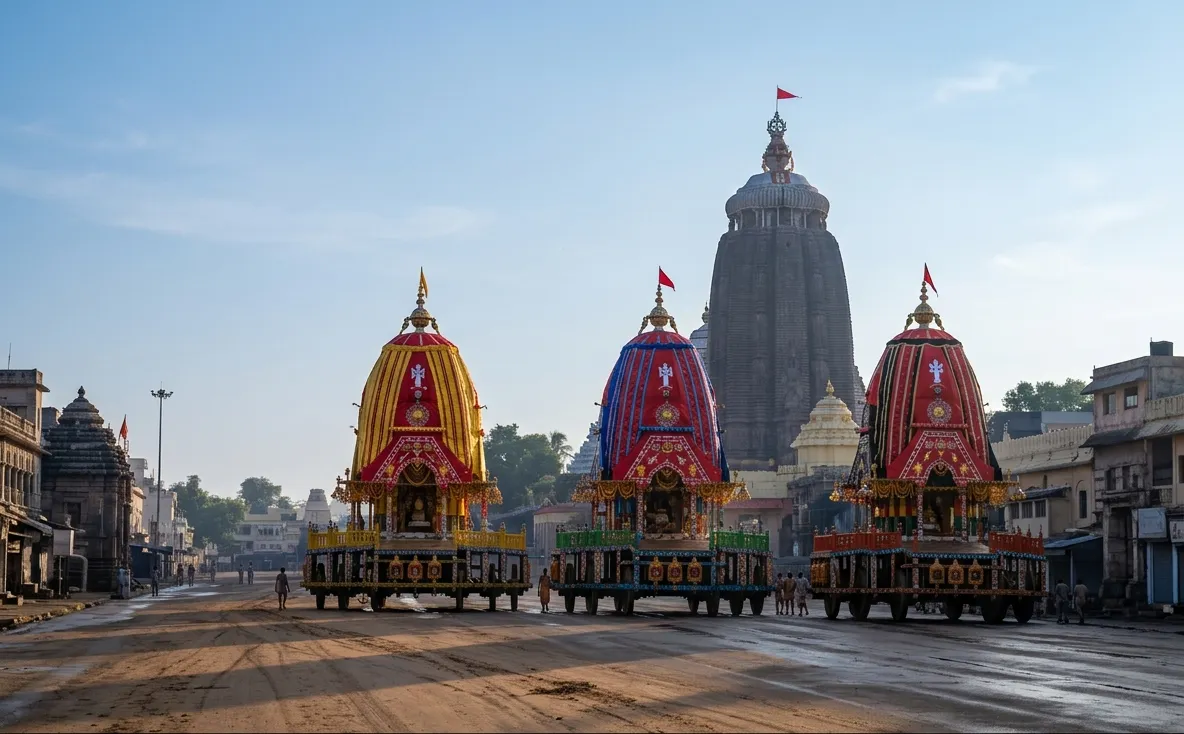
Rathyatra 2026 in Puri falls on Sunday, 12 July, when Jagannath, Balabhadra and Subhadra ride three hand-pulled chariots 2.6 km down Grand Road to Gundicha Temple. The festival runs nine days, ending with Bahuda Yatra on 20 July. Expect 800,000 to 1.2 million people, free entry, and no chance of getting near the wheels without a rooftop ticket.
Here's the thing nobody tells you about Rathyatra: the chariots barely move. I spent 40 minutes in July 2024 watching Nandighosha - Jagannath's chariot, 45 feet tall, 16 wheels, red and yellow cloth - travel roughly the length of a cricket pitch. Then it stopped. For an hour. Because 4,000 people pulling a rope don't pull in the same direction, and because the god, according to the man selling me lemon soda for 20 INR (about $0.24), "stops when he wants to stop."
That's the whole festival, really. Not spectacle. Duration.
Why Three Unfinished Gods Ride Down Grand Road Every July
The Jagannath story starts with a deadline that got blown. King Indradyumna hired a sculptor - Vishwakarma in disguise - to carve three deities from a log that washed up on the shore at Puri. One condition: nobody opens the door until he's done. The queen got impatient, opened it early, and the sculptor vanished, leaving three figures with stumps for arms and enormous unblinking eyes.
They were never finished. They're still worshipped that way.
I find this the single most interesting fact about Puri, and almost no guide mentions it. Hindu iconography is obsessive about proportion and completion. Jagannath breaks every rule - he's a black wooden torso with round white eyes and no hands, and he is arguably the most fiercely loved deity in eastern India. The Puri Rathyatra exists because these gods, once a year, leave the 12th-century temple and go visit their aunt's house at Gundicha. That's the framing locals use. Not "divine procession." Aunt's house.
The chariots get rebuilt from scratch every year. Not repaired - rebuilt. Around 1,100 logs of phassi and dhausa wood come down from Dasapalla forest, and roughly 200 carpenters (the Maharana families, hereditary, no drawings, no measuring tape beyond a bamboo rod) start work on Akshaya Tritiya. Nandighosha for Jagannath, Taladhwaja for Balabhadra at 44 feet, Darpadalana for Subhadra at 43. After the festival the wood gets broken up and burned in the temple kitchen.
"Ratha ta chalanti nahin, bhagabana chalanti." The chariot doesn't move - the god moves. A rope-puller near Balagandi told me this after we'd both failed to shift Taladhwaja an inch.
What Actually Happens on 16 July 2026, Hour by Hour
The ritual sequence is fixed and it is slow. Learn it or you'll spend the day confused.
- Mangala Arati inside the temple around 5 a.m. You won't see it. Non-Hindus are barred from Jagannath Temple entirely, and this is enforced by men with lathis, not by suggestion.
- Pahandi - the deities carried out, one at a time, rocking side to side in a slow drunken sway. Starts around 8 a.m. Takes 3 to 4 hours. This is the best part of the day and most tourists miss it because they arrive at noon.
- Chhera Pahanra, roughly 1 p.m. The Gajapati king of Puri sweeps the chariot platforms with a gold-handled broom. A king sweeping. That's the point.
- Chariot pulling from about 4 p.m. until whenever. In 2024 they didn't reach Gundicha until the next day.
Bahuda Yatra, the return trip, is 20 July 2026. Then Suna Besha on 21 July, when the deities are dressed in 208 kg of gold on the stationary chariots. Fewer crowds. Better photographs. Nobody talks about it.
Where to Stand - and the Rooftop Scam Nobody Warns You About
Grand Road (Bada Danda) is 3 km long and 60 metres wide. It fills. Government stands near Marichikote Chhak are free but you queue from 5 a.m. for a view of the back of someone's head.
Rooftops along Grand Road are the real currency. Rates in 2024: 2,500 to 8,000 INR per person (about $30 to $96) for a spot on a balcony with a plastic chair and a bottle of water. I paid 3,000 INR ($36) for a second-floor terrace opposite the Emar Mutt stretch, booked through the guesthouse owner two days ahead. Fine view. What I didn't know: the same family sold 60 spots on a roof rated for maybe 25. We stood shoulder to shoulder for six hours and I couldn't sit down once. My legs shook on the stairs afterwards.
Book rooftop access through a hotel you're actually staying in, in writing, with a room number attached - never through a man who approaches you on the street holding a laminated photo.
The counter-consensus call: everyone tells you to be on Grand Road at the moment the chariots start rolling. Skip it. The pulling is a slow-motion crush with poor sightlines. Go instead to Gundicha Temple's approach road at dawn on 13 July, when the chariots are arriving and the crowd has thinned to maybe a tenth. You get the wheels, the ropes, the exhausted rope-pullers asleep on the road, and light that isn't blown out. That's the photograph.
Is Rathyatra in Puri Worth It for Non-Hindu Travellers?
Honestly? For many people, no. You can't enter the main temple. You'll stand for eight hours in 33 C heat and 85 percent humidity, you'll be pressed against strangers, and the thing you came to see moves at walking pace with hour-long stalls. If crowds spike your anxiety, or you travel with small kids or mobility limits, this festival will hurt you.
Who it's for: anyone interested in how a living ritual actually functions at scale - the logistics, the hereditary craft, the servitor hierarchies. It rewards patience and background reading, not photography instincts.
The Jagannath Temple ban is absolute and it catches people out. There's a viewing platform on the roof of Raghunandan Library across the road, free, open roughly 9 a.m. to 5 p.m., where you can see the temple spire and the flag. That's your consolation and it's a decent one.
How Much Does Rathyatra in Puri Cost in 2026?
Budget 3,500 to 9,000 INR per day ($42 to $108) during festival week for a mid-range room, food, and a rooftop spot. Hotel rates on Chakratirtha Road triple for the nine days. Off-festival, the same room runs 1,200 INR ($14). The festival itself costs nothing to attend.
My actual July 2024 numbers: 4,200 INR ($50) a night at a plain guesthouse off C.T. Road that wanted 1,400 INR in March. Puri railway station to Grand Road by auto: 150 INR ($1.80), fixed rate during the festival, negotiate before you sit down. Prasad at Ananda Bazaar inside the temple complex - not accessible to non-Hindus, but the same khaja and dalma get sold at stalls near Swargadwar for 40 to 80 INR ($0.48 to $0.96) a portion.
Eat at Wildgrass on V.I.P. Road if you want a break from crowds. Garden seating, Odia thali around 450 INR ($5.40), and the mustard-heavy machha besara is the best fish I ate in Odisha. Skip the beachfront seafood shacks at Swargadwar during festival week - the turnover is high, the ice supply isn't, and I watched a French traveller lose two days to it.
When Should You Arrive in Puri for Rathyatra 2026?
Get to Puri by 9 July 2026. Three days early. You'll want to see Netra Utsav on 10 July, when the deities' repainted eyes are revealed after their 15-day fever seclusion, and you'll need the time to sort a rooftop and learn Grand Road on foot.
Trains sell out 60 days out. The Puri-Howrah Shatabdi and the Puri Express fill first; open your booking window the day it opens. Bhubaneswar airport is 60 km away, and a prepaid taxi runs 1,800 INR ($22), 90 minutes on a good day, three hours on 11 July.
Weather: July in Puri is monsoon. It rained on me twice on Rathyatra day 2024, hard, for twenty minutes each time, and the crowd didn't move an inch. The air smells like wet sand, frying badi, and 800,000 people's sweat. Nobody warns you about the smell. It's the thing I remember most clearly - that and the sound of the ropes, which don't creak so much as groan, low, under your feet more than in your ears.
The Practical List You'll Actually Use
- Carry 2 litres of water minimum. There's no re-supply once you're locked into a crowd.
- Phone in a zip bag. It will rain and you will not be able to lift your arms.
- Shoes off before Grand Road near the chariots. Barefoot on wet stone for hours - I lost skin on both heels. Bring thin rubber sandals you can carry.
- Cash. Card machines and mobile data both collapse under crowd load; UPI failed for me for six straight hours.
- No drones. Illegal, actively policed, and you'll be detained.
- Ask before photographing the servitors. The daitapatis are not scenery, and some of them will tell you so.
One more thing. If you get separated from your group, don't fight upstream - nobody moves against a Rathyatra crowd. Drift sideways to a shop doorway and wait. I lost my friend at Balagandi at 6 p.m. and found him three hours later, sitting on a kerb outside a paan stall with two strangers, eating khaja, entirely at peace with it.
Map-o-World Editorial Team
Travel Research & Editing
Our guides are researched from official tourism sources, local operators, transport authorities and recent traveller reports, drafted with AI assistance and reviewed by our editors before publishing. Prices, opening hours and entry rules change often - please double-check before you travel, and tell us if you spot something out of date.
Read our editorial policy arrow_forward