Tokyo Cherry Blossom 2026: 9 Best Spots & Peak Bloom Dates
The 2026 Bloom Forecast: Earlier Than You Think
The Japan Meteorological Agency is calling it: first bloom in Tokyo on March 19, with full bloom (mankai) around March 28. That's roughly a week ahead of the historical average. If you're reading this and haven't booked flights yet, you still have time, but barely. Hotels within walking distance of Ueno and Shinjuku are already running 30–40% above their off-season rates.
Here's the thing most first-timers get wrong. They plan around the first bloom date. Don't do that. First bloom means maybe 10% of the buds on a given tree have opened. It's nice, sure, but it's not the spectacle you flew twelve hours for. You want mankai through about five days after. For 2026, that window is roughly March 28 through April 3. After April 3, the petals start falling. Which, honestly? The falling petals might be even more beautiful than full bloom. The Japanese call it hanafubuki — cherry blossom blizzard — and walking through it feels like standing inside a snow globe.
The Best Free Hanami Parks (And How to Stake Your Spot)
Ueno Park (Taito-ku)
Over 800 trees line the main path from the park entrance near Ueno Station's Shinobazu exit. This is Tokyo's most famous hanami location and it earns that reputation. The atmosphere after 5 PM on a weekday is electric — salarymen loosening their ties, families spreading blue tarps, the smell of yakitori from temporary stalls mixing with cold Asahi draft (¥500 a cup). Fair warning: weekends here are shoulder-to-shoulder. If you want a prime spot under the trees on a Saturday, someone in your group needs to lay down a tarp by 8 AM. I am not exaggerating.
Yoyogi Park (Shibuya-ku)
Younger crowd. More relaxed. The cherry trees cluster in the southern section near the event plaza, and the vibe is more picnic-with-friends than formal flower viewing. I've spent entire afternoons here with a konbini bento from the 7-Eleven on Inokashira-dori (a salmon onigiri, an egg sandwich, and a Strong Zero for under ¥800 total) and never felt the need to move. Bring a blanket and a portable speaker. The park closes at sundown, so there's no evening illumination here — plan accordingly.
Sumida Park (Taito-ku / Sumida-ku)
This one doesn't appear on most tourist lists, and I've never understood why. About 640 cherry trees line both banks of the Sumida River, and from the Taito-ku side you get an unobstructed view of Tokyo Skytree framed in pink. Walk north from Asakusa Station, cross under the Azuma Bridge, and turn left along the river. The evening illumination here runs until 10 PM during peak season, and it's free. Best part: the crowds thin out dramatically once you walk about ten minutes north of the bridge.
Kinshi Park and the Smaller Neighborhood Parks
If you're staying anywhere in eastern Tokyo, ask your hotel staff where the nearest neighborhood hanami park is. Not every park worth visiting has a Wikipedia page. Kinshi Park near Kinshicho Station has maybe 50 trees, a playground, and almost zero tourists. That's where you'll see how Tokyoites actually do hanami — quietly, with homemade food wrapped in furoshiki cloth, grandparents watching kids chase pigeons under the blossoms.
"花より団子" (hana yori dango) — "dumplings over flowers." It's a Japanese proverb that basically means the food matters more than the scenery. At hanami, both matter equally. Bring good snacks.
Three Spots Worth Paying For
Shinjuku Gyoen National Garden
The ¥500 entry fee (adults) keeps the crowds manageable, which is reason enough. But the real draw is variety: Shinjuku Gyoen has over 1,000 cherry trees across roughly 70 different species, meaning something is in bloom from mid-March through late April. The Somei Yoshino grove in the English Landscape Garden section is the classic shot, but walk to the Japanese Traditional Garden on the east side for weeping cherries reflected in the pond. No alcohol allowed inside, and the gates close at 5:30 PM (last entry 5:00 PM). Open Tuesday through Sunday during sakura season — they're closed on Mondays.
Chidorigafuchi Moat
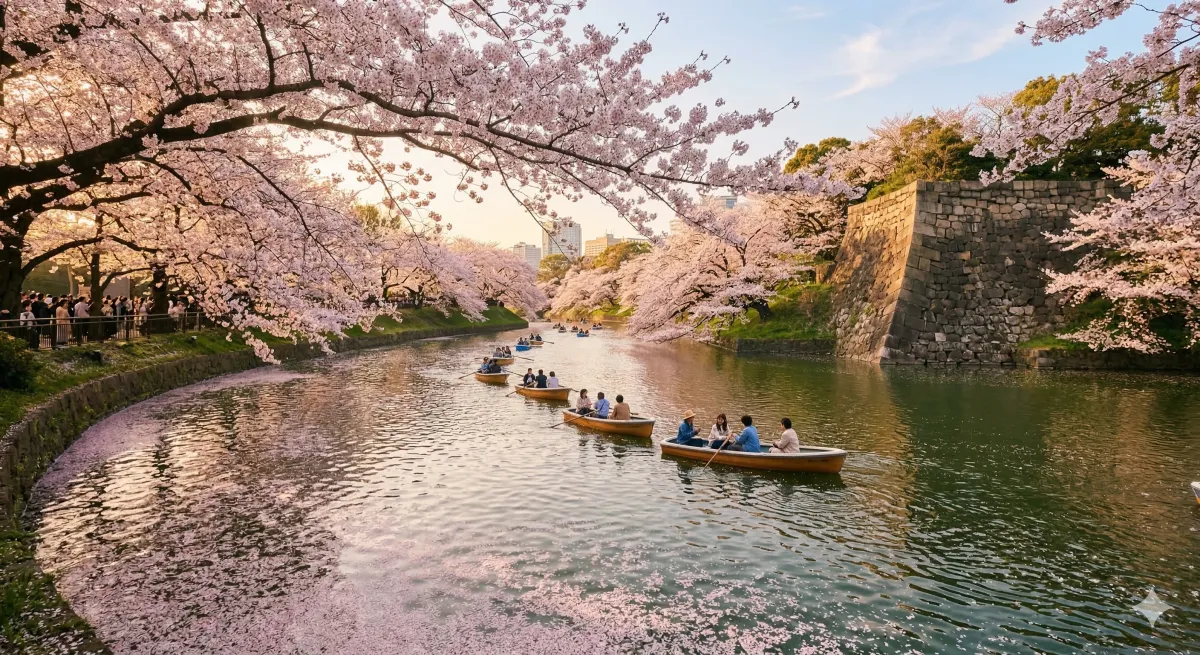
Technically free to walk along, but the experience here is the rowboat rental (¥800 for 30 minutes, ¥1,600 for 60 minutes during peak season). You paddle under a canopy of cherry trees along the old Imperial Palace moat, petals drifting onto the water around you. The queue for boats can hit two hours on weekends. Go on a Tuesday or Wednesday morning. I went at 9:30 AM on a Thursday in a previous year and waited maybe twenty minutes.
Rikugien Garden (Bunkyo-ku)
One massive weeping cherry tree dominates the entrance, lit up at night during their special evening opening (until 9 PM, ¥300 entry). It's a single tree, not a grove, and somehow that makes it more impressive. The branches cascade down like a pink waterfall. This garden is a 7-minute walk from Komagome Station on the Yamanote Line and rarely appears in English-language guides.
Practical Stuff That Actually Matters
Dress in layers. Late March in Tokyo means daytime highs around 15–18°C but it drops fast after sunset, especially near the river. I made the mistake of going to Sumida Park in a t-shirt one evening and spent the whole time shivering instead of enjoying the illumination. A light down jacket that packs into its own pocket is your best friend.
Bring a garbage bag. Japan's public parks have limited trash cans, especially during hanami season when they overflow by midday. Carrying out your own trash is expected, and honestly, it's the respectful thing to do. Convenience stores sell small plastic bags for ¥3–5 if you forget.
For tracking the bloom in real time, download the Weathernews Sakura app (桜のきせつ). It gives tree-by-tree updates from user reports across Tokyo. The JMC forecast gives you the broad strokes, but this app tells you which specific park hit full bloom today. Skip the tourist-focused English blogs that recycle the same forecast data three weeks late.
One last thing. If you arrive and the blossoms haven't quite opened yet, don't panic. Head to Atami or Kawazu on the Izu Peninsula (90 minutes by train from Tokyo Station) where earlier-blooming Kawazu-zakura varieties peak in late February and early March. And if you're late and everything has scattered? The cherry trees in the mountains around Okutama, an hour west of Shinjuku on the Chuo Line, bloom a full week or two after central Tokyo. The season is more forgiving than people think.
Map-o-World Editorial Team
Travel Research & Editing
Our guides are researched from official tourism sources, local operators, transport authorities and recent traveller reports, drafted with AI assistance and reviewed by our editors before publishing. Prices, opening hours and entry rules change often - please double-check before you travel, and tell us if you spot something out of date.
Read our editorial policy arrow_forward