Ohrid in September 2026: Europe's Quiet Lake
September is the best time to visit Ohrid. Air temperatures sit around 24-26C, the lake holds roughly 22C into early October, and the August crowds from Skopje, Tirana and Belgrade vanish after the first weekend. Expect quiet beaches, open monastery trails, and guesthouse rates roughly 30-40 percent below peak.
Here's the thing about Lake Ohrid: it is three million years old, one of the oldest lakes on Earth, and for eleven months a year almost nobody outside the Balkans thinks about it. Then August arrives, the coast fills with Albanian and Serbian families, boat touts work the promenade, and the town briefly behaves like a discount Adriatic resort. Then it stops. Around the 5th of September the school buses go home and Ohrid exhales.
What's left is the version locals actually like. Fishermen selling koran trout at the small harbour before eight. Church doors propped open for airflow rather than ticket queues. The smell of ajvar roasting on balcony grills across the old town, because peppers come in during September and every household in Macedonia processes them at once. That smoky-sweet smell follows you up the hill toward Samuel's Fortress and it is, honestly, the single most underrated sensory detail of travelling here in autumn.
Why September Beats Every Other Month on Lake Ohrid
The numbers do most of the arguing. Ohrid's September averages run about 25C daytime and 13C overnight, with rainfall still low - the wet turn comes in mid-October, not before. Lake Ohrid is enormous and deep (288m at its lowest point), so it holds summer heat long after the air cools. Swimming through late September is normal. Swimming in early October is entirely possible if you are not precious about it.
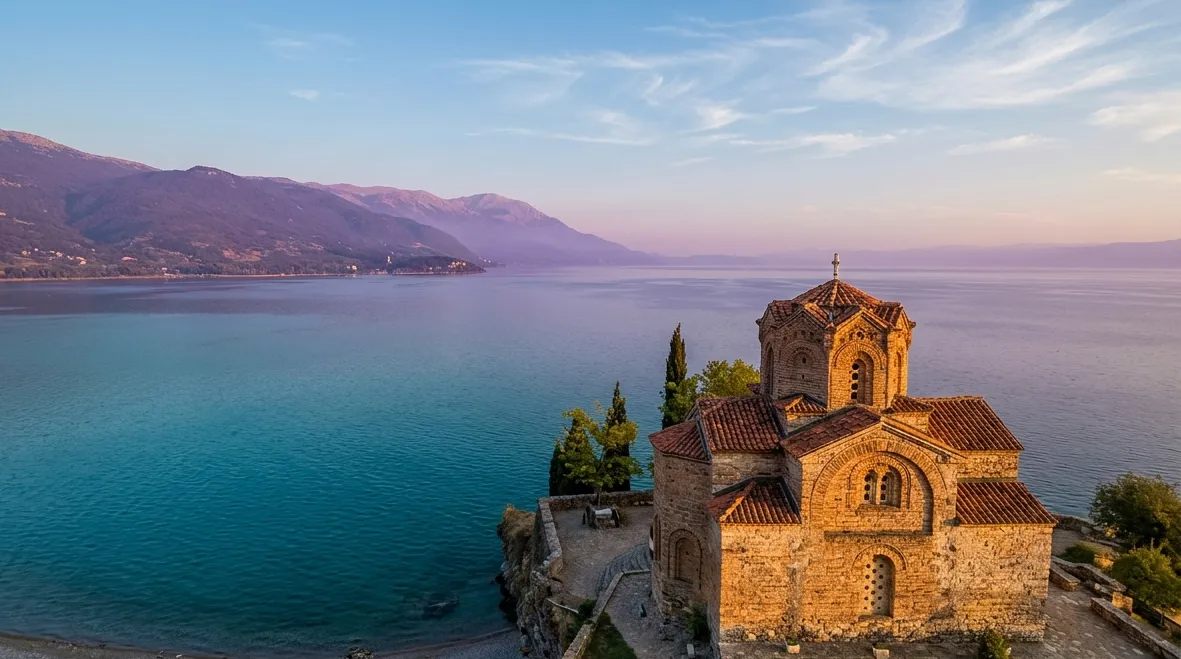
Light matters too. September sun sits lower, which means the limestone of the old town turns amber around 6pm and the lake goes from turquoise to pewter within twenty minutes. Photographers who know Ohrid time their Kaneo shots for that window rather than midday, when the water flattens out and looks like any other lake.
Then there's cost. Ohrid North Macedonia on a budget is not a stretch in September - it is the default. Guesthouse rooms in the old town that ask 4,000-5,000 denars in August drop to 2,000-3,000 (roughly 32-49 euros). A plate of grilled Ohrid trout or plasnica runs 500-700 denars. Coffee on the lakefront is 80-120 denars. Skopje-to-Ohrid buses cost around 600 denars and take about three hours on the new stretch of road.
Locals have a phrase for the season: "Ohrid is ours again in September." They mean it warmly, and they mean it about the cafes too.
What about those 365 churches?
Ohrid never had 365 churches, and any guide who repeats the "one for every day of the year" line without a wink is selling you folklore. Archaeologists have documented roughly 30-40 surviving religious sites in and around the town, with medieval records suggesting many more once existed across the wider region. The legend is lovely. It is still a legend.
The ones that matter are worth planning around. Sveti Jovan Kaneo, perched on the cliff above the water, is the postcard - go before 9am and you will likely share it with two people and a cat. Sveta Sofija, an 11th-century basilica with frescoes that survived centuries as a mosque, has some of the finest Byzantine wall painting in the Balkans and costs 100 denars to enter. Sveti Kliment i Pantelejmon at Plaosnik sits on the site where Kliment of Ohrid taught the Cyrillic-adjacent Glagolitic script in the 9th century. Fair warning: the uphill cobbles from the lakefront are steep and slick after rain.
A 7-Day Slow Travel Lake Ohrid Itinerary
Seven days sounds generous for a town you can walk across in twenty minutes. It isn't. Ohrid rewards people who stay put, and the surrounding lake shore, the Galicica ridge and the Albanian border side all deserve a day each.
- Day 1 - Old town on foot. Start at Cars Samoil Street, work up to the fortress (150 denars, open roughly 9am-6pm in September), then down through the Ancient Theatre. Sunset at Kaneo.
- Day 2 - Sveta Sofija in the morning when the light hits the apse, then Plaosnik and the icon gallery. Afternoon swim at Kadmo or the small beaches under Kaneo.
- Day 3 - Boat to Sveti Naum monastery. Roughly 700-900 denars return in September as demand thins; the crossing takes about 90 minutes each way and the peacocks at the monastery are aggressive about your sandwich.
- Day 4 - Galicica National Park. Drive or taxi to the pass between Lake Ohrid and Lake Prespa. Two lakes, one viewpoint, hardly anybody there past summer.
- Day 5 - Struga and the Crn Drim river mouth, 15 minutes by bus (60 denars). Quieter, flatter, better for a lazy day.
- Day 6 - Bay of the Bones, the reconstructed prehistoric pile-dwelling settlement at Gradiste, plus the Vevcani springs if you want the long version.
- Day 7 - Nothing scheduled. Swim, eat trout, watch the light go.
Is a Sveti Naum monastery visit worth the trip?
Yes, and September is the month to do it. Sveti Naum sits 29km south, right against the Albanian border, where the Crn Drim springs feed the lake through startlingly clear water. Go by boat rather than bus - the approach from the water is the entire point, and in September you will not be queuing for it.
The 10th-century church holds Naum's tomb, and the guides there will tell you to press an ear to the stone to hear a heartbeat. Do it. Whether you hear anything or not, the small ritual is more memorable than another photo. Springs boats at the site cost around 200-300 denars per person for a short punt through the reed channels. The last return boat to Ohrid usually leaves around 4pm in September - confirm the time at the harbour that morning, because the schedule thins as the season winds down and stranded travellers pay 1,500 denars for a taxi back.
Getting There, Sleeping, and the Mistake Most Visitors Make
Ohrid St. Paul the Apostle Airport (OHD) sits 10km north of town and has been picking up more seasonal budget routes - Wizz Air and others run seasonal links from several European cities, though schedules shift year to year, so check directly rather than trusting a blog. Skopje International is the reliable fallback, with buses from Skopje's main station running most of the day. Tirana is the sleeper option: around three hours by road, and increasingly used by travellers combining Albania with Macedonia.
Stay in the old town if you want atmosphere and can handle stairs. Stay along the lakefront toward Sv. Stefan if you want a balcony over the water and a five-minute walk in. Villa Forum, Villa Lucija and the cluster of family guesthouses on Ilindenska get repeat bookings from returning travellers for good reason: the owners cook.
Now the mistake. Almost everyone treats Ohrid as a two-night stop between Skopje and Tirana, sees Kaneo, eats one trout dinner, and leaves convinced they've done it. They haven't. The town's actual pleasure is rhythmic rather than sightseeing-driven - the morning market on Klimentska, the 5pm promenade when three generations of the same family walk the same 800 metres, the way the Galicica ridge turns violet before the town lights come on. That takes days, not hours. Two-night visitors consistently rate Ohrid lower than week-long ones, and it is not because the churches got worse.
How much does a week in Ohrid cost in 2026?
Budget travellers should plan on 35-50 euros per day in September: guesthouse bed 15-25 euros, meals 10-15 euros, transport and entry fees 8-12 euros. Mid-range with a lake-view room and daily restaurant dinners lands around 70-90 euros a day. North Macedonia remains one of Europe's cheapest destinations.
Two practical notes. Cash still rules outside hotels and larger restaurants - denars, not euros, and the exchange offices on Makedonski Prosvetiteli give better rates than the airport. And North Macedonia is outside the Schengen zone, which quietly makes Ohrid useful for anyone burning through their 90-day allowance elsewhere in Europe.
One more thing worth knowing for anyone hunting quiet places to travel in Europe in September: Ohrid's UNESCO listing covers both the cultural monuments and the lake ecosystem itself, one of only about 40 dual-listed sites worldwide. The endemic species in that water - the Ohrid trout among them - exist nowhere else. Order the farmed version rather than the wild one where you can, and the restaurant staff will tell you which is which if you ask.
Tags
Map-o-World Editorial Team
Travel Research & Editing
Our guides are researched from official tourism sources, local operators, transport authorities and recent traveller reports, drafted with AI assistance and reviewed by our editors before publishing. Prices, opening hours and entry rules change often - please double-check before you travel, and tell us if you spot something out of date.
Read our editorial policy arrow_forward