Douro Valley Harvest Season: Pinhão Vindima Guide 2026
The Douro Valley harvest season, locally the vindima, runs from roughly September 10 to early October 2026. Base yourself in Pinhão, ride the Linha do Douro train from Porto São Bento (about 2 hours 20 minutes, 11.90 EUR), and book a foot-treading session at a quinta by June, because the good ones sell out months ahead.
Nobody warns you about the sound. Forty legs churning grape must in a granite tank make a wet, rhythmic sucking noise, somewhere between a tide pool and a washing machine, and over it an accordion player from Sabrosa was taking requests. My shorts were purple to the pocket line. This was 7pm on September 18, 2025, at Quinta de la Rosa, a five-minute walk from Pinhão's train station, and it was the single best thing I did in Portugal last year.
I've done the vindima twice now, September 2024 and September 2025, both times sleeping in Pinhão rather than Porto. This guide covers what's actually on offer during those four weeks, which quintas still take bookings, what the Porto to Pinhão wine train is really like, and the mistakes I made so you don't have to repeat them.
Why the Douro Valley Harvest Season Beats Every Other Month Here
For eleven months a year the Douro is scenery. In mid-September it becomes a workplace, and that changes everything: tractors queue at the weigh stations, pickers' vans rattle down the N-222 at 7am, and the whole valley smells of crushed fruit and diesel. Terraces that look manicured from a boat deck turn out to be full of people shouting across the rows.
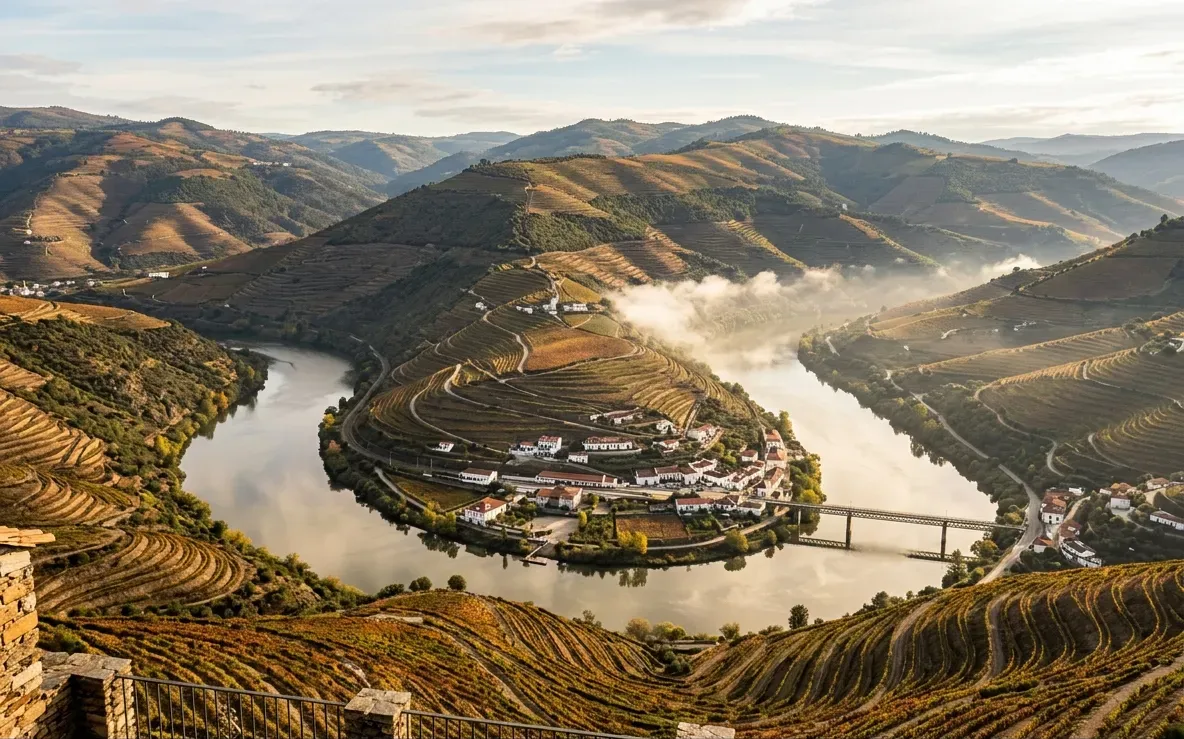
The vines help too. By the last week of September the leaves start turning amber and rust, so you get harvest activity and early autumn colour in the same frame. Daytime highs in the Douro Valley in September drop from August's punishing 38C to a workable 26-30C. River fog sits in the bends until about 9am, which sounds like a nuisance and is actually the best photography light you'll get all trip.
Here's the counter-consensus part: most people day-trip the harvest from Porto and see none of it. Picking runs from 7am to early afternoon; treading happens from about 5pm to 8pm. A day-tripper arriving at 10:45 and leaving at 17:30 catches the dead zone in the middle.
Sleep in the valley or you'll watch the vindima happen in other people's photos.
Foot-Treading and Lagar Nights: What You Can Only Do These Four Weeks
Foot-treading is not a show staged for visitors. Top port houses still crush a share of their best grapes by foot in knee-high granite tanks called lagares, because feet break skins without cracking the bitter seeds. During the vindima, several quintas around Pinhão let you join the real thing.
It works in two phases. First comes the corte: treaders line up in rows, arms over shoulders, and march in place to a caller's count, cutting the cap of skins down into the juice. Then the liberdade, when the music starts and the discipline dissolves. Must at mid-calf feels like warm gravel folded into jam, and after 20 minutes your hip flexors file a complaint. Mine ached for two days.
I paid 45 EUR (about $52) at Croft's Quinta da Roêda in September 2025 for the full harvest program: a morning picking Touriga Nacional alongside the crew, a long lunch at the farm tables, then an hour in the lagar. Over at Quinta do Tedo, 6km west of Pinhão where the Tedo river meets the Douro, a smaller version runs around 60 EUR. Quinta da Pacheca near Régua is the one every roundup lists, with its wine-barrel sleeping pods and daily stomps; it's fine, but you'll share the tank with 30 strangers and a drone. La Rosa's evening sessions, capped far smaller and offered first to house guests, are the trade I'd make every time.
"The grapes do not wait for your weekend," a picker named Zé told me somewhere around row forty. Quintas harvest when the sugars say so, which is why you build slack into your dates.
Book foot-treading for 2026 by June at the latest. Croft and Pacheca open reservations in spring, La Rosa prioritises hotel guests, and the small family quintas fill by word of mouth. Portugal has topped the autumn harvest-travel lists two years running and the lagares have not gotten any bigger.
Getting There and Timing It Right - the Porto to Pinhão Wine Train and Where to Stay
How do you get from Porto to Pinhão by train?
Take the Linha do Douro from Porto São Bento station. The ride takes about 2 hours 20 minutes and cost me 11.90 EUR (about $13.50) each way in 2025; roughly five direct trains run daily, with more options if you change at Régua. Sit on the right side leaving Porto: the river appears near Mosteirô and stays with you.
The final 50 minutes, Régua to Pinhão, run so close to the water you could flick a cork into it. Skip the full-day panoramic cruises from Porto. Nine hours, two locks, a bus transfer back, and half of it spent on the flat industrial lower river; the train covers the same best stretch for under 12 EUR, and during the vindima you roll past pickers close enough to count their buckets. The historic steam train is a separate thing, Régua to Tua on Saturdays through late October, 49 EUR, all vintage carriages and coal smut. Nice, not necessary.
Pinhão station itself earns 20 minutes of your time: 24 azulejo tile panels from 1937 showing the vindima you just came for, grape baskets, rabelo boats and all.
When is the best time to visit the Douro Valley for harvest?
Target September 14 to 28 for peak red-grape picking around Pinhão. Whites come off in early September, the highest vineyards can run into the first week of October, and in 2026 most quintas expect to start around September 10. Go midweek: crews work Saturdays, but visitor slots and trains jam up on weekends.
A warning about the shape of the season, because I got this wrong in 2024: the Douro Valley harvest season moves with the weather, sometimes by two weeks. I booked a treading slot for September 12 that year and the quinta pushed it to the 19th after late-August rain. Build two or three flexible days into the plan rather than a tight in-and-out.
For stays, Quinta de la Rosa has 15 rooms above its working winery at the river's edge, from about 180 EUR a night during harvest, and guests get first call on lagar evenings. Casa de Casal de Loivos, a manor house in the village above town, runs closer to 120 EUR with a view over the river bend that appears on half the wine labels in Portugal. The Vintage House in Pinhão proper is the polished option at 250 EUR and up. Every one of them sells out for late September by May or June.
Whatever you book, climb (or taxi, about 10 EUR from the station) to the Casal de Loivos miradouro for 8am, when the fog lifts off the river in strips. São Leonardo da Galafura, on the Régua side, is the other viewpoint worth a detour.
What to Wear in a Lagar and What Nobody Warns You About
Wear dark shorts you're willing to sacrifice. Grape must stains like beetroot mixed with iodine; my grey pair from 2025 still carries a purple tideline. You tread barefoot after a supervised foot wash, no exceptions, and the quinta will hose your legs down after, but the colour sits in your toenails for about three days. A hat and proper sunscreen matter more than you'd think, because early September afternoons still hit 33C and the schist terraces radiate heat back up at you like a griddle.
Mornings are the flip side. I stood on the Pinhão platform at 7:40am in mid-September at 13C, breath visible, and by lunch had sweated through my shirt on a south-facing terrace. Bring layers, closed shoes with grip for vineyard walking (the schist is loose and sharp), and gloves if the quinta doesn't hand them out; grape scissors take a nick out of a knuckle at least once per crew per morning. Watch for wasps around the collection bins. One got me on the wrist in 2024, and the picker beside me pressed a cut grape onto the sting, which I can't defend scientifically, but it did stop hurting.
Fair warning about who this trip does not suit: anyone needing step-free access will struggle, because quintas are vertical places built of cobbles, loose-stone ramps and centuries-old stairs. Night owls should stay in Porto, since Pinhão's three restaurant kitchens close by 10pm and the village goes silent after. If your ideal wine trip is white-tablecloth tastings without sticky hands, skip the Douro Valley harvest season entirely and come in late October, when the frenzy is over and room rates drop by a third.
Harvest Tables, Moscatel and the Festas Worth Planning Around
Harvest food in the Douro is crew food, and joining a quinta lunch is half the reason to book the participatory experiences. Expect caldo verde, bacalhau com broa (salt cod under a cornbread crust), roast veal, and jugs of the quinta's own unlabelled red on long shared tables. At Croft the lunch happened with the pickers, not apart from them, and the Portuguese-to-English ratio at my table was nine to one. Better than any restaurant meal I had that trip.
In Pinhão village, Veladouro grills bacalhau on a slate slab for around 14 EUR and fills with quinta staff by 8:30pm, so book or arrive at 7. Cross the river and drive 10 minutes up to Provesende, where Padaria Fátima has baked bread in a wood oven since the 1940s and sells it warm out the side door most mornings before 10am. For something sweet, vendors at Régua station still sell rebuçados, hard little sugar drops twisted in paper, six for a euro.
Two seasonal specifics for 2026. Favaios, 20 minutes above Pinhão by car, is moscatel country, and its mid-September village festa pairs the sweet wine with the town's four-cornered bread; the little moscatel and bread museum there is a 3 EUR stop that fills an easy hour. Through late September, many quintas also host vintage dinners where the day's lagar treaders eat late beside the tanks - ask about these when you book your treading slot, because they rarely appear on the websites.
My last morning in 2025, the 9:20 back toward Porto sat idling while a tractor crossed the line at the end of the platform, its trailer heaped with Touriga Franca, and nobody on board seemed to mind the wait. Ankles still faintly purple, I watched a man steady the load with one hand and eat a bunch off the top with the other. The Douro Valley in September doesn't perform its harvest for you. You're allowed in anyway.
Map-o-World Editorial Team
Travel Research & Editing
Our guides are researched from official tourism sources, local operators, transport authorities and recent traveller reports, drafted with AI assistance and reviewed by our editors before publishing. Prices, opening hours and entry rules change often - please double-check before you travel, and tell us if you spot something out of date.
Read our editorial policy arrow_forward