Ljubljana in September 2026: Golden Days, Fewer Crowds
Quick Answer: Ljubljana in September 2026 gets warm 20-25C days, thinner crowds than July, and the Vipava Valley and Goriška Brda wine regions an hour west are mid-harvest. Add Lake Bled and Bohinj at their quietest, a car-free centre and Friday Open Kitchen still running, and it earns a place among the best places to visit in September 2026.
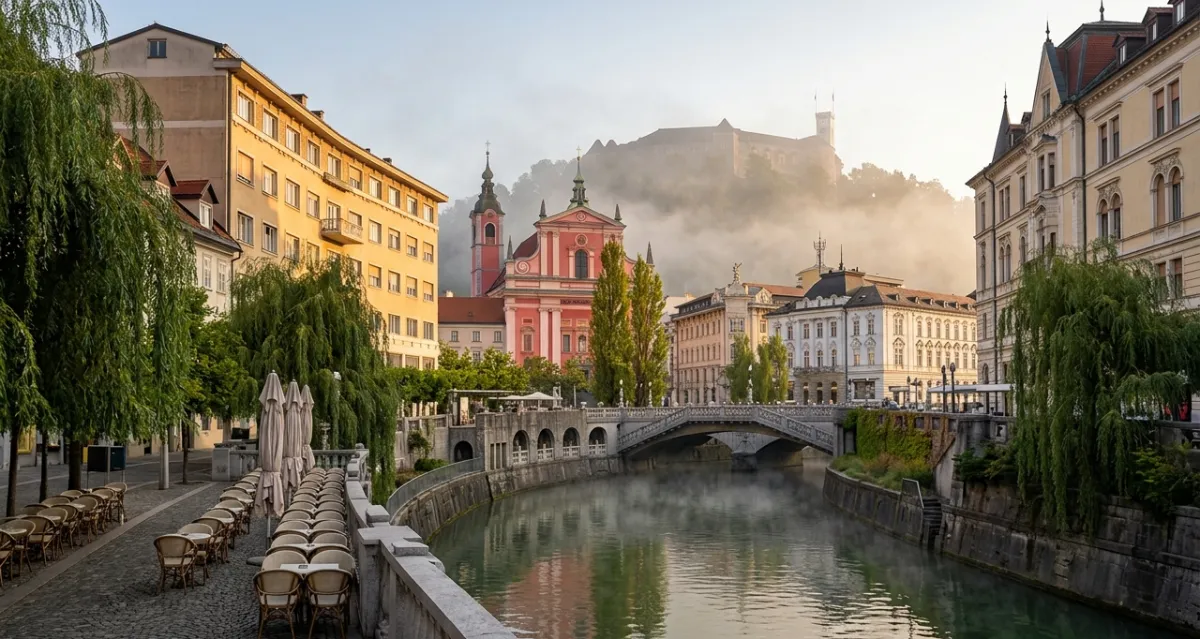
Around eight on a September morning a low mist sits on the Ljubljanica under the Triple Bridge, the willows along Petkovškovo nabrežje drip a little, and the only sound is a barista cranking open the shutters of a riverside cafe. By ten it has burned off into hard blue sky and 23C. Locals will tell you this is the city's real season: the students are back, the terraces are still out, and the tour groups that filled Prešernov trg in August have thinned to a trickle.
Here's the thing about Slovenia: it still gets a fraction of the attention Italy and Croatia do, even though it sits between them and shares their food, wine and mountains. September 2026 is when that gap works in your favour. This Slovenia September travel guide covers what the weather actually does, why the grape harvest turns two nearby valleys into the best day trips in the country, and how to see Lake Bled without standing in a queue for a boat.
Why Ljubljana in September Beats June, July and August
Start with the numbers. Ljubljana averages a daytime high of around 23C in the first half of September, sliding towards 19C by the end of the month, and the humidity that makes August in the basin feel sticky has gone. Evenings drop to 11-13C, which is jumper weather on a riverside terrace rather than go-inside weather. Rain does happen; this is one of the wetter capitals in Europe, and September brings roughly ten days with some rainfall, usually an afternoon shower that clears by dinner.
The crowd shift is the bigger deal. Ljubljana's old town is small - you can walk from Prešernov trg up Mestni trg and Stari trg to Gornji trg in ten minutes - so a few thousand extra day-trippers off coaches from Bled or Zagreb make a visible difference in July. By the second week of September the coach numbers drop, university term starts, and the city goes back to being a place where people live. Cafe tables on Petkovškovo nabrežje fill with students and office workers at 4pm instead of tour groups at noon.
And the market gets better. The Central Market along Plečnik's riverside colonnade and out onto Vodnikov trg (Monday to Saturday from around 6am, winding down by early afternoon) is at its most interesting now: figs and late peaches from Primorska, the first porcini - jurčki - out of the Notranjska forests, plums, walnuts and grapes by the crate. Odprta kuhna, the Friday open-air food market on Pogačarjev trg, runs into late October, so you still get 30-plus stalls from restaurants across Slovenia from 10am to about 9pm. Fair warning - on the Friday it rains, it simply does not happen, so have a backup plan.
What is the weather like in Ljubljana in September?
Expect 20-25C afternoons in early September, closer to 17-20C by the last week, and cool 10-12C mornings. Morning fog on the Ljubljanica is common and usually burns off by 10am. Around ten days see rain, so pack a light waterproof and a mid-layer, but leave the heavy coat at home unless you are heading above 2,000 metres.
Daylight matters for planning. Sunset is around 7.30pm at the start of the month and closer to 6.45pm by the end, so a Bled or Bohinj day trip needs an early bus, not a lazy 10am start. In the Julian Alps, September is the most settled month for walking - fewer thunderstorms than August, trails clear of snow until at least the last week - but most high huts close around the first weekend of October, and a first dusting above 2,300 metres after mid-September is normal. The green capital label is not marketing fluff either: the centre has been car-free since 2007, Tivoli Park starts three minutes from the Opera, and the free electric Kavalir carts will run anyone with tired legs from Prešernov trg to the top of Gornji trg if you flag one down.
Grape Harvest Day Trips - Vipava Valley and Goriška Brda
Trgatev, the harvest, is the reason to pick September over any other month for this trip. An hour west of Ljubljana on the A1 towards Nova Gorica, the Vipava Valley wine harvest and, beyond it, the Goriška Brda one run between the first and last week of September, whites first, then reds. Cellar doors stay open, the villages smell of crushed fruit and tractor diesel, and the osmice - eight-day pop-up taverns on family farms, a Habsburg-era licence that still exists - sell home wine, pršut and cheese at prices that make city bars look silly. Both regions work as separate Ljubljana day trips, or as a two-day loop with a night in Šmartno.
"September is when Slovenia stops performing for tourists and gets back to work - and the work happens to be picking grapes." A Ljubljana guide's line, and one regulars repeat because it turns out to be true.
Vipava Valley - the burja, zelen and a village behind walls
Vipava is the closer of the two: around 80 km and 55 minutes by car, or roughly 90 minutes on the direct bus from Ljubljana's main bus station on Trg Osvobodilne fronte to Ajdovščina and Vipava town, about 8-9 EUR each way. The valley's defining feature is the burja, a north-easterly wind that drops off the Nanos plateau in gusts strong enough to close the motorway to lorries a few times a year. Winemakers treat it as free labour; it dries the vines after rain and keeps rot away, which is why so many producers here farm with minimal spraying. The grapes to ask for are zelen and pinela, two native whites you will not find anywhere else, and the orange-wine crowd will already know names like Batič in Šempas and Guerila above Planina.
Build the day around Vipavski Križ, a walled hilltop village of a few dozen houses ten minutes from Ajdovščina, then Vipava town itself, where the river surfaces from around 25 springs directly under the Nanos cliffs. Lunch is the splurge if you want it: Gostilna pri Lojzetu at Zemono manor, a 17th-century hunting lodge on a hill outside town, does a tasting menu that Slovenians drive across the country for, and September tables go weeks ahead. Cheaper and honestly just as good a memory: an osmica table under a pergola, a litre of house wine for under 10 EUR, and a plate of prosciutto cut by whoever owns the pig.
Goriška Brda - rebula, Šmartno and the tower at Gonjače
Brda is another 40 minutes on from Vipava, hard against the Italian border, and it is the prettier of the two: terraced hills, cypresses, stone villages with church towers, and the Alps as backdrop on a clear September morning. Rebula (ribolla gialla to the Italians next door) is the local grape and it is having a moment, from fresh mineral versions at the Klet Brda cooperative in Dobrovo to skin-contact bottlings from Movia in Ceglo, Kabaj in Šlovrenc and the two Simčič estates. Tastings run 15-30 EUR for four to six wines with a snack, and most places want an appointment, especially during picking when everyone is in the vineyard from dawn.
Base yourself in Šmartno, a restored walled village that is essentially one loop of lanes, and climb the 144 steps of the Gonjače lookout tower five minutes up the road for a 360-degree view that takes in the Julian Alps, the Adriatic and the whole Collio on the Italian side. One counterintuitive tip: do Brda on a weekday. Weekend harvest lunches at the estates book out with Italians from Udine and Trieste, and the narrow roads between Dobrovo and Medana clog with tour vans.
Do you need a car for Ljubljana day trips?
Not for Lake Bled, Bohinj or Vipava - direct buses from Ljubljana's main station reach Bled in about 80 minutes and Ajdovščina in about 90. You do need one for Goriška Brda, whose wineries sit spread across hill villages with almost no public transport. Rent for two or three days mid-trip rather than the whole week.
Small rental cars run about 35-45 EUR a day in September; check that the motorway e-vignette is included, since a 7-day one costs 16 EUR if not. Parking in Ljubljana is the pain point. The P+R at Dolgi most on the ring road charges a couple of euros for a full day including a bus ticket into town, which beats 20-plus EUR in a central garage. Pick the car up on the morning you leave for the wine valleys and drop it the evening you get back from the mountains.
Lake Bled, Bohinj and the Julian Alps Without the July Queues
Everyone does Bled, and Bled is worth doing: the island church, the castle on its cliff, the lake the colour of a swimming pool. In September the queue for the pletna boats at Mlino, which can hit an hour in August, mostly disappears; a return trip to the island with 30 minutes ashore costs around 18 EUR per person, and the church with the wishing bell is a further 12 EUR or so. Skip the crowded promenade and take the 6 km loop path around the lake anticlockwise from the bus station, then climb the steep 20-minute track to the Ojstrica viewpoint above Velika Zaka for the postcard angle. Regulars swear the light is best there between 8 and 9am, while the water is still calm enough to hold the reflection.
The kremšnita, Bled's custard-and-cream slice, is around 6 EUR at Kavarna Park, the place that invented it in 1953, and yes, it is better than it needs to be. Vintgar Gorge, 4 km north, is the other Bled essential: a 1.6 km wooden walkway bolted to the rock above the Radovna river, entry 10 EUR with timed slots. Go for the first entry around 8am or after 3pm; the midday tour buses still turn up in September even when the town itself is quiet.
Here's the mistake most first-timers make: they give Bled the whole day and never reach Bohinj. Lake Bohinj, 30 minutes further into Triglav National Park, is bigger, quieter and unbuilt along most of its shore, and in mid-September it hosts the Kravji bal at Ukanc, the Cow Ball, when the herds come down from the high pastures in flower crowns and bells and the whole valley turns out for music, sausage and a lot of schnapps. Ride the Vogel cable car (just over 30 EUR return) to 1,535 metres for a view straight across to Triglav, walk 20 minutes up to Slap Savica waterfall, and if you are there in the last ten days of the month you will catch the beech forests above the lake starting to turn copper. Sleep in Bohinj rather than Bled if you have the choice - rooms are cheaper by a third and the night sky is darker.
Triglav itself, at 2,864 metres, is a serious two-day climb with fixed cables and a helmet, usually from Pokljuka via the Kredarica hut, and September is the classic window: settled air, no August storms, huts still staffed. It is not a walk. Book the hut weeks ahead for a weekend, go midweek if you can, and know that plenty of people get the same big-mountain feeling from the day route to the Seven Lakes Valley from Planina Blato, which needs no cables at all.
How Much Does a September Trip to Ljubljana Cost?
Budget roughly 90-130 EUR per person per day for a mid-range September 2026 trip: 100-150 EUR for a central double room, 12-18 EUR for a two-course lunch, around 2 EUR for an espresso and 5-8 EUR for a bus day trip. Rental cars add 35-45 EUR a day plus fuel, and hotel prices soften after the second week.
Ljubljana in September is not the bargain it was a decade ago, but it undercuts Vienna, Venice and the Croatian coast comfortably. The trick locals use is the malica, a weekday lunch deal at gostilnas between roughly 11am and 2pm: soup, a main and often a salad for 7-10 EUR. Gostilna Šestica on Slovenska cesta has been serving since 1776. Klobasarna on Ciril-Metodov trg by the cathedral sells a Carniolan sausage with mustard, horseradish and bread for around 7 EUR, and Druga Violina on Stari trg, a social enterprise staffed by people with disabilities, does štruklji and stews at prices you will not believe for the address. For dinner, TaBar on Ribji trg pairs small plates with Slovenian wines by the glass, and it is the easiest place in town to taste a Vipava zelen and a Brda rebula side by side before you go and find them at source.
Coffee is 1.80-2.50 EUR sitting down, a half-litre of Union or Laško 3.50-4.50 EUR, and a scoop of gelato at Cacao on Petkovškovo nabrežje about 2 EUR. Tap water is excellent and the city has around 30 public drinking fountains, so nobody needs to buy bottles. City buses cost 1.30 EUR a ride with an Urbana card and include 90 minutes of transfers, which covers the number 8 out to Tacen for the Šmarna gora hike: 45 minutes to an hour uphill to a hut at 669 metres that serves sausage and hot rum tea, and the closest thing Ljubljana has to a Sunday religion.
Getting in and out is simple. Ljubljana Jože Pučnik Airport is 26 km north; shared shuttles such as GoOpti and Nomago run 10-15 EUR to the centre, a taxi 40-50 EUR. By rail, Zagreb is about two and a half hours, Trieste under three, Vienna around six. For sleeping, Stari trg and Gornji trg put you in the middle of everything, Trubarjeva cesta across the river is a touch cheaper with better late-night food, and Hostel Celica in the Metelkova arts quarter, a converted military prison with artist-designed cells, remains the most interesting budget bed in the country. Book September stays six to eight weeks out; conference season keeps the good hotels fuller than the empty streets would suggest.
So the plan writes itself. Two days in Ljubljana at the start, with a Friday for Odprta kuhna if the calendar allows. A car for two midweek days for Vipava and Brda. Bled at 8am, Bohinj for the rest of that day and, if the dates line up, the Cow Ball on the Sunday. And carry the rain jacket you are certain you will not need - you will use it exactly once, on the afternoon you were sure would stay dry.
Map-o-World Editorial Team
Travel Research & Editing
Our guides are researched from official tourism sources, local operators, transport authorities and recent traveller reports, drafted with AI assistance and reviewed by our editors before publishing. Prices, opening hours and entry rules change often - please double-check before you travel, and tell us if you spot something out of date.
Read our editorial policy arrow_forward